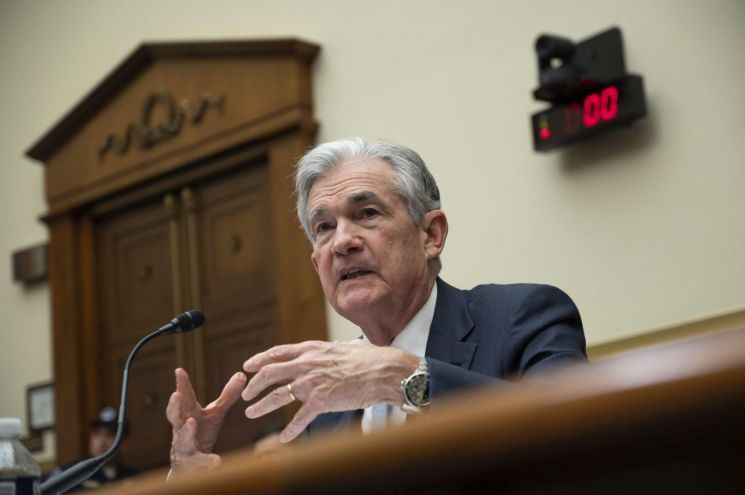
[Asia Economy New York=Special Correspondent Seulgina Jo] "There is a serious risk that high inflation could become entrenched."
Looking at the minutes of the June Federal Open Market Committee (FOMC) regular meeting released by the U.S. central bank, the Federal Reserve (Fed), on the 6th (local time), concerns about inflation becoming entrenched are evident throughout. This is the reason behind the Fed’s unprecedented move during the blackout period to signal a policy change to the market and its bold decision to raise the benchmark interest rate by 0.75 percentage points for the first time in 28 years.
The minutes revealed that the June FOMC participants "all agreed that moving toward a restrictive policy stance is appropriate given the economic outlook." If inflation, which is at its highest level in about 40 years, does not come down, more restrictive policies may be implemented.
On that day, many participants expressed concern that there were no signs of easing inflationary pressures despite the rate hikes. They pointed out that inflation has been persisting longer than initially expected. In particular, they judged that if the market begins to doubt the Fed, there is a serious risk that high inflation could become entrenched.
These assessments led to a consensus at the June meeting that the Fed must demonstrate to the market through a giant step that 'price stability' is its top policy priority. There is a need to push through a more intense tightening than originally planned until the inflation target of 2% is approached. At the June meeting, which decided the first giant step since 1994, only one of the 11 members, Esther George, President of the Federal Reserve Bank of Kansas City, voted against it. President George supported a 0.5 percentage point rate hike.
Of course, concerns were also raised at the June meeting that the Fed’s aggressive tightening could lead to a slowdown in economic growth.
The minutes stated, "Participants recognized that the strengthened (tightening monetary) policy could slow the pace of economic growth for some time." However, they added, "They viewed restoring inflation to the 2% target as important for sustaining maximum employment." Even if, as the market fears, a U.S. economic slowdown or recession occurs, the Fed is determined to prioritize 'price stability.'
Furthermore, the minutes mentioned that a 0.5 percentage point or 0.75 percentage point rate hike is possible at the July FOMC meeting. This is consistent with what Fed Chair Jerome Powell stated shortly after the June meeting.
Following the release of the minutes, market expectations that the Fed will take a giant step at the July meeting increased significantly. According to the Chicago Mercantile Exchange (CME) FedWatch, the federal funds (FF) futures market currently prices in a 96.3% chance of a 0.75 percentage point hike in July. This is higher than the previous day’s 83.8% and the previous week’s 87.3%.
Major foreign media evaluated this as "a confirmed decision to raise rates enough to impose some burden on the economy." TD Securities interpreted the Fed’s tightening resolve despite growth slowdown risks as relatively hawkish. Earlier, Loretta Mester, President of the Federal Reserve Bank of Cleveland, publicly expressed support for a giant step in July.
However, some voices mention that due to growing fears of a recession recently, the Fed might opt for a smaller rate hike than expected. The GDPNow model, compiled in real-time by the Federal Reserve Bank of Atlanta, estimated on the 1st that the U.S. second-quarter gross domestic product (GDP) growth rate would be -2.1% annualized. This is a warning that a technical recession, defined as two consecutive quarters of negative growth, is near.
In the New York bond market, the inversion of short-term interest rates exceeding long-term rates continued on this day following the previous day. Such an inversion of short- and long-term interest rates is generally considered a precursor to a recession.
Kristalina Georgieva, Managing Director of the International Monetary Fund (IMF), also expressed concern on the same day, stating, "The risk of a recession in 2023 has increased." She mentioned inflation, rate hikes, China’s economic slowdown, and sanctions due to Russia’s invasion of Ukraine, diagnosing that "the outlook has darkened significantly since the last update in April."
The IMF, after lowering its economic growth forecast in April, plans to further downgrade the 2022 and 2023 growth forecasts in an update scheduled for the end of July. This would be the third downward revision.
Jeremy Siegel, professor at the Wharton School of the University of Pennsylvania, pointed out, "We are actually in a recession. There is no doubt about it." He explained that regardless of the official judgment by the National Bureau of Economic Research (NBER), the U.S. will record two consecutive quarters of negative growth.
© The Asia Business Daily(www.asiae.co.kr). All rights reserved.
![Clutching a Stolen Dior Bag, Saying "I Hate Being Poor but Real"... The Grotesque Con of a "Human Knockoff" [Slate]](https://cwcontent.asiae.co.kr/asiaresize/183/2026021902243444107_1771435474.jpg)











