El Salvador Government Estimated to Have Suffered Approximately 82.4 Billion KRW Loss from Bitcoin Investment
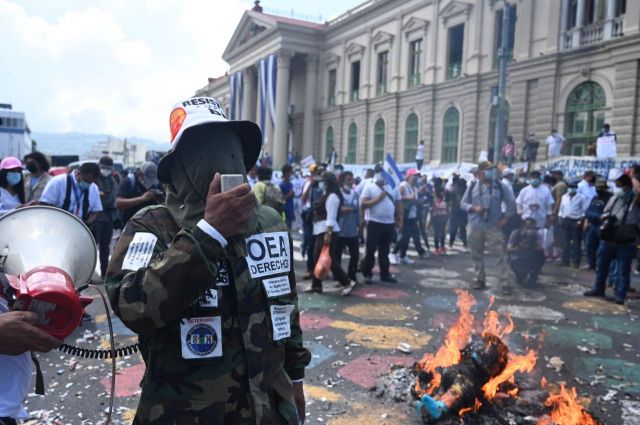 In October 2021, protests against the adoption of Bitcoin as legal tender took place in San Salvador, the capital of El Salvador. [Image source=Yonhap News]
[Asia Economy Reporter Kang Woo-seok] El Salvador, which adopted the cryptocurrency Bitcoin as legal tender, has recently faced a default crisis due to the cryptocurrency price crash.
According to a report by the New York Times (NYT) on the 5th (local time), the El Salvador government recently suffered an unrealized loss amounting to about 60% of its Bitcoin investment due to the cryptocurrency price plunge. Consequently, the usage of Bitcoin among El Salvador citizens has sharply declined, and plans to raise new funds from cryptocurrency investors have failed, pushing the national finances into a serious crisis.
President Nayib Bukele of El Salvador, a supporter of Bitcoin, invested 15% of the total investment budget last year to promote Bitcoin. The El Salvador government paid citizens who downloaded the Bitcoin wallet application 'Chivo' about $30 (approximately 39,000 KRW), which is roughly 1% of the average annual income of El Salvador citizens.
President Bukele claimed that nearly 60% (3 million people) of the adult population in the country downloaded Chivo, but the usage rate is reported to be extremely low.
According to a survey released in February by the National Bureau of Economic Research (NBER), only 10% of Chivo users continued to use the app after spending the initial support amount ($30).
It is also reported that almost no new citizens have downloaded the app this year.
A survey released by the El Salvador Chamber of Commerce in March showed that since Bitcoin became legal tender in September last year, only 14% of companies traded Bitcoin, and only 3% responded that Bitcoin trading had business value. The number of newly registered Bitcoin-related companies was limited to 48.
The El Salvador government's plan to issue $1 billion (approximately 1.3 trillion KRW) worth of Bitcoin-denominated sovereign bonds was indefinitely postponed in March due to the worsening international financial environment caused by Russia's invasion of Ukraine.
Meanwhile, with the cryptocurrency price crash, the situation for the El Salvador government has worsened, but President Bukele remains optimistic.
After the Bitcoin price plunge, he tweeted, "Bitcoin investment is safe. Bitcoin prices will rise tremendously after the bear market ends," adding, "I want to advise you not to look at charts but to enjoy life." On the 30th of last month, he also stated, "El Salvador bought 80 Bitcoins today for $19,000 (approximately 24.85 million KRW)," and said, "Bitcoin is the future. Thank you for selling at a low price."
Before this purchase, the Bukele administration had bought 2,301 Bitcoins in nine rounds. The total purchase amount is estimated at about $105.6 million (approximately 138.1 billion KRW).
The magazine Disruptive, published by Francisco Gavidia University in El Salvador, estimated that the El Salvador government suffered an unrealized loss of $63 million (approximately 82.4 billion KRW) from Bitcoin investments.
The NYT reported that as subsidies increase to stabilize fuel and food prices, which depend on overseas imports, the financial condition of the El Salvador government is worsening, and there are concerns that debt repayments starting with $800 million (approximately 1.0458 trillion KRW) in January next year and subsequent repayments may not be easy.
It also pointed out that El Salvador is approaching a situation where it must choose between drastic cuts in large-scale public financial expenditures and default due to the reckless introduction of Bitcoin.
Frank Mooch, a public policy expert at the London School of Economics (LSE), warned that President Bukele has focused more on his popular image than on sound economic policy management, and as a result, El Salvador will pay a very high price.
© The Asia Business Daily(www.asiae.co.kr). All rights reserved.
![Clutching a Stolen Dior Bag, Saying "I Hate Being Poor but Real"... The Grotesque Con of a "Human Knockoff" [Slate]](https://cwcontent.asiae.co.kr/asiaresize/183/2026021902243444107_1771435474.jpg)

















