Citigroup "May Fall to $65 per Barrel" vs Goldman Sachs "Could Rise to $140"
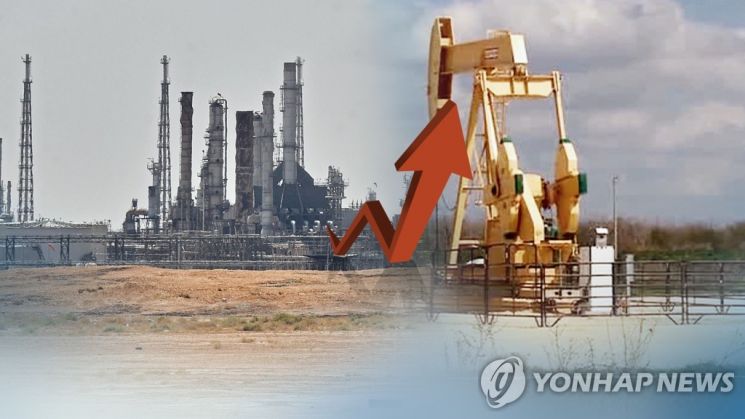 Conflicting analyses from investment banks are emerging regarding the outlook for international oil prices.
 [Image source=Yonhap News]
[Asia Economy Reporter Yoon Seul-gi] As concerns over a global economic recession grow, international oil prices, which had been soaring, have plummeted, leading to divergent oil price forecasts from investment banks. Citigroup warned that prices could fall to $65 per barrel by the end of this year, while Goldman Sachs predicted prices could rise to $140 per barrel.
On the 5th (local time) at the New York Mercantile Exchange (NYMEX), West Texas Intermediate (WTI) crude oil for August delivery closed at $99.50 per barrel, down 8.2% ($8.93) from the previous trading day. This marks the first time in nearly two months since May 11 that WTI prices have fallen below $100 per barrel.
At the London ICE Futures Exchange, Brent crude for September delivery closed sharply down 9.45% at $112.77 per barrel, the lowest level in two months since May 10 ($102.46).
The significant drop in oil prices amid the ongoing Russia-Ukraine war is due to expectations of an economic recession or slowdown ahead, which is anticipated to reduce energy demand.
Citigroup also warned of a sharp decline in oil prices. According to Bloomberg on the 5th (local time), Citigroup analysts stated in a memo sent to clients that "if a recession that paralyzes demand occurs, crude oil prices could plunge to $65 per barrel by the end of this year and further drop to $45 per barrel by the end of 2023." They also noted that "if a global recession leads to rising unemployment and bankruptcies among households and businesses, prices of commodities including international oil will collapse."
On the other hand, Jeff Currie, Global Head of Commodities at Goldman Sachs, forecasted that "international oil prices will rise to $140 per barrel." Currie told CNBC on the 5th (local time), "Commodity prices move based on what is currently happening," adding, "If selling occurs due to concerns about future weakness, it will reduce supply and actually be positive."
 On the 6th, citizens are refueling their vehicles at the Altteul Gas Station in Mannam Square Rest Area, Seocho-gu, Seoul. Photo by Hyunmin Kim kimhyun81@
He explained, "It is still a long way from the end of the current situation, and supply remains very tight," emphasizing that "there is a high risk of oil price increases in the short term."
Earlier, JP Morgan analysts also predicted that "if Russia cuts production by 5 million barrels per day, oil prices could surge to $380." According to Bloomberg on the 3rd, in a letter sent to their clients, they noted a high probability that Russia would retaliate with production cuts in response to the 'price cap' agreement recently made by the Group of Seven (G7) leaders, warning that if Russia reduces crude oil production, international oil prices could soar to more than three times the current level.
The reason investment banks have issued conflicting oil price forecasts appears to be due to the possibility of a real supply shortage alongside ongoing variables such as the risk of an economic recession.
The European Union (EU) has agreed to reduce imports of Russian oil by 90% by the end of this year as part of economic sanctions against Russia. This has caused energy supply concerns, but the Organization of the Petroleum Exporting Countries (OPEC) and other oil-producing countries including Russia, collectively known as OPEC+, have decided to maintain the previously agreed production cut of 648,000 barrels.
The possibility of an economic recession supports the downward pressure on oil prices. Recently, indicators suggesting an economic slowdown have emerged, including the inversion of short- and long-term interest rates in the United States, which is considered a signal of recession.
© The Asia Business Daily(www.asiae.co.kr). All rights reserved.
![Clutching a Stolen Dior Bag, Saying "I Hate Being Poor but Real"... The Grotesque Con of a "Human Knockoff" [Slate]](https://cwcontent.asiae.co.kr/asiaresize/183/2026021902243444107_1771435474.jpg)

















