Omicron Variant, Early Resurgence Possible This Summer
Public Fatigue and Breakthrough Infections as Variables... BA.5 Soon to Become Dominant in Korea
Strengthening Social Distancing Difficult... Experts Urge "Urgent Medical System Establishment"
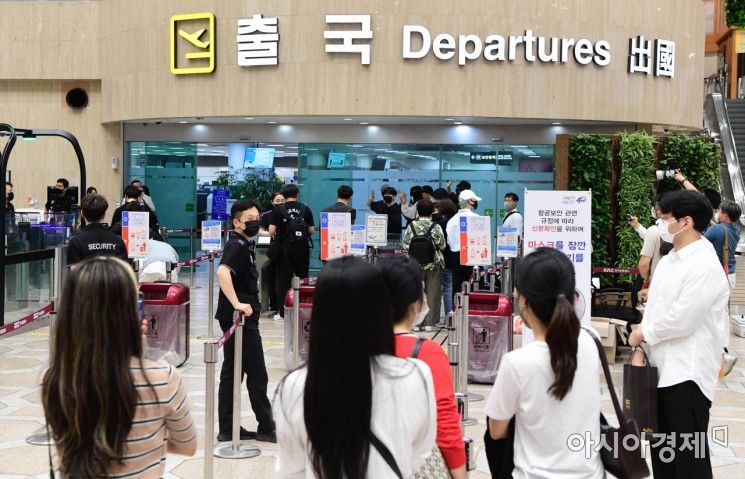 On the 29th, when the Gimpo-Haneda flight route resumed operations, passengers were moving to depart at the international terminal of Gimpo Airport in Gangseo-gu, Seoul. / Photo by Moon Honam munonam@
As the number of new COVID-19 cases rises again, concerns are growing that the resurgence this summer will come earlier than initially expected. This is due to a surge in travel during the vacation season, including overseas trips, following the easing of social distancing measures, increased use of air conditioning in enclosed spaces amid the heatwave, and the gradual decline of immunity gained from vaccination and previous infections, which raises the risk of reinfection. Although health authorities find it difficult to conclude that the summer resurgence has already begun, they remain on high alert.
Will the 4th Dose Vaccination Start for the General Public?
In response to the overall decline in immunity, authorities are discussing with experts the possibility of expanding the 4th COVID-19 vaccine dose, which has so far been limited to high-risk groups aged 60 and above, to the entire population. However, public fatigue and distrust due to accumulated vaccinations, along with a significant number of breakthrough infections among those who received the 3rd dose, make it difficult to push for a nationwide 4th dose vaccination.
Moreover, there is currently no vaccine that can strongly counter the Omicron subvariant BA.5, which is spreading not only domestically but also in Europe and the United States. Existing COVID-19 vaccines were developed against the virus before mutations occurred, so their effectiveness against variants is reduced. Pharmaceutical companies have started developing vaccines targeting the Omicron variant, but their effectiveness against BA.5 is lower compared to BA.1. According to clinical results announced by Pfizer last month for their Omicron-targeted vaccine, neutralizing antibody titers were about 10 times higher against the Omicron variant than the original vaccine, but immune responses to BA.4 and BA.5 were approximately three times lower.
Im Suk-young, head of the Central Disease Control Headquarters' situation management team, stated, "The detection rate of BA.5 in imported cases is 49.2%, so it can already be considered the dominant strain." She added, "The detection rate of BA.5 among domestic confirmed cases has also increased significantly compared to last week, so it is expected to rise further next week, raising concerns about it becoming the dominant strain soon." Baek Soon-young, emeritus professor at the Catholic University of Korea College of Medicine, said, "Although the BA.1-targeted Omicron-adapted vaccine is less effective against BA.5, it is still more effective than the existing vaccines, which offer almost no protection against Omicron infection." He emphasized, "We need to introduce the adapted vaccine and administer booster shots to the elderly and high-risk groups."
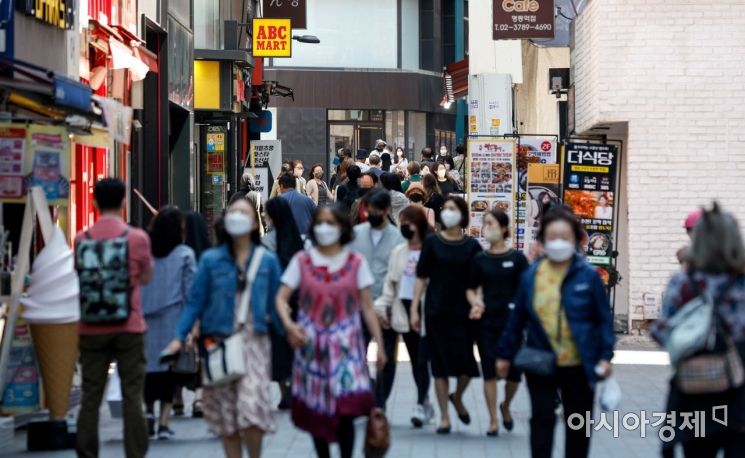 On the 10th, as eased social distancing measures continue, citizens and tourists visiting Myeongdong in Jung-gu, Seoul, are strolling along the streets. Photo by Jin-Hyung Kang aymsdream@
Strengthening Social Distancing Is Difficult
With the domestic and global economies in a fragile state and the ongoing policy of returning to normal life, finding effective measures to minimize the spread of the virus seems challenging. Since the new government took office, health authorities have set criteria for deciding whether to lift isolation requirements but have not established standards or procedures for strengthening quarantine policies in the event of a resurgence. Last week, the National Infectious Disease Crisis Response Advisory Committee was formed and planned to reconsider the extension of isolation requirements, initially extended until the 17th, but given the recent rise in cases, the likelihood of lifting isolation appears low.
Another challenge is preparing the healthcare system for an increase in confirmed and severe cases. During the Omicron wave, severe care beds expanded to 2,825 and total dedicated COVID-19 beds reached about 22,300, but since the end of April, the government has been steadily reducing beds as part of the recovery plan. Currently, only 5,717 COVID-19 treatment beds remain, including 1,469 severe care beds.
The medical community urges the rapid establishment of an emergency medical response system in preparation for the resurgence. Kim Won-young, policy director of the Korean Society of Emergency Medicine and professor of emergency medicine at Seoul Asan Medical Center, said, "During the Omicron wave, there was a shortage of hospitals able to accommodate confirmed cases, and both patient transfers and admissions for confirmed and general patients faced difficulties." He proposed, "We should identify the appropriate number of isolated emergency room beds based on regional confirmed case numbers and population, select key or on-call emergency rooms, and assign them to provide emergency care for moderate to severe COVID-19 patients within their regions."
© The Asia Business Daily(www.asiae.co.kr). All rights reserved.
![Clutching a Stolen Dior Bag, Saying "I Hate Being Poor but Real"... The Grotesque Con of a "Human Knockoff" [Slate]](https://cwcontent.asiae.co.kr/asiaresize/183/2026021902243444107_1771435474.jpg)

















