Inflation Rate Hits 6% Range for First Time Since Foreign Exchange Crisis
Big Step Possible at BOK Monetary Policy Meeting on 13th
Government Begins Preparing for Aftershocks of Interest Rate Hike
Interest Burden Could Increase by Over 7 Trillion Won if Big Step Taken
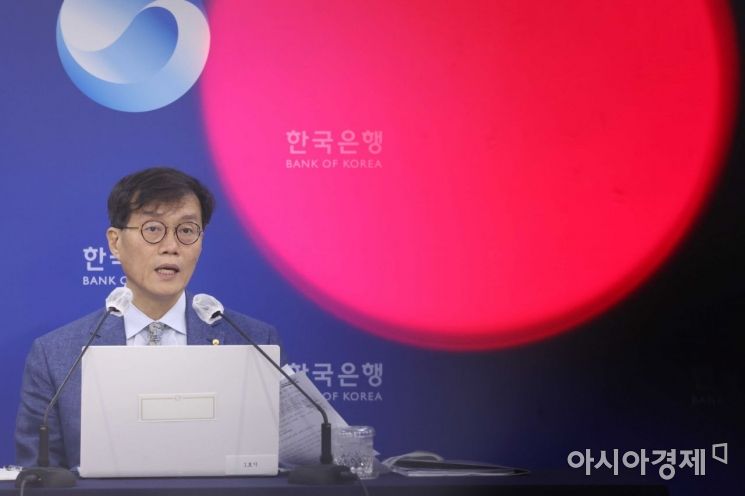 Bank of Korea Governor Lee Chang-yong held a briefing on the status of inflation target management at the Bank of Korea press room in Jung-gu, Seoul, on the 21st of last month. Photo by Moon Ho-nam munonam@
As the domestic consumer price inflation rate soars to 6%, the possibility of the Bank of Korea implementing a ‘big step’ (a 0.5 percentage point hike in the base interest rate at once) has increased significantly. If inflationary anxiety is not curbed early, economic uncertainty could spiral out of control, leading to widespread expectations that a big step will be taken at the Monetary Policy Committee meeting scheduled for next week.
On the 5th, immediately after Statistics Korea released the June consumer price trends, the Bank of Korea held a ‘Price Situation Review Meeting’ at 8:30 a.m. in the main conference room of its headquarters in Jung-gu, Seoul, chaired by Deputy Governor Lee Hwan-seok, to assess recent inflation trends and future outlook.
The Bank of Korea analyzed that the inflation rate entering the 6% range for the first time since the foreign exchange crisis was due to a combination of overseas supply-side factors such as rising crude oil and grain prices, and domestic demand recovery factors following the return to normalcy after COVID-19. Given that high oil prices caused by the Ukraine crisis and the global rise in food prices are unlikely to stabilize in the short term, coupled with domestic factors such as increases in electricity and city gas rates, the Bank expects the inflationary trend to continue for a considerable period.
Accordingly, the analysis that a historic big step will be taken at the Monetary Policy Committee meeting on the 13th is gaining momentum. Although voices calling for a big step have been raised in the market for several months, the Bank of Korea has maintained a principled stance that monetary policy should be implemented by comprehensively considering not only inflation but also the economy, exchange rates, and interest burdens.
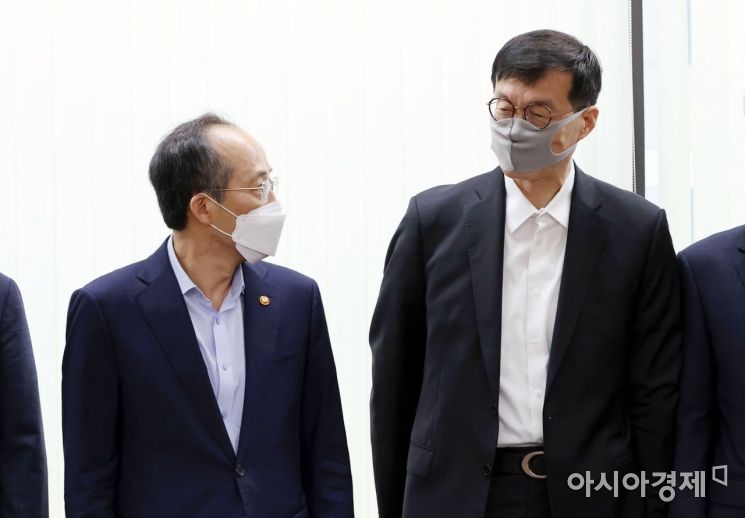 Deputy Prime Minister and Minister of Economy and Finance Choo Kyung-ho is having a conversation with Lee Chang-yong, Governor of the Bank of Korea, at the Financial Authorities Breakfast Meeting chaired by the Deputy Prime Minister held at the Bankers' Hall in Jung-gu, Seoul on the 4th. Photo by Moon Ho-nam munonam@
However, as strong opinions about the severity of the recent inflation surge have emerged both inside and outside the government, the Bank of Korea’s stance has somewhat shifted. Following a meeting the previous day with Vice Chairman Kim So-young of the Financial Services Commission, Financial Supervisory Service Governor Lee Bok-hyun, and Presidential Office Economic Secretary Choi Sang-mok, Bank of Korea Governor Lee Chang-yong and Deputy Prime Minister and Minister of Economy and Finance Choo Kyung-ho stated, "We will establish a joint response system among related ministries to proactively address macroeconomic risk factors during the domestic and international interest rate hike period to prevent their materialization."
This has led to speculation that the Bank of Korea is preparing to take a big step, while the Ministry of Economy and Finance, Financial Supervisory Service, and Financial Services Commission are starting procedures to prepare for the aftershocks of interest rate hikes, such as protecting vulnerable borrowers. After the meeting, Governor Lee told reporters, "There is a monetary policy direction decision meeting next week, so I cannot comment today," entering a silence mode.
While many agree that a big step is inevitable to ease the sharp inflation rise and concerns over capital outflows due to the interest rate differential between Korea and the U.S., household debt, which reached 1,859.42 trillion won as of the first quarter of this year, is considered an obstacle.
According to the Bank of Korea Economic Statistics System, the proportion of variable-rate loans affected by interest rate hikes accounts for 77.7% (based on outstanding balance) of household loans, so arithmetically, a 0.5 percentage point increase in interest rates would raise household interest burdens by more than 7 trillion won. Although financial authorities are exploring measures to ease the burden of loan interest repayments, there are inevitably limits to policy efforts during periods of rapid interest rate hikes.
Deputy Governor Lee Hwan-seok said at the meeting, "Expected inflation is rising to a level close to 4%, and inflationary pressures are spreading widely," adding, "It is necessary to be especially cautious about the spread of inflation expectations to prevent the high inflation situation from becoming entrenched."
© The Asia Business Daily(www.asiae.co.kr). All rights reserved.


















