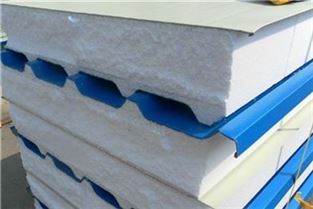
 A sandwich panel is a special plywood made by layering different materials in a sandwich form and bonding them with adhesive. It consists of lightweight porous materials (paper, wood, Styrofoam, etc.) and external metal sheets (plastic, aluminum, stainless steel, etc.) that wrap around them, making it vulnerable not only to heavy snowfall but also to fire.
 [Photo by Asia Economy DB]
[Asia Economy Reporter Kim Jong-hwa] Controversy continues over the ‘Quality Certification and Management Standards for Building Materials (Quality Certification System)’ introduced to enhance the fire safety of sandwich panels. The Quality Certification System requires sandwich panels using organic insulation materials to pass full-scale fire tests before being distributed in the market. However, opposition from the organic insulation industry persists, citing unclear evaluation criteria for the testing methods introduced to assess the performance of sandwich panels.
According to the related industry on the 5th, organic insulation manufacturers are requesting an extension of the validity period for certifications such as full-scale fire tests on sandwich panels obtained before the introduction of the Quality Certification System, as well as an additional extension of the one-year grace period already granted for the system. An industry insider pointed out, "While sandwich panels using organic insulation materials are subjected to mandatory testing, non-combustible inorganic insulation materials such as glass wool or mineral wool are exempted from these tests, raising concerns about fairness." They also argued that the testing methods adopted from overseas were designed for exterior wall insulation materials, not sandwich panels, resulting in insufficient data and unclear evaluation criteria. The insider emphasized, "Requesting a grace period for an already implemented system means asking for the system to be corrected by revising detailed operational guidelines."
The controversial Quality Certification System was introduced by the Ministry of Land, Infrastructure and Transport (MOLIT) after careful consideration, alongside ‘Fire Safety Measures at Construction Sites,’ to prevent recurring large-scale fire disasters such as the 2020 Icheon logistics warehouse fire. Since April 2019, MOLIT formed an advisory group with the Korea Expanded Polystyrene Industry Cooperative, Korea Polyurethane Industry Association, Korea Fireproof Building Materials Association, and experts, and after numerous discussions, amended the Building Act in December 2020 to introduce the Quality Certification System.
The core objective is to secure the quasi-noncombustible performance of sandwich panels using organic insulation materials such as EPS, commonly known as Styrofoam, and polyurethane. Sandwich panels are building materials made by attaching steel plates to both sides of insulation materials, but when ignited, joints can burst or toxic gases can be emitted, raising ongoing safety concerns. To establish the system, a one-year grace period was granted until the end of last year, and even after the grace period ended, the actual implementation of the Quality Certification System was delayed due to the time required for enacting subordinate legislation, with full enforcement beginning on February 11.
MOLIT’s stance is clear. At the time of introducing the Quality Certification System, MOLIT had continuously demanded enhanced quality for sandwich panels over the past decade. Despite half of the sandwich panels failing performance standards in annual building safety monitoring conducted since 2014, no improvements were made, so MOLIT stated that the enforcement of the law could no longer be postponed. A MOLIT official said, "Although there were shortcomings related to testing, alternatives are being prepared, and test applications are being accepted again," adding, "Particularly, conflicts of interest arise only regarding sandwich panels. Requests for a grace period for an already implemented system are unacceptable."
Experts emphasize that safety assurance should take precedence over industry interests. An academic expert who requested anonymity said, "Issues such as lack of testing facilities are being addressed through organic cooperation with private institutions," and added, "In a situation where urgent preparation is needed to prevent a second or third Icheon logistics warehouse fire, excessive criticism of an already implemented system is not desirable."
© The Asia Business Daily(www.asiae.co.kr). All rights reserved.
















