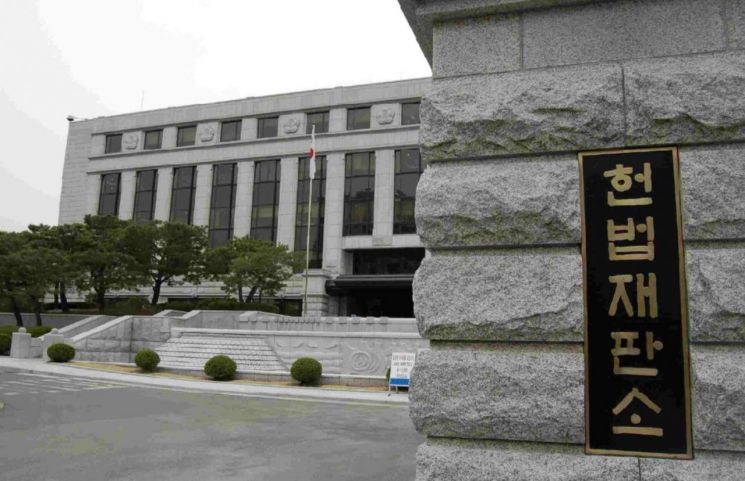
[Asia Economy Reporter Choi Seok-jin, Legal Affairs Specialist] The Constitutional Court has ruled constitutional the provision of the Environmental Improvement Cost Burden Act that imposes an environmental improvement charge on diesel vehicle owners.
This is the Constitutional Court's first ruling on the constitutionality of the environmental improvement charge system introduced when the Environmental Improvement Cost Burden Act, enacted in December 1991, came into effect in July the following year.
On the 5th, the Constitutional Court announced that it had unanimously decided the constitutionality of Article 9, Paragraph 1 of the Environmental Improvement Cost Burden Act, which stipulates that the Minister of Environment imposes and collects environmental improvement charges from diesel vehicle owners, in a constitutional complaint case.
A, who drove a Pregio small cargo vehicle, filed a lawsuit seeking cancellation of the charge imposition after receiving a notice from the Mayor of Changwon in March 2019 for the first installment environmental improvement charge of 69,910 KRW along with overdue charges totaling 569,140 KRW.
After losing in the first trial, A requested the court to refer a constitutional review of Article 9, Paragraph 1 of the Environmental Improvement Cost Burden Act, which was the basis for the charge imposition, during the second trial. When this was dismissed, A filed a constitutional complaint with the Constitutional Court.
Article 9 (Imposition and Collection of Environmental Improvement Charges), Paragraph 1 of the Environmental Improvement Cost Burden Act states, "The Minister of Environment shall impose and collect environmental improvement charges from owners of vehicles using diesel as fuel."
In the constitutional complaint, A argued that ▲ the Transportation, Energy, and Environment Tax Act already designates diesel as a taxable item and imposes transportation, energy, and environment taxes, so imposing environmental improvement charges again on diesel vehicle owners violates the principle of prohibition of double taxation; ▲ it is possible to impose environmental improvement charges differentially based on the mileage or vehicle maintenance status of diesel vehicles by accurately measuring pollutant emissions, but imposing charges uniformly just because one owns a diesel vehicle violates the principle of prohibition of excessive regulation and infringes on the property rights of diesel vehicle owners; ▲ there is no basis to conclude that diesel vehicles contribute more to environmental pollution than gasoline vehicles, yet environmental improvement charges are imposed only on diesel vehicle owners and not on gasoline vehicle owners, which constitutes unreasonable discrimination and violates the principle of equality.
First, the Constitutional Court rejected A's claim that imposing charges on diesel vehicle owners separately from the transportation, energy, and environment tax constitutes double taxation, stating, "Environmental improvement charges are not taxes but charges, so the claimant's argument that this violates the principle of prohibition of double taxation is unfounded."
Furthermore, the Court explained, "The transportation, energy, and environment tax is levied per liter of diesel, so the burden increases proportionally with diesel consumption but does not consider the pollution level caused by individual diesel vehicles. Therefore, if only the transportation, energy, and environment tax is imposed without environmental improvement charges, vehicles with high pollution levels such as old diesel vehicles or those registered in large cities receive relatively greater benefits, while owners of environmentally friendly diesel vehicles with relatively low pollution bear a relatively higher burden. This differs from the policy direction aimed at achieving environmental improvement through the polluter-pays principle and transition to eco-friendly vehicles."
Regarding property rights infringement, the Court cited Article 35, Paragraph 1 of the Constitution, which guarantees the right of citizens to live in a pleasant environment, and judged that "the legislative purpose is legitimate." It also viewed the charge imposition as an appropriate means since it indirectly induces the reduction of diesel vehicle ownership.
Considering the practical inevitability of uniform charge calculation and the provision allowing exemption for vehicles with significantly low emissions, the Court found that the burden imposed on owners is not excessive.
The Court stated, "This legal provision indirectly regulates the ownership and operation of diesel vehicles that emit large amounts of air pollutants through economic incentives rather than direct regulation. The economic burden imposed by this indirect regulation (ranging from a minimum of 8,513 KRW to a maximum of 377,726 KRW per half-year as of 2022) cannot be considered excessive to the extent that it directly regulates diesel vehicle ownership and operation."
It added, "On the other hand, the public interest in creating a pleasant environment, which is the foundation for the nation's sustainable development, is by no means smaller than the disadvantages borne by diesel vehicle owners. Therefore, this legal provision does not violate the balance of legal interests."
The Court also concluded that, based on research results showing that diesel vehicles emit significantly more air pollutants such as fine dust, ultrafine dust, and nitrogen oxides compared to gasoline vehicles, and that the environmental damage costs caused by diesel vehicles are also considerably higher, the provision does not violate the principle of equality.
© The Asia Business Daily(www.asiae.co.kr). All rights reserved.
![Clutching a Stolen Dior Bag, Saying "I Hate Being Poor but Real"... The Grotesque Con of a "Human Knockoff" [Slate]](https://cwcontent.asiae.co.kr/asiaresize/183/2026021902243444107_1771435474.jpg)











