Hashimoto Mitsui OSK President: "Expanding Nuclear Power Difficult and Replacing Cheap Russian LNG Not Easy"
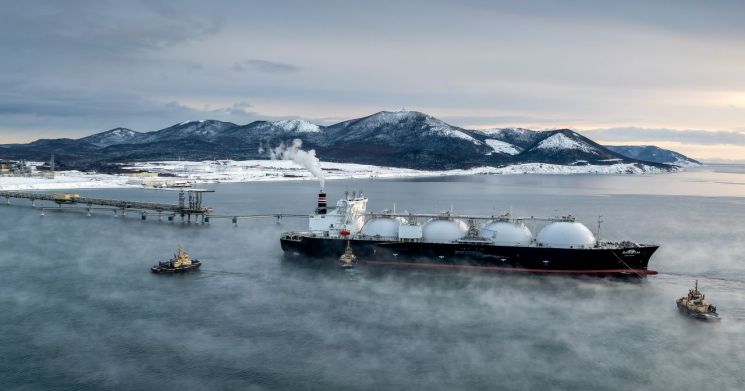
[Asia Economy Reporter Park Byung-hee] Takeshi Hashimoto, President and CEO of Mitsui OSK, Japan's largest shipping company, reportedly stated that Japan has no choice but to continue purchasing liquefied natural gas (LNG) from Russia, according to major foreign media on the 3rd.
This claim comes amid the situation where, following Russia's invasion of Ukraine on February 24, the US and Europe have expanded bans on Russian energy imports to cut off funding, and Japan is compelled to take a different stance from the West. It also draws attention as it can be interpreted as a response to Russia's recent request for Japan to decide whether to continue investing in the Sakhalin 2 gas development project, an important gas supply source for Japan.
President Hashimoto argued that Russian LNG is necessary for Japan. He said that due to soaring energy prices and the limited possibility of restarting nuclear power plants in Japan, the country has no choice but to rely on Russia. He added that there are few alternatives to replace Russian LNG.
Before the Fukushima nuclear accident in 2011, nuclear power accounted for about 30% of Japan's electricity production. After the accident, the share of nuclear power gradually declined and recently fell below 10%. As the share of nuclear power decreased, the share of fossil fuels increased, and Russian LNG accounts for about 10% of Japan's total gas imports.
Recently, Russia has been pushing to establish a new corporation related to the Sakhalin 2 gas development project. Two Japanese trading companies, Mitsui & Co. and Mitsubishi Corporation, must decide whether to continue investing.
Russian President Vladimir Putin recently signed a bill to change the rights related to the Sakhalin 2 gas project. The bill stipulates that all rights related to the Sakhalin 2 gas project will be transferred to a newly established Russian company. Currently, the shares of the Sakhalin 2 gas project are held 50% by the Russian state-owned gas company Gazprom, and the remaining half is owned by British oil company Shell (27.5%), Japan's Mitsui & Co. (12.5%), and Mitsubishi Corporation (10%).
As Russia plans to transfer all shares to the new corporation, Shell, Mitsui & Co., and Mitsubishi Corporation must decide within a month whether to take shares in the new corporation or to forgo them and receive compensation. According to a statement released by the Russian government on the 30th of last month, the reason for transferring shares to the new corporation is for Russia's national interest and economic security. Sakhalin 2 has long supplied large amounts of natural gas to Japan at low prices.
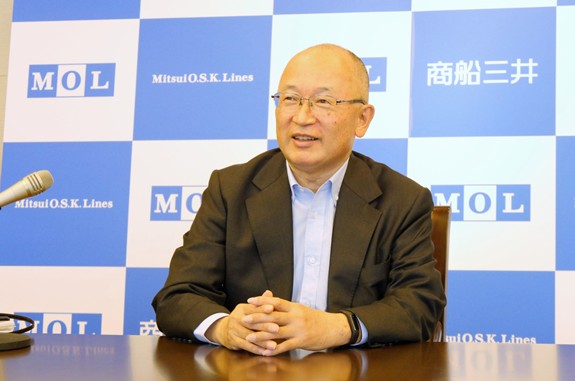
President Hashimoto emphasized that purchasing Russian LNG under long-term contracts allows securing base-load LNG, which is a major power source, at a low cost. He explained that the high prices of LNG and coal in the spot market are among the reasons why Japan hesitates to stop importing LNG from Russia.
Mitsui OSK is Japan's largest shipping company, owning about 700 vessels. It plays an important role in exporting Russian LNG from Siberia using icebreakers.
President Hashimoto stated plans to continue importing gas from Russia and supply it to Tokyo Gas and JERA. He said, "Since Japanese companies want LNG from Sakhalin 2, Mitsui OSK will do its best to supply gas regardless of Russia's national policies."
He also revealed that vessels have been ordered for Russia's other gas development project, Arctic LNG 2.
President Hashimoto expressed confidence that Russia will complete the first phase of the three-phase Arctic LNG 2 project by next year, but noted that almost all projects related to expansion plans have been halted. He said that each phase of the Arctic LNG 2 project is designed to produce about 6.6 million tons of LNG, and that completing just the first phase could increase Russia's LNG exports by about 20%.
President Hashimoto explained that Mitsui OSK ordered three icebreakers in 2020 for the Arctic LNG 2 project, which are now nearly completed. He also stated that following the icebreakers, four LNG carriers and one condensate tanker have been ordered.
With a general election approaching, Japan is experiencing a heatwave, intensifying debates over the need to restart nuclear power plants. However, President Hashimoto said that considering public opinion, it is very difficult for Japan to operate many nuclear power plants, and that Japan will import oil, coal, and LNG for longer than other countries.
© The Asia Business Daily(www.asiae.co.kr). All rights reserved.
!["The Woman Who Threw Herself into the Water Clutching a Stolen Dior Bag"...A Grotesque Success Story That Shakes the Korean Psyche [Slate]](https://cwcontent.asiae.co.kr/asiaresize/183/2026021902243444107_1771435474.jpg)

















