"Cupbap and Hagwon Replaced by Home Meals and Online Lectures" Number of Students in Public Service Exam Villages Decreases Due to High Inflation
Competition Rates for Civil Service Exams Continue to Decline...29:1 for Grade 9, 42.7:1 for Grade 7
Increase in Early-Career Resignations, from 5,181 in 2017 to 9,258 in 2020
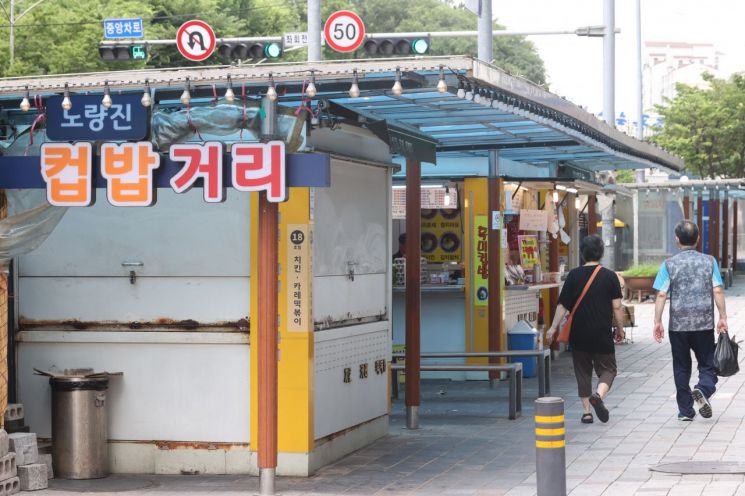 Some shops in the Cupbap Street of the Noryangjin academy district in Seoul were temporarily closed during lunchtime on the 28th of last month. According to nearby merchants, due to rising prices and online lectures in the academy district, some cupbap shops are irregularly closed.
 [Image source=Yonhap News]
[Asia Economy Reporter Kim Jung-wan] #. Park Jae-chan (25), a first-year civil service exam candidate, recently left Noryangjin and returned to his hometown. Over the past year, Park balanced part-time jobs and studying for the exam while nurturing his dreams in Noryangjin, but recently he felt that the advantages of being a civil servant were diminishing. He said, "Prices have gone up recently, but the civil servant salary was much lower than I expected. Although the pension is an advantage, I wondered if it was worth investing for that level of stability."
As demand among people in their 20s and 30s for civil servant jobs, once considered stable careers with pensions after retirement, has decreased, Noryangjin, known as a hub for exam candidates, is also showing signs of change. Not only has the number of students decreased due to lower preference, but the price of cup rice meals has also risen due to high inflation. There are voices suggesting reducing financial burdens by switching from academy lectures to online classes.
Recently, demand for civil servants among people in their 20s and 30s has significantly declined. According to the Ministry of Personnel Management, the competition rate for the national level Grade 9 civil servant exam this year was 29 to 1, sharply down from 47 to 1 in 2017. This is the lowest since 19.3 to 1 in 1992. The competition rate for the Grade 7 civil servant exam this year was also 42.7 to 1, down more than 10% from 47.8 to 1 last year. This is the lowest since 23.5 to 1 in 1970.
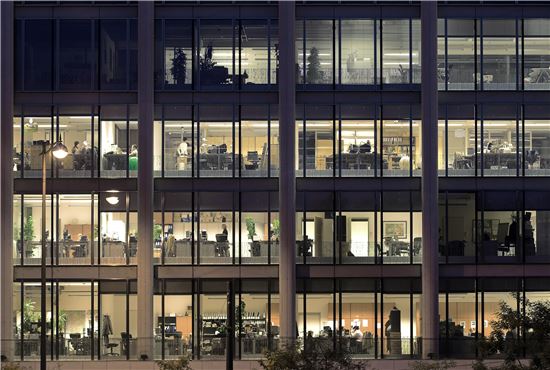 The preference for public servant jobs among people in their 20s and 30s is decreasing. Excessive workload compared to salary is cited as one of the reasons. [Image source=Getty Images]
There are also many cases of people quitting shortly after becoming civil servants. According to data from the Ministry of Personnel Management, the number of civil servants who resigned within five years of appointment sharply increased from 5,181 in 2017 to 9,258 in 2020. According to the Government Employees Pension Service, 5,961 civil servants aged 18 to 35 retired in 2020. This is more than 1,500 higher than the 4,375 in 2017.
Lee (20s), a first-year local government civil servant, said, "There are many overtime hours, and the workload is much heavier than I expected," adding, "I feel like I work too much compared to the salary. I'm still in my 20s, and I wonder if it's right to live doing this kind of work for life." He added, "I'm personally feeling the reason why demand is decreasing."
Due to the decreased preference for civil servant jobs among the younger generation, the number of students in Noryangjin has declined. Meanwhile, prices in the Noryangjin cup rice meal district have also risen due to high inflation. Kim (24), an exam candidate, sighed, saying, "Most were 3,500 won, but now they've gone up to the 4,000 won range. People say it's inflation, but since I eat cup rice meals all the time, I didn't really feel it much, but now it hits me hard." Kim added, "It's 500 won, but the burden has increased," and said, "I'm considering increasing my part-time job hours."
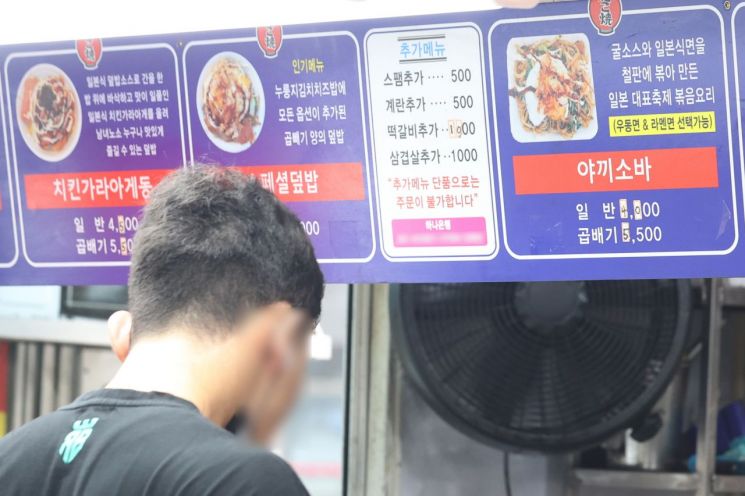 On the 28th of last month during lunchtime, the menu prices at a shop in the Noryangjin Cupbap Street in Seoul were updated. Merchants explained that due to soaring prices, the cost of ingredients increased, leading to a rise in Cupbap prices.
 [Image source=Yonhap News]
The soaring prices have also affected cup rice meals, which have been a representative meal for exam candidates. This is due to the rise in all ingredient prices. According to Statistics Korea, consumer prices in May rose 5.4% compared to the same month last year. The increase rate for agricultural, livestock, and fishery products was also 4.2%. Accordingly, prices for chicken (16.1%), pork (20.7%), and imported beef (27.9%) rose. Processed food prices also increased, with 69 out of 73 items rising, including flour (26%) and cooking oil (22.7%). Prices of major food items such as vinegar (21.5%), soybean paste (18.7%), and soy sauce (18.4%) also rose by more than 10%.
Given this situation, some exam candidates are trying to reduce financial burdens by switching from cup rice meals to home-cooked meals and from academy lectures to online classes. Jo (25), preparing for the Grade 7 civil servant exam, said that he used to attend academies near Noryangjin and buy cup rice meals, but now studies alone at home with online lectures and eats home-cooked meals. He explained, "Although I work part-time, I eat every meal, and when I study, I get hungry and want to eat heartily in the evening, but it became a burden. To reduce that burden even a little, I decided to study at home." He added, "Now that I'm getting used to online lectures, I made the decision for that reason as well."
© The Asia Business Daily(www.asiae.co.kr). All rights reserved.


















