Jungnowi Enters Hyundai Motor Labor-Management Negotiation Mediation
Legal Right to Strike Secured if 'Mediation Suspension Decision' Made
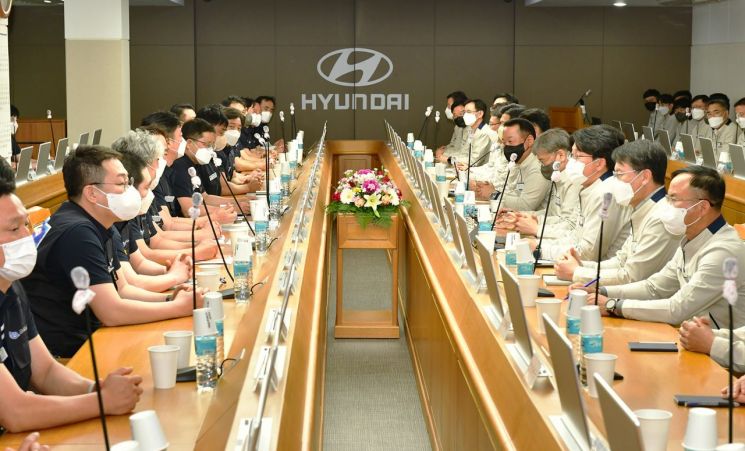
[Asia Economy Reporter Kiho Sung] Labor conflicts between completed car manufacturers are intensifying, with the Hyundai Motor Union entering the process of a strike. Amid a bleak outlook for the completed car industry due to the shortage of vehicle semiconductors and rising raw material prices, there are concerns that extreme confrontations between labor and management could bring even greater difficulties.
According to the Ministry of Employment and Labor on the 4th, the Central Labor Relations Commission began mediation for Hyundai Motor labor-management negotiations at 10 a.m. that day. However, due to significant differences in positions between the two sides, it is highly likely that the mediation will be suspended. Earlier, the union conducted a strike vote among all 46,568 union members on the 1st, with 33,436 (71.80%) voting in favor, passing the motion. If the Central Labor Relations Commission declares the negotiations broken down, the union will obtain the legal right to strike. The union is expected to convene a strike countermeasure committee on the 5th to review the detailed strike schedule.
Previously, the union declared the breakdown of negotiations on the 22nd of last month. In this year’s negotiations, the union demanded ▲a basic monthly wage increase of 165,200 KRW (excluding seniority increments) ▲a 30% performance bonus based on net profit. Additionally, ▲new personnel recruitment ▲extension of retirement age ▲job security ▲abolition of the wage peak system ▲establishment and investment in domestic factories related to the future car industry were included in separate demands. If the strike approval is decided, it will be the first time in four years since 2018, facing new adversities amid semiconductor supply shortages, COVID-19 related lockdowns in China, and parts shortages.
If the Hyundai Motor Union proceeds with the strike, production disruptions are expected to cause damage not only to the company but also to parts suppliers and consumers. In Hyundai Motor’s case, performance deterioration is inevitable. According to Daishin Securities, from 2000 to last year, Hyundai Motor’s union strikes caused an average annual production disruption of 63,000 vehicles. The estimated average sales loss was 1.6 trillion KRW. The most severe damage occurred in 2016, with production disruption volume of 142,000 vehicles and a loss amounting to 3.55 trillion KRW.
The parts suppliers face similar issues. Automobile parts suppliers generally align their schedules with completed car manufacturers. When the completed car manufacturers’ factories shut down, parts suppliers also halt operations.
Consumers are expected to face even longer waiting times for new cars, which are already extended. Currently, Hyundai Motor’s popular models have waiting times exceeding one year. In particular, the delivery waiting period for popular models such as Tucson and Santa Fe already reaches up to 16 months. If production disruptions occur, the period consumers wait to receive their vehicles could become even longer.
© The Asia Business Daily(www.asiae.co.kr). All rights reserved.
![Clutching a Stolen Dior Bag, Saying "I Hate Being Poor but Real"... The Grotesque Con of a "Human Knockoff" [Slate]](https://cwcontent.asiae.co.kr/asiaresize/183/2026021902243444107_1771435474.jpg)
















