Relaxation of Online Delivery Restrictions on Large Mart Holidays
Government-Level Discussions Begin... Industry Expectations Rise
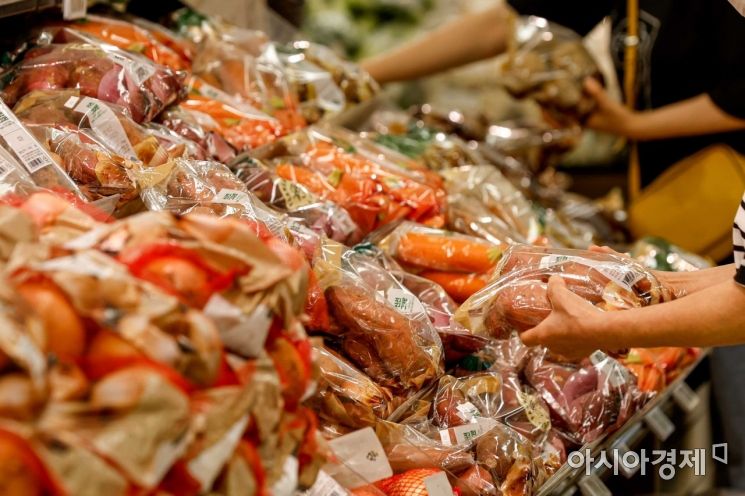 Customers are shopping at a large supermarket in Seoul on the 3rd, as vegetable prices surge due to the recent heavy rain and the monsoon season. Photo by Kang Jin-hyung aymsdream@
As government-level discussions begin regarding online delivery on mandatory closure days for large supermarkets, the industry is keenly watching to see if the long-blocked path to online delivery during mandatory closure days and late-night hours will open.
According to the distribution industry on the 4th, the Fair Trade Commission recently decided to ease regulations on online delivery during large supermarket closure days as one of the major regulatory improvement tasks and has started consultations with the Ministry of Trade, Industry and Energy, the relevant authority, raising industry expectations. Attention is also focused on whether the National Assembly will move to amend the Distribution Industry Development Act. The industry expects that with government-level discussions underway, if the National Assembly begins serious deliberations on the bill, regulations related to online sales will be eased.
Currently, large supermarkets are restricted from online delivery during the restricted business hours from midnight to 10 a.m. Since the Picking and Packing Centers (PP Centers), which function as logistics centers, are all located at hub stores, dawn delivery is impossible. This is the result of offline business regulations stipulated in the Distribution Industry Development Act being applied as-is to online businesses. Under current law, large supermarkets cannot process online orders even on the two mandatory closure days per month. According to the Distribution Industry Development Act enacted in 2013, local governments can limit the business hours of large supermarkets and designate two mandatory closure days each month to protect traditional markets.
Large supermarkets cite this regulation as a representative unfair disadvantage that hinders fair competition with e-commerce companies such as Coupang and Market Kurly. Over the past two years, during which e-commerce rapidly grew amid the COVID-19 era, 22 large supermarkets and 112 corporate supermarkets (SSMs) have closed. Large supermarkets decreased from 406 in 2019 to 384 last year, and SSMs declined from 1,215 to 1,103 during the same period. This also negatively affected sales. Last year, major distribution companies showed growth in both online (15.7%) and offline (7.5%) sectors, but large supermarkets and SSMs saw decreases of 2.3% and 9.1%, respectively.
If regulations are improved, Emart, Lotte Mart, Homeplus, and others will be able to use their nationwide stores as hubs to launch dawn delivery services. SSMs will also be utilized as delivery forward bases. Emart has about 120 PP Centers nationwide. By expanding delivery zones leveraging the nationwide PP Center logistics network, a nationwide infrastructure will be completed. Homeplus also uses about 80% of its nationwide stores, including SSMs, as logistics hubs. A representative from a large supermarket said, "Since the abolition of regulations related to mandatory closure days is a long-standing wish of the industry, we see significance in taking one step at a time and are watching with expectations."
© The Asia Business Daily(www.asiae.co.kr). All rights reserved.
![Clutching a Stolen Dior Bag, Saying "I Hate Being Poor but Real"... The Grotesque Con of a "Human Knockoff" [Slate]](https://cwcontent.asiae.co.kr/asiaresize/183/2026021902243444107_1771435474.jpg)
















