Integrated transfer centers are emerging as a key factor heating up the real estate market. They serve not only as 'terminals' connecting transportation such as urban rail, buses, taxis, and parking lots, but also accompany various development projects, creating regional hubs in the area.
In the metropolitan area, the vicinity of Gwangmyeong Station in Gyeonggi Province is a representative example. Equipped with an integrated transfer center connecting KTX and Line 1 trains with public transportation such as buses and taxis, it has risen as a major transportation hub representing the southwestern metropolitan area. Thanks to this convenience, not only residential facilities but also large commercial complexes, university hospitals, and office facilities have been additionally expanded, leading the local real estate market.
The area around Dongdaegu Station, which had become outdated, has also emerged as a 'hot place' thanks to the integrated transfer center. It is designed so that transfers between KTX, trains, city and intercity buses, subway, and taxis can be made within a 10-minute walk. In particular, with the opening of Shinsegae Department Store right in front of the station alongside the integrated transfer center, the area has been reborn as a new commercial district where transportation and shopping can be solved in a one-stop manner.
Among the currently planned integrated transfer centers, the Cheongnyangni area is attracting attention. According to the Ministry of Land, Infrastructure and Transport and Seoul City, the Cheongnyangni integrated transfer center will be developed as a complex including transportation, residential, and commercial facilities, similar to the world-renowned integrated transfer center 'La D?fense' in Paris, France.
From a transfer perspective, with 10 lines expected to pass through including the future GTX-B and C lines, an increase in foot traffic is anticipated, and plans are in place to establish a horizontal transfer system to minimize transfer times. Additionally, leveraging synergies with research complexes and nearby universities centered around Cheongnyangni Station, the project aims to create regionally specialized jobs and new growth industries, along with introducing youth housing and cultural facilities linked to these developments. In other words, the plan is to transform Cheongnyangni Station into a hub not just for transfers but as a space where people stay.
Research team leader Kwon Il from Real Estate Info said, “There is no other place in Korea where multiple new railway openings and large-scale surrounding developments are simultaneously underway like Cheongnyangni.” He added, “Following the creation of integrated transfer centers, places like France’s La D?fense Station and Germany’s Berlin Central Station have transformed into hubs, and Cheongnyangni will further strengthen its role as a core axis of Seoul’s economy.”
As the integrated transfer center is expected to increase foot traffic and improve infrastructure, surrounding commercial facilities are also bustling. Commercial spaces within previously sold residential-commercial complexes in the Cheongnyangni area, such as 'Hillstate Cheongnyangni The First,' 'Cheongnyangni Station Harrington Place,' and 'Hillstate Cheongnyangni Metroble,' have all been 100% contracted, and the newly launched 'Cheongnyangni Station Hanyang Sujain Art Forest' is attracting significant interest from investors.
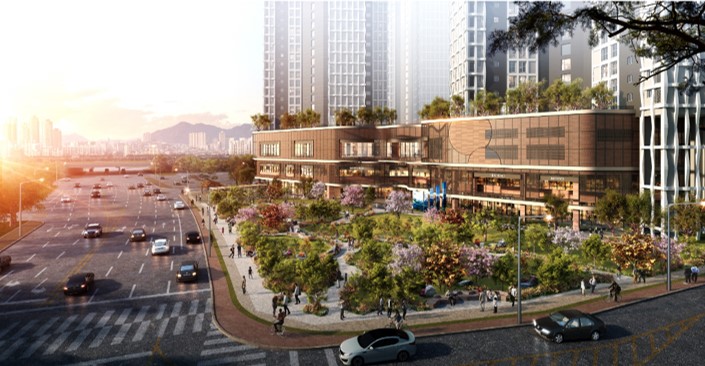
The 'Cheongnyangni Station Hanyang Sujain Art Forest,' located on the 2nd basement to 3rd floor of the up to 59-story residential-commercial complex 'Cheongnyangni Station Hanyang Sujain Graciel,' consists of a large-scale commercial facility with a total of 219 units. It is situated on Dapsimni-ro, which is emerging as a new main commercial district in Cheongnyangni with the formation of a super high-rise residential-commercial skyline. Notably, Dapsimni-ro is scheduled to be expanded from the current two lanes in each direction to up to eight lanes, making Cheongnyangni Station Hanyang Sujain Art Forest a commercial area facing a major road.
Moreover, Cheongnyangni Station Hanyang Sujain Art Forest collaborates with the world-renowned graphic artist Camille Walala to present a space infused with artistic elements that differentiate it from surrounding commercial areas. It is also notable that a park of approximately 3,400㎡, the largest in the Cheongnyangni Station area, is planned to be newly established right in front.
Cheongnyangni Station Hanyang Sujain Art Forest is currently operating a promotional center.
© The Asia Business Daily(www.asiae.co.kr). All rights reserved.

















