Sharp Rise in Power Demand Forecast Amid Heatwave
Supply Capacity Similar to Last Year's 100GW Range
Alps Glacier Collapse and Italy Hits 50 Degrees
Global Heatwave Emergency
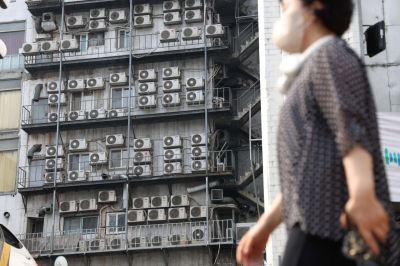 On the 4th, as early heatwaves cause a surge in electricity demand, the exterior wall of a building in Jung-gu, Seoul is fully equipped with outdoor air conditioner units. Photo by Mun Ho-nam munonam@
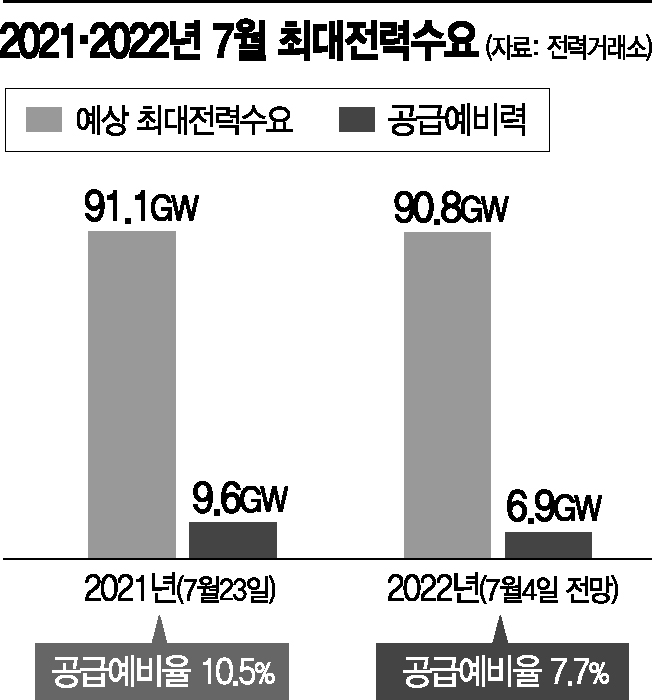
The government's projection that the peak power demand in early July will surpass the 90GW mark is highly unusual.
This reflects the nationwide heatwave caused by abnormal weather conditions, which is arriving faster and lasting longer than expected. The Ministry of Trade, Industry and Energy forecasted the reserve margin for this summer to be at least 5.2GW as of the second week of August. If it falls below 5.5GW, it falls within the range for issuing a power supply emergency alert. The peak power demand during this period is expected to reach 95.7GW, 5.0% higher than last year's 91.1GW.
The power supply situation from late July to mid-August during the midsummer is expected to be even more challenging. Although power demand will surge due to the heatwave, the supply capacity remains at a similar level to last year, around 100GW.
While nuclear power plant operations have increased, this is offset by the retirement and maintenance of aging coal-fired power plants. If power demand explodes with limited supply capacity, a 'power supply emergency stage' could be declared for the first time in nine years since 2013. In such a case, public institutions, shopping malls, and other multi-use facilities will be forced to conserve electricity, and factory operations during peak times may be restricted. The government explained that it has secured an additional 9.2GW of reserve resources in preparation for the surge in power demand, but the power industry expressed concerns that it may be difficult to adequately cope with stable supply if the record-breaking heatwave continues.
Not only domestically but also worldwide, emergencies have been triggered by the heatwave. In Europe, suffering from the heatwave, a glacier in the Alps collapsed, causing at least six deaths. The British daily The Guardian reported on the afternoon of the 3rd (local time) that a glacier collapsed on the hiking trail leading to Marmolada, the highest peak of the Dolomites in Italy, burying hikers. Authorities reported at least six dead and eight injured, with two of the injured in serious condition. Marmolada, located in the Trentino-Alto Adige autonomous region bordering Austria, is the highest peak of the Dolomites, a branch of the Alps, standing at 3,343 meters.
Local media such as Italy's public broadcaster RAI reported that the cause of the glacier collapse may be the heatwave that has been intensifying since the end of June. In Italy, recent maximum temperatures have risen up to 50 degrees Celsius. AFP news agency explained that this disaster occurred just one day after the temperature at the summit of Marmolada reached a record high of 10 degrees Celsius.
Meanwhile, at the end of last month, the Bordeaux region in France recorded a historic high temperature of 40.5 degrees Celsius for June. The Arctic country Norway also saw its highest ever temperature soaring to 32.5 degrees Celsius.
© The Asia Business Daily(www.asiae.co.kr). All rights reserved.


















