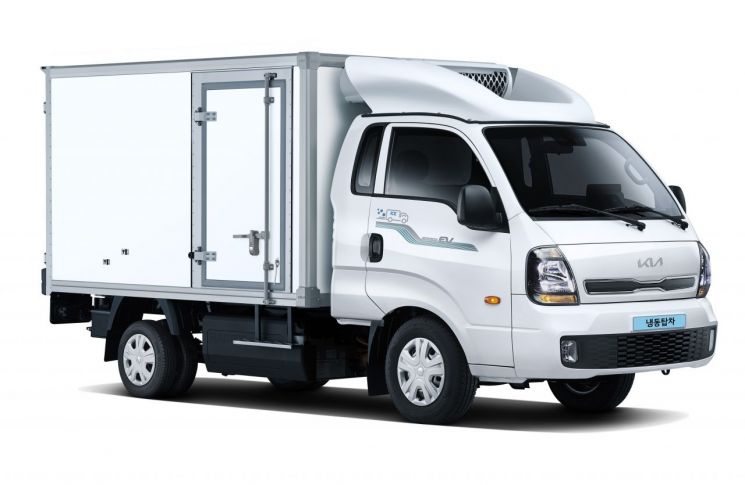
[Asia Economy Reporter Choi Dae-yeol] Kia announced on the 4th that it will launch the BongoⅢ EV (electric vehicle) refrigerated truck, a small commercial vehicle.
This is a special-purpose vehicle based on the BongoⅢ EV extra-long King Cab, which was launched in January 2020. It has a payload capacity of about 1000 kg, which is approximately 350 kg more than other specialty vehicle manufacturers' vehicles. This is because the high-voltage battery installed in the vehicle powers the refrigeration unit, eliminating the need for a separate auxiliary battery. Since there is no separate auxiliary battery, there is no need to charge it.
The company explained that it reflects the direction of purpose-built mobility (PBV). Before the vehicle launch, usability was pre-verified with local refrigerated and frozen logistics service companies and drivers, and this feedback was incorporated into the development stage.
Equipped with a 135 kW motor and a 58.8 kWh battery, it can travel 177 km on a single charge (based on the refrigeration unit being off). Even when the refrigeration unit is operating, it can travel over 150 km. While diesel vehicles are restricted from idling for more than 5 minutes, diesel trucks can keep the refrigeration unit running steadily even when stationary.
Standard features include electric power steering, paddle shifters, push-button start smart key, and electronic parking brake, which are exclusive to the existing BongoⅢ. Customer-preferred features such as ventilated and heated driver seats, full-auto air conditioning, and auto light control headlamps are also standard.
All models come standard with a battery heating system that reduces charging time in winter. Safety features that assist safe driving, such as forward collision avoidance assist, lane departure warning assist, and driver attention warning, are also standard.
It will be released in two models: low-floor and standard, priced at 59.84 million KRW and 59.95 million KRW, respectively. It qualifies for a small cargo electric vehicle subsidy of 18.4 million KRW, local government subsidies (Seoul 7.88 million KRW, varying by municipality), and an acquisition tax reduction up to 1.4 million KRW. The company explained that the actual price burden for buyers is in the 30 million KRW range, making it economical. There are also benefits such as discounts on public parking fees and highway tolls.
According to the company, the online food market size doubled from 27 trillion KRW in 2019 to 58.5 trillion KRW last year. The registration of refrigerated and frozen trucks also increased by more than 20%, from 17,300 units to 21,200 units during the same period.
© The Asia Business Daily(www.asiae.co.kr). All rights reserved.
![Clutching a Stolen Dior Bag, Saying "I Hate Being Poor but Real"... The Grotesque Con of a "Human Knockoff" [Slate]](https://cwcontent.asiae.co.kr/asiaresize/183/2026021902243444107_1771435474.jpg)
















