[Asia Economy Reporter Yoo In-ho] The Yoon Suk-yeol administration has effectively joined NATO's new strategic concept, which openly aims to check Russia and China, by participating in the North Atlantic Treaty Organization (NATO) summit. As a result, maintaining amicable relations with the two countries has become a new challenge going forward.
Depending on diplomatic achievements with China and Russia, there is a high possibility of influencing the situation on the Korean Peninsula, including North Korea's nuclear issue.
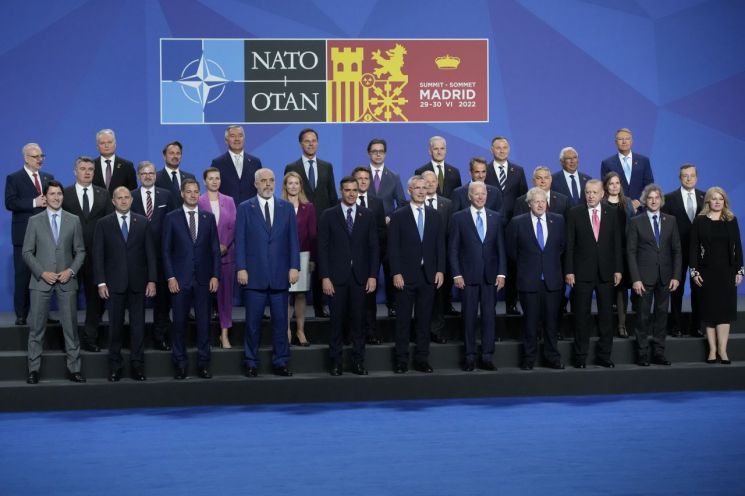
President Yoon Suk-yeol completed the 2-night, 3-day NATO member-partner summit schedule on the 30th of last month (local time) after holding summit meetings with the Czech Republic, Canada, and others.
According to the presidential office's self-assessment, through the NATO summit, which was the first participation by a Korean president, they confirmed Japan's willingness to improve relations, strengthened cooperation with NATO member countries and Indo-Pacific partner countries, and achieved results in sales diplomacy such as nuclear power and defense industries.
However, redefining relations with China and Russia has emerged as a diplomatic challenge.
Above all, the relationship with China is an urgent priority. It is expected that the foreign ministers of South Korea and China will meet face-to-face for the first time at the upcoming G20 Foreign Ministers' Meeting, and if this meeting takes place, it will serve as a gauge to see whether South Korea-China relations are on a smooth course.
The government emphasizes that it is not excluding or targeting any particular country, but it is difficult to deny that the risk regarding China has increased given that the core of the current US-China conflict is a 'value confrontation.'
In the new strategic concept document adopted at this meeting, NATO defined that "China's explicit ambitions and coercive policies challenge our interests, security, and values."
However, neither our government nor the Chinese government has yet taken a confrontational stance. On the 2nd, Foreign Minister Park Jin said in an interview with a media outlet, "(China) is a country that has benefited the most from free trade, and I think participating in the new order will actually be more beneficial for China."
China is sending cautious glances toward the Yoon administration's joining of the value alliance but still does not appear to be taking a direct confrontational stance against South Korea.
Chinese Foreign Ministry spokesperson Zhao Lijian said at a briefing on the 30th of last month, "South Korea is an important country in Asia and a mutually important cooperative partner with China, sharing broad common interests," and added, "China hopes that all relevant parties will jointly work to develop bilateral relations and safeguard peaceful and stable development in Asia."
On the same day, Xing Haiming, the Chinese Ambassador to South Korea, stated at the 30th anniversary academic conference of Korea-China diplomatic relations, "I hope South Korea, as a friendly neighbor of China, will empathize and understand the feelings of the Chinese people and China's position and support it."
Accordingly, the government plans to resolve bilateral issues through various channels of consultation between South Korea and China.
The G20 Foreign Ministers' Meeting to be held in Bali, Indonesia, on the 7th and 8th is expected to be the first testing ground. Since both Foreign Minister Park and Chinese State Councilor and Foreign Minister Wang Yi have officially announced their attendance at the G20 meeting, there is a possibility of a first face-to-face bilateral meeting.
Diplomatic efforts with Russia are also not easy. Our government has only expressed fundamental agreement on Russia's responsibility for the invasion of Ukraine, but Russia still appears cautious. This is evident as the Russian government has not yet granted agr?ment for the ambassador to Russia.
There are concerns that if the confrontation structure between South Korea-US-Japan and North Korea-China-Russia solidifies further, issues on the Korean Peninsula may become more strained.
© The Asia Business Daily(www.asiae.co.kr). All rights reserved.

















