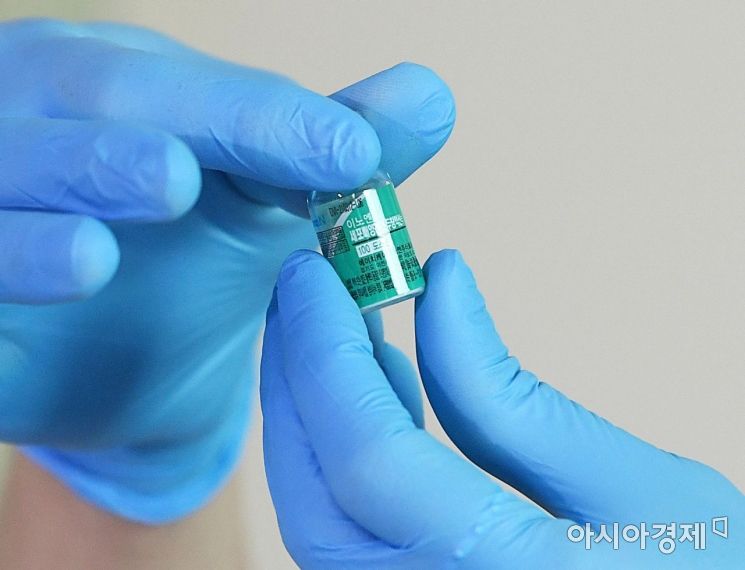
 On the 27th of last month, an official at the main building of the National Medical Center in Jung-gu, Seoul, is showing the freeze-dried monkeypox vaccine to the press. Photo by Moon Honam munonam@
[Asia Economy Reporter Moon Hyewon] With the domestic COVID-19 outbreak shifting to an upward trend and monkeypox spreading globally, health authorities are on high alert.
On the 3rd, the Central Disease Control Headquarters announced 10,059 new confirmed cases, maintaining over 10,000 cases following the previous day's 10,715.
The number of new confirmed cases had remained below 10,000 since the 10th of last month (9,310 cases), but the decline in the outbreak gradually slowed, and on the 29th of last month (10,455 cases), it rose above 10,000 again.
The trend in the reproduction number also indicates a rebound in the COVID-19 outbreak. The reproduction number quantifies how many people one infected person transmits the virus to; a value above 1 indicates outbreak expansion, while below 1 indicates containment.
Until the 4th week of last month (19th?25th), the reproduction number remained below 1 for 13 consecutive weeks but rose to 1.0 on the 28th of last month. The government explained, "This means the COVID-19 outbreak has shifted from a declining to an increasing trend."
Despite a high vaccination rate (87% for the second dose as of the 30th of last month), immunity acquired through large-scale natural infections during the Omicron variant pandemic is gradually waning, leading to a tendency for confirmed cases to rise again.
Professor Choi Jae-wook of the Department of Preventive Medicine at Korea University College of Medicine said, "It is clear that there is a risk of a resurgence currently. We need to carefully monitor the situation." He added, "COVID-19 vaccines are not completely ineffective; they prevent severe illness, but they seem unable to prevent reinfection. Measures to protect high-risk groups such as the elderly and immunocompromised are necessary, and the timing of additional vaccinations should be considered."
The number of imported COVID-19 cases among new domestic confirmed cases continues to increase. Since the 24th of last month (113 cases), imported cases have been recorded at over 100 per day. On that day, 191 cases were reported.
The increase in overseas arrivals could lead to concerns about the spread of monkeypox. Since a Korean national who entered the country on the 21st of last month was confirmed as the first domestic monkeypox case, no additional transmission cases have been identified, but authorities remain vigilant about the possibility of monkeypox importation.
The World Health Organization (WHO) reported on the 2nd that over 4,500 monkeypox cases have been confirmed in 31 countries worldwide, with more than 90% occurring in Europe, where cases have tripled in two weeks.
Health authorities emphasized that because monkeypox has a long incubation period of 21 days and symptoms such as fever and rash make surveillance difficult, voluntary reporting is very important, urging anyone with suspicious symptoms to report immediately.
© The Asia Business Daily(www.asiae.co.kr). All rights reserved.

















