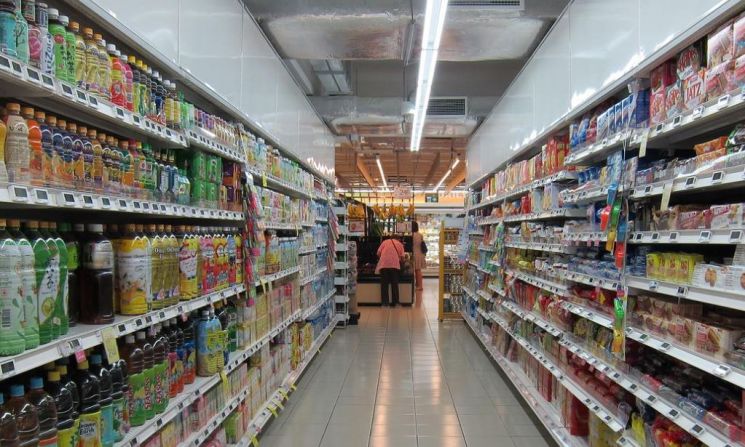
 Shrinkflation is spreading worldwide. The photo is not related to any specific expression in this article. [Image source=Pixabay]
[Asia Economy Reporter Hwang Sumi] The global economy is freezing due to a tsunami of soaring prices. Inflation in the Eurozone hit a record high last month, and South Korea's consumer price inflation rate for June is also expected to exceed 6%. In addition, the spread of shrinkflation?where companies reduce quantity instead of raising product prices?is raising concerns about the cost of living.
According to recent AFP reports, Eurostat, the statistical office of the European Union (EU), announced that the consumer price inflation rate for June in the 19 countries using the euro soared to 8.6%, marking the highest level since records began. On the 12th of last month, the Organisation for Economic Co-operation and Development (OECD) reported that consumer prices in its 38 member countries rose by a staggering 9.2% in April alone, the highest increase in 34 years since September 1998 (9.3%). The inflation rate gradually increased from 7.8% in February, when Russia invaded Ukraine, to 8.8% in March and 9.2% in April.
South Korea's situation is no different. The consumer price inflation rate in May was 5.4%, the highest in 13 years and 9 months since August 2008 (5.6%). Furthermore, the inflation rate for June, to be announced on the 5th, is expected to be even higher. Experts widely predict that the June inflation rate has exceeded 6%. Additionally, inflationary pressures on consumer prices are likely to intensify further in July and August, when electricity and gas rates rise and demand for Chuseok seasonal goods surges.
The biggest cause of rising prices worldwide is attributed to Russia's invasion of Ukraine. The prolonged war has caused international raw material prices such as crude oil and grains to soar, shaking the global economy.
In this era of high inflation, companies face rising production and labor costs. There are also concerns about weakened consumer purchasing sentiment. As a result, shrinkflation appears to be spreading worldwide. Companies resort to tricks such as reducing quantity or number instead of raising prices.
Shrinkflation is a compound word combining "shrink," meaning to reduce size or quantity, and "inflation," meaning price increase. According to Bloomberg News, this phenomenon has long been adopted by companies to protect profits but is recently gaining popularity again due to rising prices and other factors.
On the 8th of last month (local time), AP News reported that Kleenex, a U.S. toilet paper manufacturer, reduced the number of tissues in a small box from 65 sheets to 60 sheets. The capacity of Chobani Flip yogurt, a favorite among Americans, was reduced from 157 ml to 133 ml. In the UK, Nestl?'s Azera Americano coffee can shrank from 100 ml to 90 ml. In Australia, famous brands like Oreo have also reduced quantities while keeping prices the same.
In India, a bar of Vim dishwashing soap shrank from 155 g to 135 g. According to local media Mint on the 28th of last month, India's fast-moving consumer goods (FMCG) companies are adopting a strategy of reducing pack sizes instead of direct price increases in response to soaring prices. Shrinkflation in India is known to be mainly practiced in rural areas where poorer people are more sensitive to price changes. Japanese snack manufacturer Garubi announced last month that due to a sharp rise in raw material prices, it would reduce the quantity of many products by 10% and raise prices by 10%.
This phenomenon has also occurred in South Korea. The so-called "nitrogen snack" controversy that erupted in 2014 is a representative case. Nitrogen snacks refer to snacks with excessively little content compared to the size of the packaging. To preserve snacks for a long time, nitrogen is filled inside the bag, causing the packaging to puff up, which led to the term nitrogen snack. The snack industry is said to have lowered costs and maintained prices by filling nitrogen instead of snacks since the foreign exchange crisis. Although the quantity of snacks decreased, sales were not significantly affected because they were sold at the same price. Thus, nitrogen snacks became an emergency manual for the snack industry to survive during recessions. However, consumers were outraged by this corporate behavior. At that time, two university students dissatisfied with nitrogen snacks made headlines by crossing the Han River on a raft made of about 60 domestic snack packages, criticizing food companies' excessive packaging.
Through shrinkflation, where quantity is reduced while maintaining prices, companies can reduce costs. Also, to avoid consumer backlash or resistance to price increases, more companies are adopting such tricks. Shrinkflation is not just about maintaining corporate profits but can also lead to significant profit generation.
The problem is that from the consumer's perspective, this phenomenon is equivalent to a price increase. When inflation is high and shrinkflation becomes widespread, low-income households, which are greatly affected by the cost of living, may suffer. Another issue is that it is difficult for consumers to accurately grasp the cleverly reduced product quantities. Once product sizes are reduced, they tend to remain that way.
Experts point out that companies deceive consumers to earn more money and use supply restrictions as a weapon. They also advise strengthening companies' labeling obligations so that consumers can examine products more carefully and make informed purchases.
© The Asia Business Daily(www.asiae.co.kr). All rights reserved.
![Clutching a Stolen Dior Bag, Saying "I Hate Being Poor but Real"... The Grotesque Con of a "Human Knockoff" [Slate]](https://cwcontent.asiae.co.kr/asiaresize/183/2026021902243444107_1771435474.jpg)
















