KCCI Survey on Regulatory Innovation Tasks Desired by Companies
Key Tasks to be Addressed by the Current Government
Proposal of 100 Tasks in 6 Major Areas
[Asia Economy Reporter Jeong Dong-hoon] The Korea Chamber of Commerce and Industry (KCCI) has proposed "100 Regulatory Innovation Tasks Desired by Companies" to the government ahead of the government's full-scale regulatory innovation drive.
KCCI announced on the 3rd that it delivered the "Regulatory Innovation Tasks Desired by Companies" to the government. The proposal includes regulatory innovation tasks discovered through the private regulatory sandbox support center and KCCI communication platform, as well as tasks received from member companies and 72 local chambers of commerce.
This proposal selected 100 tasks across six key areas?new industries, on-site difficulties, environment, location, health and medical care, and general management?considering the core fields of the recently announced "Economic Regulatory Innovation Task Force." Given the government's announcement of bold regulatory innovation, KCCI requested prompt review and improvement of the regulatory innovation tasks desired by companies.
KCCI explained the background of this proposal, stating, "Regulations are perceived by companies not just as something 'better if absent' but as a 'noose tightening their necks immediately.' This means conveying the desperate situations of companies struggling due to regulations to the government and urging the promotion of regulatory innovation that can relieve companies' constraints."
100 Tasks in 6 Key Areas: New Industries, On-site Difficulties, Environment
KCCI classified the regulatory innovation tasks that the government should pursue into six major areas to achieve comprehensive regulatory innovation that companies in all sectors can feel.
First, it called for regulatory innovation in the new industry sector, which is in the blind spot of legal systems. The proposal included 26 regulatory innovation tasks related to new industries and new technologies such as AI, robots, drones, eco-friendly new technologies, hydrogen economy, sharing economy, and mobility. Among these are tasks approved through the regulatory sandbox that require proactive follow-up legal revisions due to their significant socio-economic impact or verified safety.
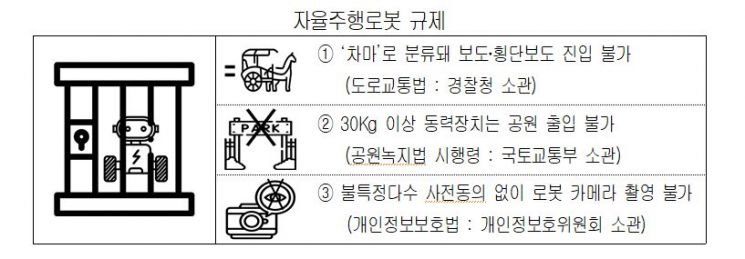
Regulations in new industries often remain under outdated legal systems and involve multiple ministries. For example, autonomous driving robots have been activated in advanced countries like the U.S. and the U.K., surpassing a global market size of 2 trillion KRW, but cannot freely operate domestically. They are classified as 'chama' (horse-drawn vehicles) under the Road Traffic Act enacted in the 1960s, prohibiting entry onto sidewalks and crosswalks; access to parks is restricted under the Park and Green Space Act; and AI learning and robot camera video recording for collision prevention are limited under the Personal Information Protection Act. Similarly, wireless charging technology for electric vehicles using radio waves cannot be commercialized due to the absence of related standards under the Radio Act, Electrical Appliances Safety Control Act, and Automobile Management Act. Both technologies are currently operated only as pilot projects through the regulatory sandbox.
KCCI explained that to prevent companies from falling behind in global competition due to inability to enter innovative industries, a cross-ministerial effort is needed to close regulatory loopholes that fail to reflect changes in new technologies and services.
Investment Difficulties and Regulatory Issues in CCU, etc. Must Be Resolved
Second, KCCI proposed resolving regulatory difficulties faced by companies on the ground. The proposal included 12 tasks related to investment difficulties caused by various regulations, institutional deficiencies, and delays in permits and approvals, including issues in carbon capture utilization (CCU) technology, flammable high-pressure gas storage facilities, and vapor liquefaction technology.
The representative task is the commercialization of carbon capture utilization (CCU) technology. CCU captures carbon dioxide emitted from factories and utilizes it. Technologies have been developed to produce cement raw materials through chemical reactions between captured carbon dioxide and industrial by-products, but these are classified as waste recycling businesses under the existing industrial classification system, limiting permit acquisition and commercialization. Additionally, some industrial by-products used in this technology cannot be recycled under current laws, requiring exceptional application.
The proposal also included 10 environmental regulatory innovation tasks that, although introduced to respond to climate and environmental changes, have become burdensome to companies or fail to support eco-friendly technologies. Specifically, it suggested easing corporate burdens by simplifying the registration of research and development substances and supplementing the system by establishing standards for pyrolysis oil products from waste plastics.
Currently, importing one research and development substance requires submitting separate administrative documents to different management agencies under three laws (Chemical Substances Control Act, Chemical Substances Registration and Evaluation Act, Industrial Safety and Health Act). The proposal calls for unifying this process to reduce administrative burdens on companies and establishing separate manufacturing standards suitable for products using eco-friendly pyrolysis oil from waste plastics.
Next, KCCI requested improvement of 11 location-related regulations, such as industrial complex residency. It particularly suggested flexible application of industrial complex residency requirements to promote investment in new industries.
If a company developing an industrial complex wants to change the original development purpose and invest in new business areas like secondary battery materials through subsidiaries, there are restrictions on land disposal. According to the Industrial Location Act, the project operator can dispose of land and facilities only after five years from the factory establishment completion report, and leasing is limited to cooperative companies for joint product manufacturing and research and development, making it difficult to pursue new businesses requiring rapid investment.
KCCI also requested improvement of five regulations related to health and medical care. Although conflicts among stakeholders over telemedicine, medicine delivery, and medical data utilization have long remained unresolved, regulatory innovation is necessary considering companies that have commercialized innovative medical platforms and citizens who cannot benefit from medical services.
For example, telemedicine is permitted in all G7 countries and 32 out of 38 OECD countries, but it is basically prohibited domestically. About 5.5 million telemedicine consultations were conducted under temporary allowances during COVID-19, but it will become impossible again as the national crisis alert level lowers. With increasing demand for telemedicine using ICT technologies such as AI and smart medical devices, discussions on regulatory innovation are now necessary.
The proposal also included 36 regulatory innovation tasks covering overall corporate management areas such as taxation, labor, fair trade, and industrial safety. Specifically, it suggested comprehensive review and improvement of regulations restricting corporate management, including resolving double taxation on dividend income, improving working hour systems, enhancing support systems for U-turn companies, and eliminating overlapping safety regulations at workplaces.
Double taxation on dividend income is a representative tax-related regulation. Currently, domestic companies receiving dividends from subsidiaries are exempt from taxation on the entire dividend only if the subsidiary's shareholding is 100%; otherwise, only 30-50% is exempt depending on the shareholding ratio. KCCI proposed amending the Corporate Tax Act to exempt the entire dividend from taxation regardless of shareholding ratio, as in the U.K., to enable distribution of retained earnings to parent companies and promote corporate investment.
Urgent Resolution of Tasks Possible Through Subordinate Legislation Amendments
KCCI emphasized, "Unlike legislative amendments requiring parliamentary cooperation, tasks that can be improved through amendments to subordinate legislation such as enforcement decrees and enforcement rules should be resolved promptly," and called for visible regulatory innovation achievements by separately identifying immediately improvable tasks.
One representative proposal was to expand the scope of national strategic technologies. Currently, national strategic technologies are limited to semiconductors, secondary batteries, and vaccines, but reflecting the latest technology trends, the scope should be expanded to fields such as 'D.N.A (Data, Network, AI)' and tax support strengthened to strategically foster related industries. It also proposed recognizing intelligent semiconductors, which add computing functions to existing semiconductors, as next-generation memory semiconductors under national strategic technologies.
Other tasks selected for immediate improvement include 'automotive wireless updates (OTA),' 'expansion of greenhouse gas emission offset credits in the emissions trading system,' and 'realistic standards for pyrolysis oil products from waste plastics.'
Meanwhile, KCCI announced plans to open and operate a "Regulatory Innovation Hotline" through 72 chambers of commerce nationwide to continuously discover and propose on-site difficulties of local companies. Utilizing KCCI's regional network, dedicated regulatory innovation staff will be assigned to each local chamber to regularly identify on-site difficulties and proposal tasks from companies and channel them to the government.
Kang Seok-gu, head of KCCI's Research Headquarters, said, "KCCI plans to continuously discover regulations and voice improvement measures through various communication channels with members, such as the nationwide chambers' regulatory innovation hotline." He added, "In the short term, we will focus on resolving company-specific proposals and regulatory innovation tasks, but in the long term, we must move away from fixing individual regulations one by one and boldly abolish and consolidate numerous unreasonable or non-functional regulatory laws."
© The Asia Business Daily(www.asiae.co.kr). All rights reserved.
![Clutching a Stolen Dior Bag, Saying "I Hate Being Poor but Real"... The Grotesque Con of a "Human Knockoff" [Slate]](https://cwcontent.asiae.co.kr/asiaresize/183/2026021902243444107_1771435474.jpg)











