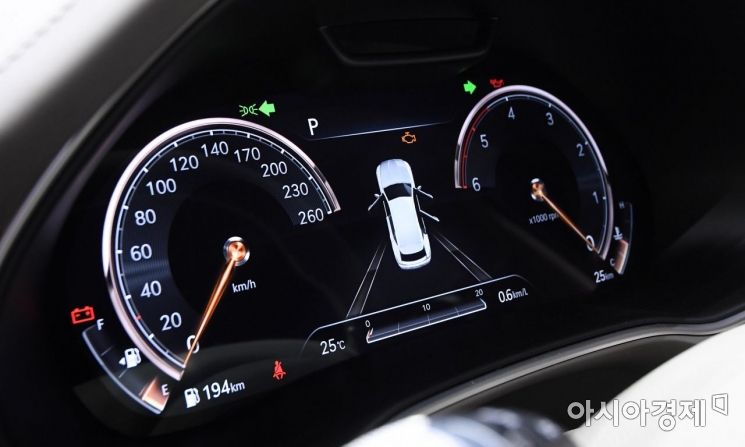
 Genesis's first SUV GV80 driver's instrument panel. It is a digital display with 3D technology, produced by the German parts manufacturer Continental. Hyundai and Kia use mostly displays from their affiliate Hyundai Mobis for their finished vehicles, but foreign products are used for some models. / Goyang=Photo by Kim Hyunmin kimhyun81@
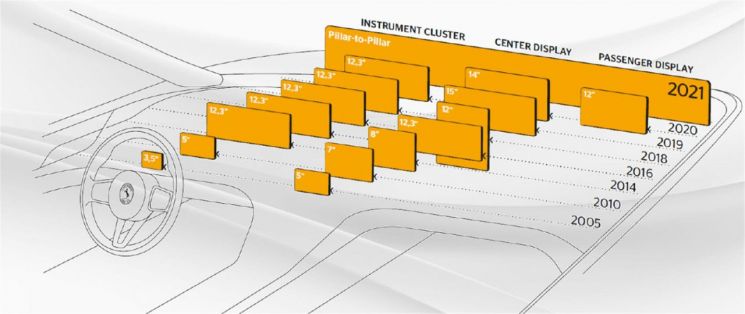
[Asia Economy Reporter Choi Dae-yeol] Until the early 2000s, the presence of displays inside cars was almost nonexistent. To know the speed or engine RPM on the driver's instrument panel, one had to watch the actual needle movement, and the rest were identified by indicator lights. The screen, about the size of a finger joint, that showed audio information was embarrassingly small to be called a display by today's standards.
Around 2005, a screen about 5 inches in size began to be placed between the driver and passenger seats. It mainly provided audio, video, and navigation information. In some high-end brand models, a small digital screen of about 3.5 inches was used in the driver's instrument panel alongside the existing analog system.
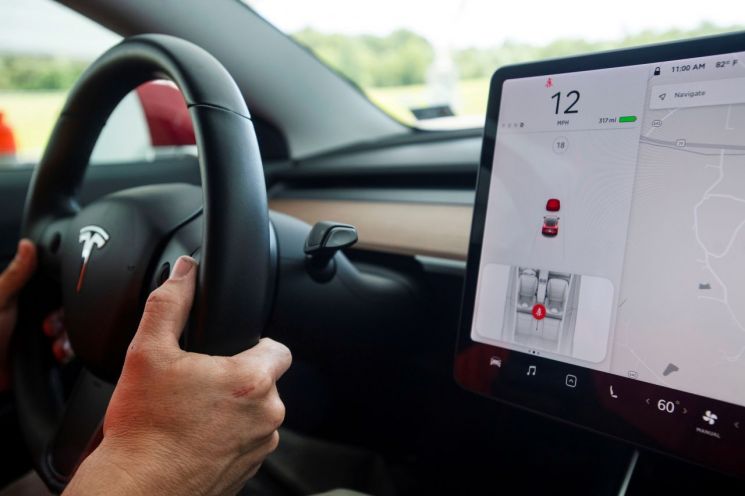
The gradually growing vehicle displays completely changed their status with Tesla's "unconventional play." Tesla cars placed a large 17-inch display, about the size of a tablet PC or small monitor, in the center of the vehicle, sometimes removing the instrument panel entirely and installing only a large central display.
The significantly enlarged display influenced not only the interior but also the overall impression of the vehicle. Vehicle interiors became more complex and diverse, and the display took on the role of controlling these functions. Tesla's approach is called unconventional because traditional automakers were hesitant to boldly apply large displays.
Jang Won-sik, Director at Continental Automotive Korea, said, "Panel prices have dropped and connectivity technology has advanced, so display screens have grown compared to the past, but the effective size in the driver's seat was realistically expected to be up to about 12 inches," adding, "As autonomous driving technology develops, displays will be needed not only in the front but also on the sides, rear, and throughout the interior."
The unique characteristics of the Chinese automotive market also contributed to the enlargement of displays. Chinese automakers, criticized for relatively lagging internal combustion engine technology, focused early on electrification, which led to larger displays inside vehicles. Global automakers release long-wheelbase (LWB) models with extended front and rear lengths specifically for the Chinese market. The recent rapid increase in display size aligns with Chinese consumers' preference for flashy exterior appearances, according to industry insiders.
Competition among companies has intensified. Shytech, a German parts supplier to Mercedes-Benz and Genesis, is considered one of the advanced technologies. This technology places the display module beneath surfaces used for interior decoration such as decorative films, cover glass, or fabric. The screen operates only when needed, and when off, it becomes part of the interior design.
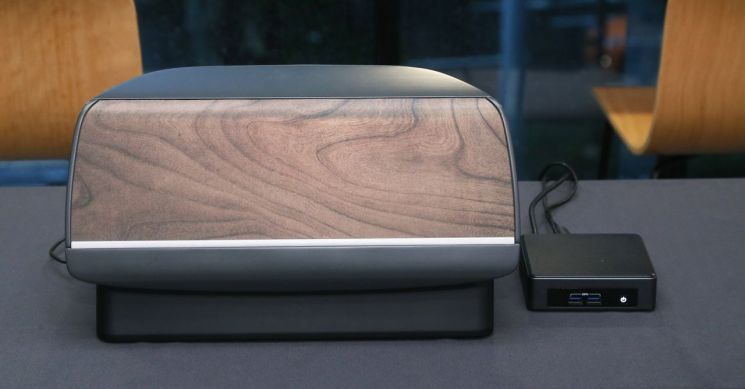
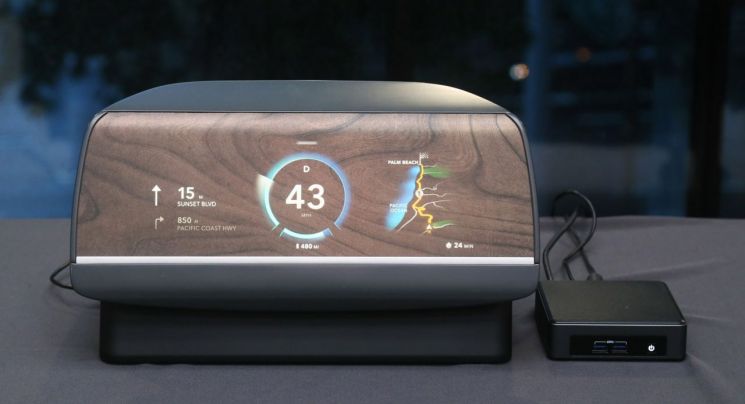 Continental Shytech Display. When the screen is off (top photo), it appears as a regular interior surface, and when turned on (bottom photo), it functions as a display.
 The advantage of this technology is that designers do not have to worry much about the larger display when designing the interior. The display surface can be designed to follow the shape of the dashboard, and in inactive mode, it can appear as decorations made of materials like wood, leather, aluminum, or carbon. Until now, automakers felt that a turned-off display detracted from the overall design, but this issue can now be resolved.
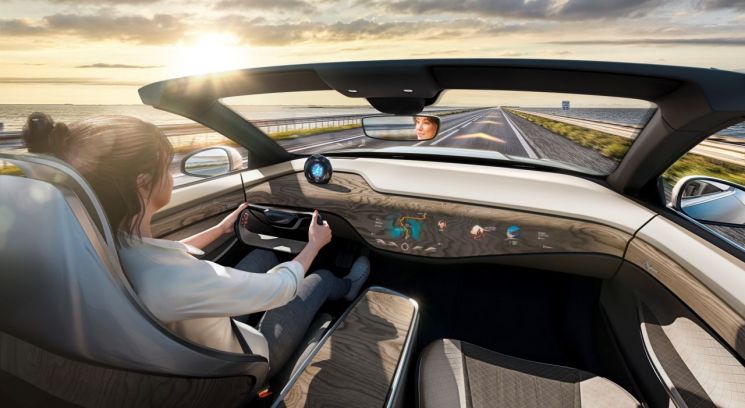 An artist's rendering of a vehicle equipped with Continental's ShyTech display technology. The technology development has been completed, and discussions are currently underway with some automakers.
 The pillar-to-pillar display method, which fills the space from one end of the front A-pillar to the opposite side, considers even the front passenger. Such a large display has a function that blocks the passenger side screen while driving for safety. Vehicles equipped with large curved displays using organic light-emitting diode (OLED) panels and displays that technically implement privacy protection so that only specific passengers can view screen information are expected to appear soon.
Director Jang said, "With the development of electrification and autonomous driving technologies, differentiation in the future automotive market will require creating an impression like a well-decorated home that delights various senses of drivers and passengers when they get in," explaining, "Displays are also being developed as solutions linked to the overall user experience inside the vehicle."
© The Asia Business Daily(www.asiae.co.kr). All rights reserved.



















