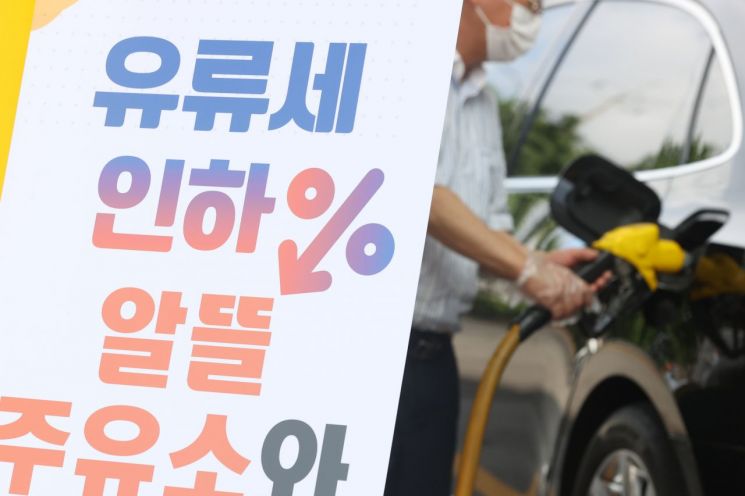
 A gas station in Seoul reflecting the additional fuel tax reduction on the 1st, where the fuel tax cut rate was expanded from 30% to 37%.
 [Image source=Yonhap News]
[Asia Economy Reporter Hwang Sumi] Amid the expansion of the fuel tax reduction from 30% to 37%, it has been found that most gas stations nationwide have yet to lower their selling prices. It is expected that it will take about 1 to 2 weeks for the measure to be fully reflected at gas stations.
On the first day of the additional fuel tax cut, the Energy and Petroleum Market Monitoring Team analyzed the prices of gasoline and diesel at 10,976 gas stations nationwide using price information from the Korea National Oil Corporation's oil price information service, Opinet, comparing them with the previous day. The results showed that about 66-67% of stations either had no change or even raised prices. Gas stations that raised prices accounted for 4.44%, while those with no price change made up 61.94%. By brand, 97% of budget-friendly gas stations receiving government financial support lowered prices by more than the fuel tax reduction amount. In contrast, the oil company S-OIL accounted for only about 5-6%.
The nationwide average gasoline price decreased by 16.02 KRW per liter compared to the previous day. With an additional 7% fuel tax cut, prices should have dropped by at least 57 KRW per liter. However, only 22% of gas stations actually reflected this reduction. Diesel showed a similar trend. On that day, the nationwide diesel price fell by 9.94 KRW per liter. Although the additional fuel tax cut should have reduced prices by 38 KRW per liter, only 22.6% of gas stations reflected this.
The industry explains that a time lag of about 1 to 2 weeks occurs before the fuel tax reduction measure is fully reflected in gas station selling prices. The industry expects domestic gasoline and diesel prices to show a downward trend next week due to this measure.
In this situation, the government announced plans to form a joint inspection team to monitor the refining industry. The Ministry of Trade, Industry and Energy stated that from the 1st, when the additional fuel tax cut was implemented, a joint market inspection team composed of related ministries will be organized and operated. To enhance the effectiveness of the fuel tax reduction measure, the team will visit gas stations nationwide at least twice a week to check refining companies' supply prices and gas stations' selling prices, focusing on cracking down on collusion and the distribution of counterfeit oil.
Meanwhile, domestic gasoline and diesel prices continued to rise for eight consecutive weeks. According to the Korea National Oil Corporation's oil price information service Opinet on the 2nd, the average gasoline selling price at gas stations nationwide for the fifth week of June (6.26?30) was 2,137.7 KRW per liter, up 21.9 KRW from the previous week. The average diesel price also increased by 31.1 KRW to 2,158.2 KRW per liter. This is attributed to the recent decline in U.S. commercial crude oil inventories and the agreement among the Group of Seven (G7) countries to pursue a price cap on Russian oil, which has led to a rise in international crude oil prices.
© The Asia Business Daily(www.asiae.co.kr). All rights reserved.

















