[Asia Economy Reporter Yoo In-ho] South Korea and the United States have stepped up pressure on North Korea through independent sanctions targeting North Korean individuals and institutions.
The two governments recently held close high-level consultations and plan to finalize independent sanctions on North Korea soon, aiming to strongly pressure the regime.
According to diplomatic sources on the 2nd, the U.S. Department of the Treasury announced that during Deputy Secretary Brian Nelson's recent visit to South Korea, they closely coordinated with the South Korean government on responses to North Korean provocations and sanctions against Russia.
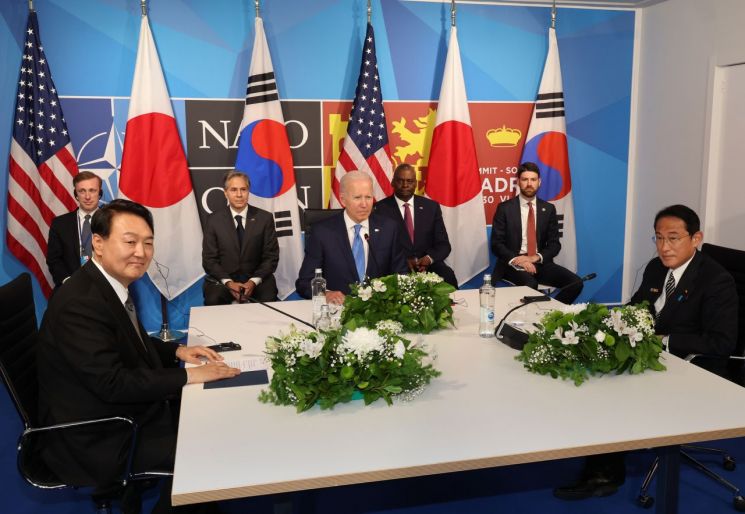
The U.S. Treasury stated on the 30th of last month (local time), "Deputy Under Secretary for Terrorism and Financial Intelligence Nelson visited Seoul from the 27th to the 29th to continue close coordination with the South Korean government regarding responses to North Korea's aggressive actions and sanctions on Russia following the invasion of Ukraine."
It added, "In recent months, the Treasury has targeted North Korea's revenue-generating activities, including sanctions on financial facilitators, procurement networks, and money laundering of cryptocurrency theft proceeds."
Furthermore, "The Treasury is working closely with South Korean officials to impose historic sanctions on Russia, including blocking access to key technologies in the defense industry," it said.
Additionally, the Treasury announced that following Deputy Secretary Nelson's visit, "Treasury Secretary Janet Yellen will visit South Korea from July 19 to 20."
Accordingly, the U.S. will further strengthen the sanctions network against North Korea in cooperation with the South Korean government. Relatedly, Advisor Sullivan stated, "The U.S. has increased the level of sanctions against North Korea over the past 18 months, and especially as North Korea continues to adjust how it generates revenue, the U.S. has been exploring new sanction targets."
He explained, "This issue will be an agenda item for substantive discussions between Secretary Yellen and South Korea's financial supervisory authorities."
In fact, the U.S. Treasury has imposed five rounds of independent sanctions against North Korea this year alone, including designating six North Korean nationals, one Russian individual, and one Russian company as Specially Designated Nationals (SDN) in response to North Korea's ballistic missile launches in January.
In April, the Treasury, along with the Department of Homeland Security and the Federal Bureau of Investigation (FBI), issued a joint cyber advisory warning of cyber threats from hacking groups supported by the North Korean government targeting blockchain companies.
Diplomatic circles are watching with interest whether the U.S. will use the secondary boycott card against China and Russia, who support North Korea.
A secondary boycott sanctions third-country companies, banks, and governments that do business with the sanctioned country, regardless of the legality of those transactions.
A representative example is the U.S. Treasury's Office of Foreign Assets Control adding Russian banks, Far East Bank and Sputnik Bank, to the sanctions list on May 27.
The U.S. has not yet imposed secondary boycott sanctions on China, but it could take such measures if North Korea conducts a nuclear test. U.S. Secretary of State Antony Blinken said at the Korea-U.S. foreign ministers' meeting press conference on the 13th of last month, "We have imposed sanctions on Russian and Chinese individuals and entities that assist North Korea's nuclear missile program," and added, "We will continue to do so."
South Korea's independent sanctions plan is likely to align with the U.S. approach. In the past, when the U.S. designated individuals and entities for independent sanctions against North Korea, South Korea, Japan, and the European Union often imposed sanctions together to enhance their effectiveness.
© The Asia Business Daily(www.asiae.co.kr). All rights reserved.

















