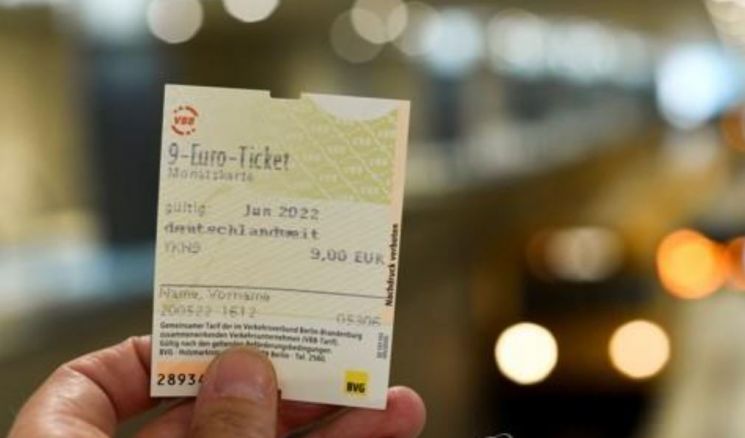
[Asia Economy Reporter Hwang Sumi] Just 9 euros (about 12,000 won). This is the price of a public transportation pass that allows unlimited travel throughout Germany for one month. The entire country is enthusiastic about this pass, introduced last month in response to rising prices caused by high oil prices.
The German government decided to introduce the "9 Euro Ticket" from the 1st of last month until August. The 9 Euro Ticket allows unlimited use of most local public transportation for just 9 euros per month. During the three months the policy is in effect, purchasing the 9 Euro Ticket grants access to public transportation such as subways, buses, and trams, excluding intercity trains (IC trains). In cities like Berlin and Hamburg, ferry rides are also included. Considering that the cheapest monthly pass in central Berlin, the capital of Germany, was previously 63 euros (about 85,000 won), this is a groundbreaking measure.
This initiative aims to address the inflation caused by Russia's invasion of Ukraine. It seeks to reduce the living expenses of German citizens burdened by soaring fuel costs. Additionally, by encouraging the use of public transportation, the government intends to reduce the number of car users, thereby saving energy and decreasing greenhouse gas emissions.
The government has allocated a budget of 2.5 billion euros (about 3.4 trillion won) to provide subsidies to railway and transportation companies that will experience revenue losses due to the ticket introduction. Furthermore, citizens who have already purchased monthly passes will receive refunds or compensation for the price difference.
Public response to the 9 Euro Ticket has been largely positive. According to the German Transport Companies Association (VDV) on the 30th of last month (local time), 21 million tickets were sold in the first month. Adding the 10 million annual pass holders, a total of 31 million tickets were sold. This means that one out of every three people in Germany purchased the ticket. The initial target of 30 million tickets has already been surpassed. The VDV also reported that preliminary surveys indicate a similar level of purchase intention for July. Moreover, overseas travelers planning to visit Germany this summer are expected to show great interest in this ticket.
Since the ticket's introduction, traffic congestion has also decreased. According to Yonhap News Agency, traffic data specialist TomTom analyzed 26 cities nationwide at the request of the German news agency DPA and found that traffic congestion levels decreased in 23 cities compared to before the 9 Euro Ticket was introduced. Additionally, commuting times for car users were reduced in most of the surveyed cities.
However, some concerns have been raised. In the case of subways, the number of trains in operation has not increased significantly compared to the number of tickets sold. This has caused inconvenience for passengers who missed their trains, while railway workers complain that the sudden increase in passengers is difficult to manage. Contrary to the government's intentions, there is a possibility that citizens, frustrated with overcrowded buses and subways, may return to using cars after three months. There are also concerns that public transportation fares may rise sharply once the 9 Euro Ticket program ends.
Meanwhile, the United States has also introduced public transportation discount policies. Metra, one of the largest commuter train operators in the U.S., announced on the 1st of last month the launch of a monthly pass called "Super Saver," priced at $100 (about 125,000 won), allowing unlimited train rides regardless of distance. Earlier, Metro-North Railroad (MNR), based in the New York metropolitan area, also offered promotional products such as 20% discount tickets. These measures aim to recover the number of passengers that sharply declined during the COVID-19 pandemic and to respond to soaring gasoline prices caused by the Ukraine crisis.
© The Asia Business Daily(www.asiae.co.kr). All rights reserved.
![Clutching a Stolen Dior Bag, Saying "I Hate Being Poor but Real"... The Grotesque Con of a "Human Knockoff" [Slate]](https://cwcontent.asiae.co.kr/asiaresize/183/2026021902243444107_1771435474.jpg)
















