[Asia Economy Reporter Jeong Dong-hoon] As domestic shipbuilders take the lead in the global shipbuilding market with eco-friendly LNG (liquefied natural gas) vessels, collaboration and contract orders are increasing to advance in the defense sector.
According to the industry on the 1st, Korea Shipbuilding & Offshore Engineering recently signed a construction contract with the Philippine Department of National Defense for six 2,400-ton offshore patrol vessels. The total contract is worth 744.9 billion KRW. The offshore patrol vessels have a displacement of 2,400 tons, a length of 94.4 meters, a width of 14.3 meters, a maximum speed of 22 knots, and a cruising speed of 15 knots. They will be built at Hyundai Heavy Industries in Ulsan and delivered by 2028. Notably, with a cruising range of 5,500 nautical miles (11,900 km), they can conduct long-duration operations and are equipped with one naval gun. They feature a helideck capable of operating helicopters and unmanned aerial vehicles.
Hyundai Heavy Industries secured the customized contract by reflecting the Philippine side’s requirements based on its experience in building and delivering frigates to the Philippines. Starting with this offshore patrol vessel order, the company plans to actively explore overseas markets in the naval vessel sector.
They have also set a goal to achieve annual sales of 2 trillion KRW in the naval vessel sector by 2030, doubling the current scale. Through this, they aspire to become a ‘global top-class naval solution partner’ encompassing naval vessel design, construction, and lifecycle management services.
Hyundai Heavy Industries’ corporate research institute is currently researching ‘improving survivability by reducing the hit probability of surface ships (warships floating on water).’ They are also conducting research to enhance ship survivability by applying metamaterial (artificial materials with properties not found in nature) electromagnetic wave absorbers.
In the case of Daewoo Shipbuilding & Marine Engineering, they are collaborating with the UK’s Babcock, which has participated in the design and construction of world-class naval vessels including the British aircraft carrier HMS Queen Elizabeth. Their strategy is to secure core technologies necessary for future naval vessel projects through a specialized defense company with top-level competitiveness in developing key equipment for surface ships and submarines. Based on this, they have entered the competition to secure an order for a 1,400-ton submarine to be used by the newly established Philippine Navy submarine unit. This project is worth 1.75 trillion KRW and is competing against France’s Naval Group.
The defense industry and naval vessel sector account for about 10% of shipbuilders’ sales. Although smaller compared to other sales such as container ships and bulk carriers, it has the advantage of relatively stable revenue generation and large-scale orders that are less affected by economic cycles. This is the background for shipbuilders’ efforts to establish global competitiveness in the defense industry sector as well.
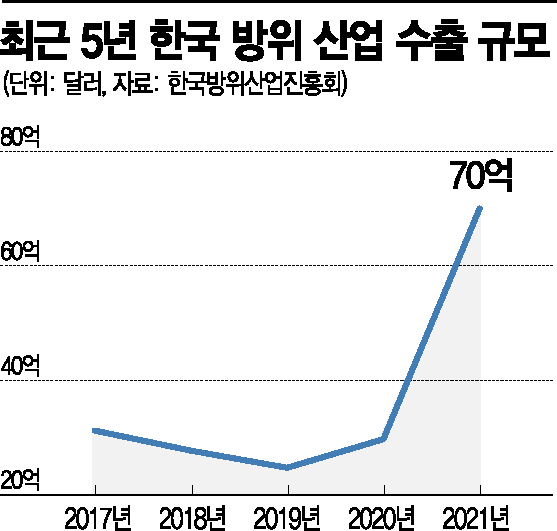
According to the Korea Defense Industry Association, Korea’s defense exports last year amounted to 7 billion USD (about 9.1 trillion KRW), ranking 6th in the world. Considering that it was 2.56 billion USD (about 3.33 trillion KRW) five years ago, this represents nearly a threefold growth. Among this, the naval vessel sector is known to be at the 2 trillion KRW level.
© The Asia Business Daily(www.asiae.co.kr). All rights reserved.

















