[Asia Economy New York=Special Correspondent Joselgina, Reporters Byunghee Park, Hyunjung Kim] "The upcoming crisis will not be like before. We are heading toward a crisis that combines 1970s-style stagflation and the 2008-style financial debt crisis."
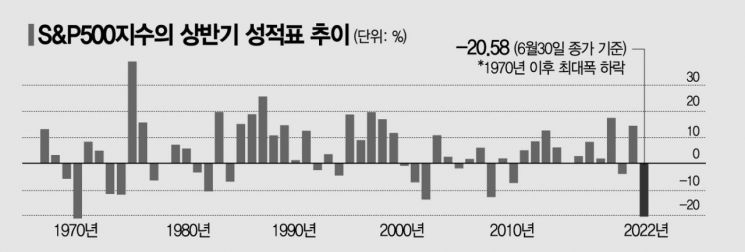
On the 30th (local time), when fears of an economic recession caused the U.S. stock market to close the worst first half in 52 years, the warning message from 'Dr. Doom' Nouriel Roubini, a professor at New York University, was ominous. This was partly because there was also an analysis that the U.S. Gross Domestic Product (GDP) could enter a 'technical recession' by declining for two consecutive quarters. There are also repeated analyses that the stock market, which has fallen double digits over the past six months, has not yet hit bottom.
◇Will U.S. Q2 Growth Rate Turn Negative?
GDPNow, a real-time GDP tracker by the Federal Reserve Bank of Atlanta, forecasted on the day that the U.S. Q2 GDP growth rate would record an annualized -1.0%. This is the first time it has dropped into negative territory since the 0.3% recorded on the 27th.
If this continues, a 'technical recession'?meaning two consecutive quarters of negative growth following Q1's -1.6%?could become a reality. On the same day, S&P Global Market Intelligence also revised down its Q2 GDP forecast to an annualized 1.5% decline. S&P has lowered its GDP forecasts twice just this week.
It is also confirmed that consumer spending, which accounts for 70% of U.S. GDP, has already slowed. The U.S. Department of Commerce announced that personal consumption in May increased by only 0.2% compared to the previous month. In particular, real personal consumption adjusted for inflation decreased by 0.4%. This is the first decline in real personal consumption this year. Lindsay Piesza, Chief Economist at Stifel Financial, expressed concern, saying, "There are clear signs that consumer spending, the backbone of the U.S. economy, is slowing down."
Professor Roubini, who accurately predicted the 2008 global financial crisis, also raised the possibility of a so-called 'stagflationary debt crisis' through Project Syndicate on the same day. He warned that the next economic crisis would be a combination of the 1970s stagflation, the debt crisis, and the 2008-style deflation.
He particularly pointed out that soaring inflation and central banks' tightening measures are not only a U.S. phenomenon but a global one, which "increases the possibility of simultaneous global economic recessions," according to Professor Roubini's diagnosis.
◇Pessimism Spreads in the Stock Market... Where Is the Safe Haven?
As fears of recession rise, pessimism is spreading in the stock market.
Deutsche Bank revealed that over 70% of survey respondents expected the S&P 500 index, currently at 3700, to fall to around 3300. George Ball, Chairman of Sanders Morris Harris, said, "The market has not yet hit bottom. We will see a bigger decline ahead," forecasting that the S&P 500 could drop to around 3100.
Markets that experienced large declines in the first half of the year typically tend to recover in the second half. According to Dow Jones Market, in years when the S&P 500 fell more than 15% in the first half?such as 1932, 1939, 1940, 1962, and 1970?the index rose an average of 24% in the second half.
However, considering the Federal Reserve's rate hikes and stock price trends, the outlook for the second half is not very optimistic. According to research by the Federal Reserve Bank of St. Louis, the U.S. economy entered a recession in 4 out of 6 instances when the Fed raised interest rates. Lauren Goodwin, a strategist at New York Life Investments, described the Fed's soft-landing management runway as "not only narrow but also winding and bumpy."
Investors are seeking safe havens to withstand the bear market. Jim Rogers, Chairman of Rogers Holdings and regarded as an investment guru, recently said, "There is no safe place," but named silver and agricultural stocks as low-risk investment options for the next 2 to 3 years. However, he also emphasized that it is not yet the time to buy. His explanation is that in a bear market, everything tends to collapse.
Seth Klarman, CEO of Baupost Group, identified gold as a safe haven. He also stated that the dollar's strength is expected to continue for the time being. Investment bank UBS highlighted energy and materials stocks benefiting from rising oil prices, along with financials, real estate, and telecommunications services. Investment bank Bernstein focused on the sharply fallen tech stocks, recommending Apple, IBM, Dell, and Hewlett Packard Enterprise. CNBC mentioned AutoZone and Dollar Tree as stocks that performed well in previous recessions.
© The Asia Business Daily(www.asiae.co.kr). All rights reserved.
![Clutching a Stolen Dior Bag, Saying "I Hate Being Poor but Real"... The Grotesque Con of a "Human Knockoff" [Slate]](https://cwcontent.asiae.co.kr/asiaresize/183/2026021902243444107_1771435474.jpg)
















