Focus on 'Establishing' Safety Systems Until Mid-Year
From July 1, Detailed Scrutiny of 'Compliance' for Prosecution
Investigation Intensity Increases as Half a Year Passes Since Law Enforcement
Corporate Burden Likely to Grow... "Field Confusion Remains"
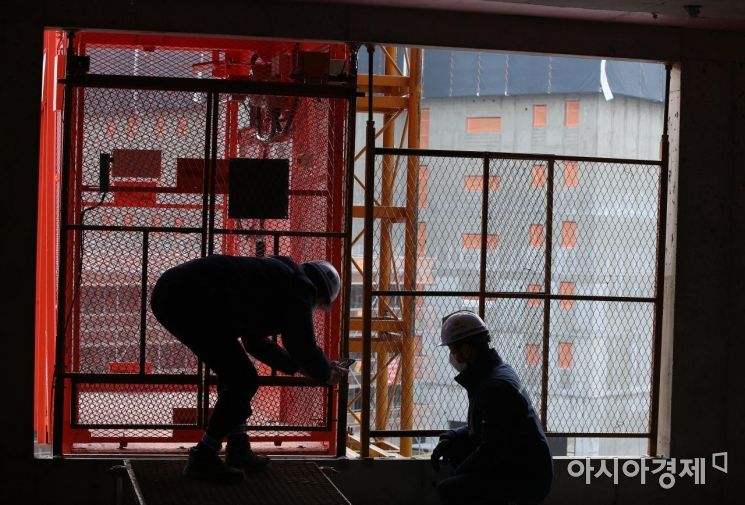 Managers are conducting a safety inspection at an apartment construction site in Gyeonggi-do. Photo by Hyunmin Kim kimhyun81@
From the 1st, companies where serious accidents such as worker fatalities occur will face an increased likelihood of prosecution for violating the Serious Accidents Punishment Act. This is because, starting in the second half of the year, the Ministry of Employment and Labor and the prosecution have established a policy to meticulously verify not only the 'establishment' but also the 'implementation' of companies' safety and health management systems before prosecuting. Amid ongoing legal uncertainties, the management burden on companies is also expected to intensify.
According to the Ministry of Employment and Labor and labor circles, labor inspectors and prosecutors investigating serious accidents in companies will strengthen investigations into whether safety obligations have been fulfilled for accidents occurring from this day forward. A ministry official stated, "Until the first half of the year, investigations mainly focused on whether safety and health management systems were established, but from the second half, they will examine whether those systems are actually functioning on site," adding, "This represents a different dimension."
According to the enforcement decree of the Serious Accidents Punishment Act, business managers of companies must inspect seven mandatory items?including compliance with the Industrial Safety and Health Act, improvement of risk factors, and collection of workers' opinions?at least once every six months and take necessary measures. After the Act's enforcement at the end of January, the government judged that it was difficult to consider that companies had an obligation to implement such measures until the first half-year (June), so it only reflected this as a reference in investigations and prosecutions.
However, from this day forward, as investigations by the Ministry of Employment and Labor and prosecutors expand to focus on implementation, there is an analysis that the number of companies prosecuted under the Serious Accidents Punishment Act could significantly increase from the second half of the year. For example, the CEO of Daeheung R&T was investigated under the Act in February for causing occupational diseases such as toxic infections to workers, but at the prosecution stage, the fact that the safety and health management system was 'established' was recognized, and he was only prosecuted without detention for violating the Industrial Safety and Health Act. The Ministry of Employment and Labor believes that if the accident had occurred after July, Daeheung R&T would have been naturally prosecuted for violating the Serious Accidents Punishment Act.
In the business community, there are criticisms that strengthening investigations is inappropriate while the government and ruling party acknowledge the problems of the Serious Accidents Punishment Act and are pursuing improvements. Since confusion among small and medium-sized enterprises has already increased after the law's enforcement, priority should be given to legal amendments. The business community has consistently pointed out that the criteria for judging what safety and health obligations business managers have implemented to prevent serious accidents are ambiguous, and that the penalties are excessive. In response, the government recently announced plans to revise the enforcement decree to clarify the obligations of business managers through the 'New Government Economic Policy Direction.'
A lawyer specializing in the Serious Accidents Punishment Act at a major law firm said, "Although five months have passed since the law was enacted, ambiguities initially pointed out as problems remain unresolved, causing significant confusion," adding, "If the law is not concretized, the discretion of investigative agencies cannot be objectified, inevitably increasing uncertainty."
© The Asia Business Daily(www.asiae.co.kr). All rights reserved.
![Clutching a Stolen Dior Bag, Saying "I Hate Being Poor but Real"... The Grotesque Con of a "Human Knockoff" [Slate]](https://cwcontent.asiae.co.kr/asiaresize/183/2026021902243444107_1771435474.jpg)
















