[Asia Economy Reporter Lim Hye-seon] On the 1st, the Ministry of Science and ICT announced the achievements in technology development and commercialization in the quantum field at the '1st Anniversary Ceremony of the Future Quantum Convergence Forum' held at the Korea Institute of Science and Technology (KIST) headquarters in celebration of '2022 Quantum Information Week.' Quantum technology is an essential national strategic technology that will lead the future era by overcoming existing limitations in semiconductor and battery performance innovation, new drug and new material development, and more. Major countries overseas recognize the importance of quantum technology and are actively promoting technology development while making efforts to link it with industry. The United States is operating the Quantum Economic Development Consortium (QEDC), which involves 170 institutions including Google, IBM, and Amazon.
The First Year of Domestic Quantum Technology Commercialization
The government is expanding investment across the entire spectrum of technology, from quantum cryptographic communication to quantum internet sensors, computers, and quantum support technologies. This year, the government will invest 81.8 billion KRW in quantum technology, a 68% increase compared to the previous year.
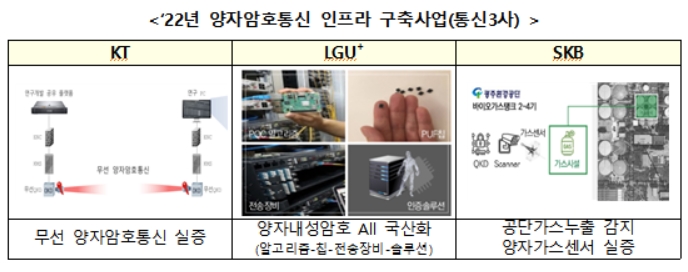
Since 2020, the government has pilot-built quantum cryptographic communication networks for 26 public and private demand institutions, including Hyundai Heavy Industries, through the 'Quantum Cryptographic Communication Infrastructure Construction Project.' Based on this experience, telecommunications companies commercialized domestic quantum technology this year. KT and SK Broadband launched dedicated quantum cryptographic communication line services on this day. Quantum cryptographic dedicated lines apply the quantum key distribution (QKD) method, which utilizes quantum properties such as uncertainty, superposition, and no-cloning, to enterprise dedicated lines. Through this commercialization, institutions and companies requiring high-level security can conveniently establish quantum cryptographic communication networks. SK Broadband expects that by launching the quantum cryptographic dedicated line product, it will be possible to provide optimal security services not only to national agencies handling state secrets but also to public and financial institutions requiring protection of personal and financial information, as well as companies needing large data transmission. Earlier, LG Uplus introduced a dedicated line service using quantum-resistant cryptography.
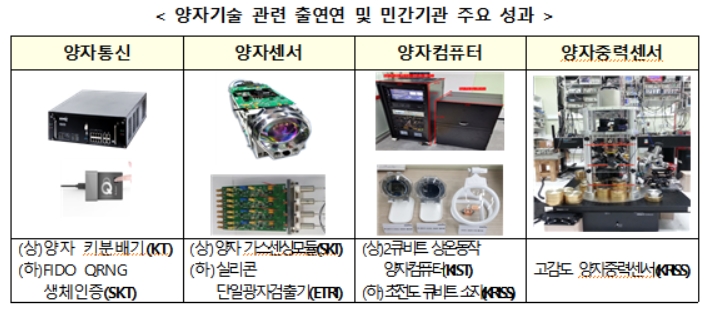
The Korea Research Institute of Standards and Science (KRISS) developed a quantum gravity sensor and has taken the first step toward commercialization by promoting full-scale demonstrations this year for precise underground resource exploration, structural diagnosis, and GPS-free navigation.
The Electronics and Telecommunications Research Institute (ETRI) and KIST are advancing quantum cryptographic communication technologies such as single-photon detectors (ETRI), wireless quantum cryptographic communication (ETRI), and 1xN quantum cryptographic communication and system technology (KIST). As the nationally designated Quantum Internet Research Institute, they are actively pursuing research on quantum internet for quantum inter-device information transmission.
The Ministry of Science and ICT also announced the development of ▲ SK Telecom's quantum random number generator chip ▲ SK Telecom's ultra-precise gas sensor ▲ KIST's room-temperature quantum computer ▲ KRISS's qubit device for superconducting computing.
1st Anniversary Future Quantum Convergence Forum "Full-Scale International Cooperation"
Launched last year with 64 institutions and 162 members, the Future Quantum Convergence Forum has expanded to 83 institutions and 316 members across industry, academia, and research. The Quantum Forum is linking quantum technology, which was concentrated in universities and research institutes, to the industry, expanding the value chain of the quantum industry's upstream and downstream ecosystems.
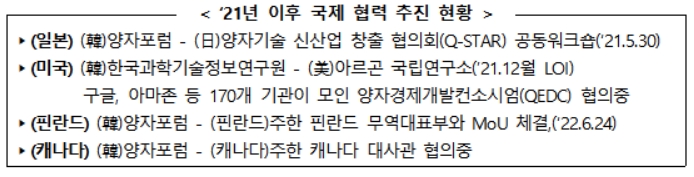
So far, the forum has discovered industrialization models linked to companies in various industries such as manufacturing, medical, pharmaceutical, and telecommunications through diversified cooperation. This year, in addition to the United States and Japan, it is actively promoting international cooperation for technology and personnel exchange with countries such as Canada and Finland. At the event, an international cooperation achievement announcement and a signing ceremony for securing international standardization were held, with participation from Canada and Finland, who are exchanging with the quantum forum and industry-academia-research institutes developing quantum technology, to discuss quantum technology industrialization plans.
The forum plans to go beyond being a platform for industry-academia-research cooperation to actively promote industry participation and play a more proactive role in technology development, industrialization, standardization, and human resource development hubs.
Minister Lee Jong-ho of the Ministry of Science and ICT said, "Since quantum technology and industry are fields where the whole world has just taken the first step, there is still an opportunity for us to write a second semiconductor growth story," adding, "I hope the Quantum Forum will serve as a bridge for organic linkage between technology development and industrialization, becoming a focal point for quantitative and qualitative growth of the quantum ecosystem through industry-academia-research collaboration."
© The Asia Business Daily(www.asiae.co.kr). All rights reserved.
![Clutching a Stolen Dior Bag, Saying "I Hate Being Poor but Real"... The Grotesque Con of a "Human Knockoff" [Slate]](https://cwcontent.asiae.co.kr/asiaresize/183/2026021902243444107_1771435474.jpg)


















