[Asia Economy Reporter Kang Nahum] Apple has decided to allow third-party payments for all Korean applications (apps) on the 'App Store.' This is the first time Apple has permitted third-party payments for all apps in a single country. However, since there is little difference from Google's third-party payment fees and methods, which have been controversial, Apple is also criticized for joining the loophole tactics to circumvent the 'Google Gapjil Prevention Act.'
◆ Apple allows third-party payments for all Korean apps = According to the industry on the 1st, Apple officially announced on its website the day before that it will allow third-party payments for Korean media content apps to comply with the amended Telecommunications Business Act (Google Gapjil Prevention Act).
Apple explained that developers can use external purchase permissions, and through this permission, they can provide alternative in-app payment processing options for apps distributed only in South Korea on the App Store.
Apple stated that if this permission is used, payments made outside the App Store's secure payment system cannot be verified, so some App Store features such as purchase requests and family sharing cannot be provided to users.
Apple added that it cannot support users regarding refunds, purchase history, subscription management, and other issues arising from purchasing digital goods and services through alternative payment methods, and that the responsibility for supporting these issues lies with the developers. At the same time, Apple required app developers to prioritize selecting one of four domestic certified electronic payment gateway companies (PG) for third-party payments: KCP, Inicis, Toss, and NiceE.
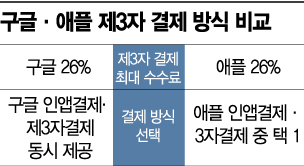
◆ Controversy over loophole tactics to circumvent domestic law continues = In particular, Apple set the commission rate for third-party payments at 26%, which is 4 percentage points lower than its own in-app payment (maximum 30%). In addition to the stated 26% commission for third-party payment methods, additional card company fees apply. This is the same method Google introduced to circumvent the Google Gapjil Prevention Act.
The difference from Google is that app developers can choose to offer either Apple's in-app payment or the third-party payment method in-app payment within the app. Google provides both Play Store in-app payment and third-party payment method in-app payment simultaneously.
In the domestic content industry, Apple is also criticized for imposing an excessive 26% commission on third-party payment methods like Google while inducing in-app payments. An industry insider said, "Even if you choose the third-party payment method, when you add payment gateway (PG) and card fees, the commission exceeds 30%, resulting in a loss," and pointed out, "It is practically no different from Apple inducing in-app payments."
The regulatory authority, the Korea Communications Commission, plans to conduct a full-scale inspection to determine whether Apple has violated laws such as forcing in-app payments. A KCC official said, "We have requested materials related to Apple's notice that some functions cannot be provided to users," and added, "We plan to closely examine whether there is discrimination between app market self-payments and third-party payments."
© The Asia Business Daily(www.asiae.co.kr). All rights reserved.
![Clutching a Stolen Dior Bag, Saying "I Hate Being Poor but Real"... The Grotesque Con of a "Human Knockoff" [Slate]](https://cwcontent.asiae.co.kr/asiaresize/183/2026021902243444107_1771435474.jpg)
















