On the 30th of last month, a post circulated in a real estate investor community stating, "Today, investors in Seoul are flocking to Daegu by KTX and SRT trains, signing direct contracts for one property each," along with a screenshot showing that train tickets to Dongdaegu were sold out. This came right after the Ministry of Land, Infrastructure and Transport held a Residential Policy Deliberation Committee meeting and decided to partially lift regulations such as Speculative Overheated Districts and Adjustment Target Areas, mainly in provincial regions where recent housing price increases have been relatively low and unsold properties have been rising.
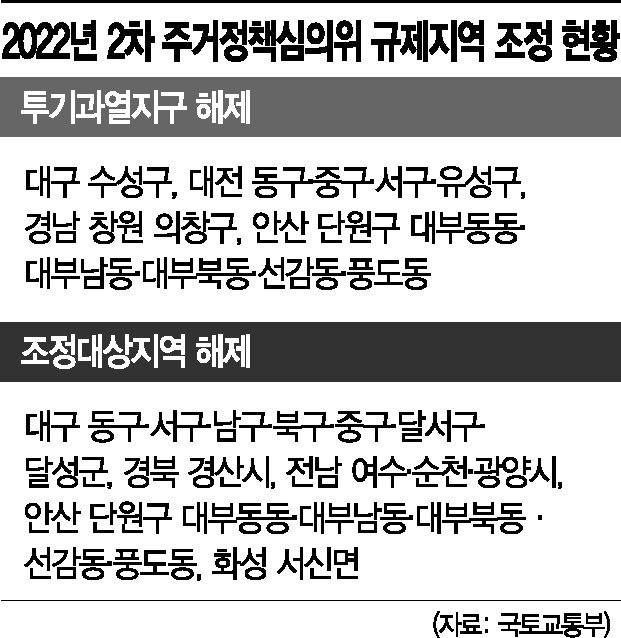
According to this measure, six areas including Suseong-gu in Daegu, Dong-gu, Jung-gu, Seo-gu, and Yuseong-gu in Daejeon, and Uichang-gu in Changwon, Gyeongnam, were removed from the Speculative Overheated District designation. Eleven areas including Dong-gu, Seo-gu, Nam-gu, Buk-gu, Jung-gu, Dalseo-gu, and Dalseong-gun in Daegu, Gyeongsan-si in Gyeongbuk, and Yeosu, Suncheon, and Gwangyang-si in Jeonnam were removed from the Adjustment Target Areas, becoming non-regulated areas. Sejong City, where housing prices have been declining since June last year, and the metropolitan area decided to maintain existing regulated areas. This measure will take effect from the 5th of this month. Daegu was the first to react to the news of deregulation. According to the real estate big data platform Asil, on the day the deregulation was announced, the number of apartment listings in Daegu was 32,247, a 1.32% decrease compared to the previous day (32,679).
However, the market views the deregulation measures applied only to some areas this time as having a limited impact on the real estate market. Although the regulatory locks were loosened, the transaction slump is already severe, and the sharp interest rate hikes have also dampened buying demand. While short-term investment demand may flow into some areas such as Suseong-gu in Daegu, experts point out that since the market has already entered a phase of stabilized decline, such movements are unlikely to act as a catalyst to drive up housing prices. Another reason is that regulations in the metropolitan area, which lead housing prices and influence the real estate market atmosphere, remain unchanged. Yoon Ji-hae, chief researcher at Real Estate R114, said, "There is room for speculative demand to enter, and it will help resolve accumulated unsold and stagnant properties in deregulated areas," but added, "However, since only some areas have been deregulated, a market-wide reversal that drives prices up will not occur." Additionally, Lee Eun-hyung, research fellow at the Korea Institute of Construction Policy, said, "The impact of this regulatory adjustment on the market is limited," noting, "Because key areas of public interest such as the metropolitan area and Sejong were excluded from the adjustment."
© The Asia Business Daily(www.asiae.co.kr). All rights reserved.
![Clutching a Stolen Dior Bag, Saying "I Hate Being Poor but Real"... The Grotesque Con of a "Human Knockoff" [Slate]](https://cwcontent.asiae.co.kr/asiaresize/183/2026021902243444107_1771435474.jpg)
















