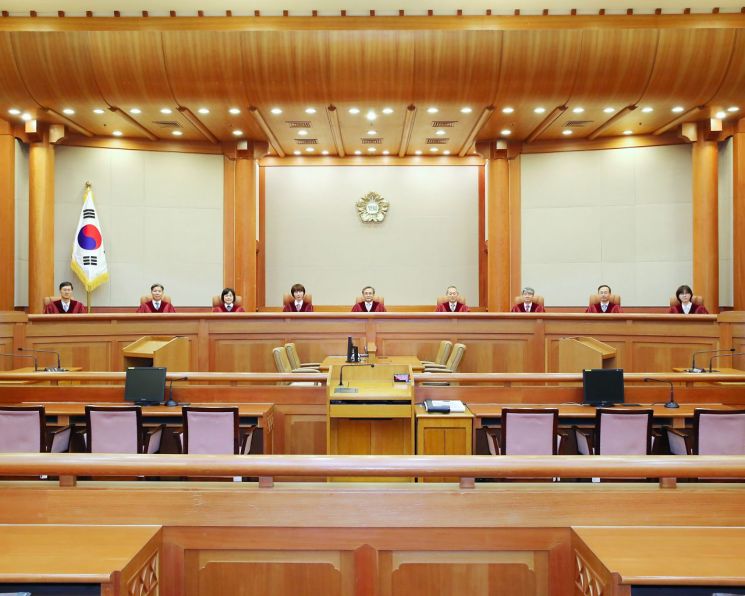
[Asia Economy Reporter Choi Seok-jin, Legal Affairs Specialist] The Constitutional Court has ruled that a prosecutor's refusal to allow inspection and copying of a statement record, despite a court's approval, is unconstitutional.
Previously, the Constitutional Court confirmed that a prosecutor's refusal to allow inspection and copying of investigation records in a criminal case, despite the court's permission, violated basic rights and was unconstitutional. However, this is the first time the Court has made a ruling related to a separate case filed independently.
On the 30th, the Constitutional Court unanimously ruled unconstitutional in a constitutional complaint filed by Mr. A, who was undergoing a criminal trial and claimed that "the prosecutor's refusal to allow inspection and copying infringes on the right to a fair trial."
The Court stated, "Although there was a court decision permitting inspection and copying of documents held by the prosecutor related to a separately filed and finalized case, the prosecutor denied the relevance of these documents to the criminal case involving the petitioner and refused to allow inspection and copying. This act infringes on the petitioner's right to a prompt and fair trial and the right to legal counsel, thus violating the Constitution."
Mr. A, who worked as a manager in charge of the Baegun Lake ecological restoration road construction project in Uiwang City, Gyeonggi Province in 2016, was indicted on charges of accepting bribes from a construction supply company and was found guilty in the first trial on August 24, 2018.
During the second trial, Mr. A's lawyer learned during the cross-examination of witness Mr. B that Mr. B had been investigated by the prosecution in connection with Mr. A's case.
Mr. B had been convicted in December 2018 for violating the Attorney-at-Law Act related to the same construction project.
Mr. A sought to inspect and copy Mr. B's statement record, but the prosecution refused, leading Mr. A to apply to the court for permission on January 24, 2019.
The second trial judge asked the prosecutor for their opinion on the inspection and copying request, and the prosecutor opposed it.
The prosecutor argued that since Mr. B was investigated separately after Mr. A was indicted and was not directly related to Mr. A's case, allowing inspection and copying of Mr. B's statement record could significantly harm the honor, privacy, safety, and peaceful life of the parties involved.
However, on January 30, 2019, the court ordered that Mr. A be allowed to inspect and copy Mr. B's statement record and related documents.
Following the court's approval, Mr. A's lawyer requested inspection and copying from the prosecutor the next day, but the prosecutor did not comply.
Consequently, Mr. A filed a constitutional complaint on April 2, 2019, claiming that the prosecutor's refusal infringed on his fundamental rights.
While the constitutional complaint was under review, Mr. A received a final guilty verdict from the Supreme Court in May 2019.
The Constitutional Court first examined the admissibility of the constitutional complaint.
Since constitutional complaints are a remedy for fundamental rights violations, the petitioner must have an interest in protecting their rights both when filing and when the decision is made. However, because Mr. A's guilty verdict was already finalized, even if the Court confirmed the prosecutor's refusal was unconstitutional, it would not change the trial outcome, thus providing no benefit to Mr. A's rights protection.
Nevertheless, the Court has recognized that even when the petitioner's subjective interest in rights protection is absent, constitutional complaints serve to uphold constitutional order. Therefore, when constitutional clarification is necessary for maintaining constitutional order, the Court has acknowledged an objective interest in rights protection and proceeded with the review.
The Court determined that this case also involves such an objective interest in rights protection.
Previously, in 2010, the Court confirmed that a prosecutor's refusal to allow inspection and copying of investigation records requested by a defense attorney under Article 266-4 of the Criminal Procedure Act violated the attorney's fundamental rights and was unconstitutional.
However, this case concerns inspection and copying of documents held by the prosecutor related to a separately filed and finalized case, not the investigation records of the criminal case itself, distinguishing it from the earlier decision.
The Court stated, "Since violations of this type are likely to recur and constitutional clarification on this issue is crucial for safeguarding constitutional order, even if the petitioner's subjective interest in rights protection has ceased, the interest in filing this complaint still exists."
Regarding whether the prosecutor's refusal infringed on Mr. A's fundamental rights, the Court explained, "The Criminal Procedure Act regulates the defendant's or defense attorney's right to inspect and copy investigation documents after indictment and provides a separate appeal procedure against the prosecutor's refusal. This legislative decision reflects the policy judgment that a prompt and effective remedy is necessary, considering that the right to inspect and copy investigation documents is an essential part of the constitutional rights to a prompt and fair trial and legal counsel, rather than relying on indirect remedies such as constitutional complaints or administrative litigation under the Information Disclosure Act."
The Court continued, "If the court finds no justifiable reason for the prosecutor's refusal and orders inspection and copying to protect the defendant's constitutional rights, the prosecutor must promptly comply with the court's decision in accordance with the rule of law and separation of powers. This applies even to records related to separately filed and finalized criminal cases."
Furthermore, the Court noted, "If the prosecutor fails to promptly comply with the court's decision permitting inspection and copying, the defendant not only suffers the disadvantage of being unable to use the witness or documents as evidence but also experiences infringement of the right to inspect and copy, as well as the rights to a prompt and fair trial and legal counsel. The respondent's (prosecutor's) refusal infringes on these rights."
A Constitutional Court official stated, "This decision clarifies that under the evidence disclosure procedure pursuant to Article 266-3 of the Criminal Procedure Act, the defendant or defense attorney can exercise the right to request inspection and copying of documents related to separate cases connected to the criminal case, and if the court permits such inspection and copying under Article 266-4, the prosecutor must comply with the court's decision."
© The Asia Business Daily(www.asiae.co.kr). All rights reserved.

















