[DTx Era⑦] Substance Use Disorder DTx, First to Break Through US Regulations
 The above photo is not related to the article content. Photo by Asia Economy DB
☞Substance Use Disorder (SUD)= Refers to a condition where an individual repeatedly uses a specific substance despite experiencing various cognitive, behavioral, and physical problems, and is unable to stop or control the use. It also includes tolerance and withdrawal symptoms related to the substance. Addiction to alcohol, tobacco, and drugs are representative examples.
[Asia Economy Reporter Kim Young-won] Social demand for treatment of Substance Use Disorder (SUD), such as alcohol and nicotine, is increasing. This is due not only to the harm to health but also the significant social costs involved. According to Statistics Korea and the Korea Disease Control and Prevention Agency on the 5th, the number of alcohol-related deaths in 2020 was 5,155, a 9.8% increase from the previous year. The social and economic costs estimated by the National Health Insurance Service due to drinking reached 9.4524 trillion KRW. In 2019, the number of deaths caused by smoking was 58,036, with social and economic costs amounting to 12.1913 trillion KRW.
The harm caused by drinking and smoking also increased after the outbreak of COVID-19. According to the ‘National Health Statistics Plus’ issue report published by the KDCA in December last year, the high-risk drinking rate among men in South Korea rose by about 3 percentage points after the COVID-19 outbreak in 2020. The previously declining trend in the current smoking rate among men slowed down. The per capita number of cigarettes smoked, which had been decreasing since 2011, increased from 12.4 cigarettes in 2019 to 13.5 cigarettes in 2020.
However, treatment for patients with substance use disorders is not being adequately provided. The treatment experience rate for patients with alcohol use disorder is less than 10%, and the readmission rate after discharge exceeds 50%. The number of participants in smoking cessation support programs decreased annually from 81,115 in 2017 to 47,351 in 2020. Since existing substance use disorder treatments are mostly conducted through medical consultations such as psychiatry, many patients hesitate to visit due to stigma associated with psychiatric treatment. Cognitive-behavioral therapy, which changes cognition in the surrounding environment to resolve psychological issues, is important in treating substance use disorders, but simple counseling often fails to provide an environment where patients can respond to various complex craving situations.
Substance Use Disorder DTx, First FDA Approval
Digital therapeutics (DTx) complement these shortcomings by helping patients consistently participate in treatment. They reduce the burden by allowing personal use at home and add motivational elements tailored to the patient to encourage treatment participation.
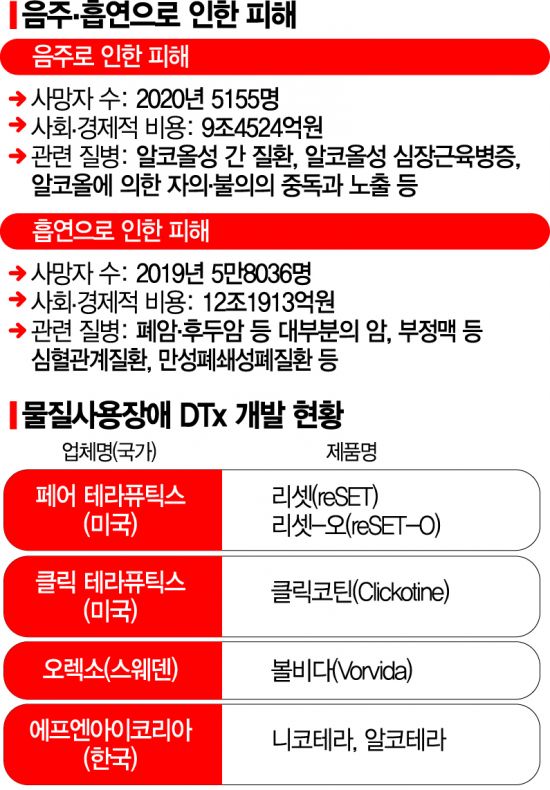
‘reSET’ by Pear Therapeutics, a DTx for treating substance use disorders such as alcohol and cannabis, was the first DTx to receive approval from the U.S. Food and Drug Administration (FDA) in 2017, proving its effectiveness. It is characterized by providing rewards for substance misuse, motivating patients. reSET is available by prescription from a physician and is used alongside existing treatments. Patients prescribed reSET follow a 12-week program that includes online lectures on coping with impulses and quizzes. Clinical trials involving about 400 participants showed that patients using the reSET application had a 40.3% adherence rate to substance misuse abstinence, more than twice that of the control group (17.6%).
Pear Therapeutics also developed ‘reSET-O’ for opioid use disorder treatment following reSET. The opioid problem has intensified in the U.S., with 500,000 deaths from heroin and other opioids overdoses between 2009 and 2019. reSET-O received FDA approval in 2018. Corey McCann, CEO of Pear Therapeutics, said regarding the FDA approval of reSET-O, "In 2017, there were 50,000 deaths in the U.S. due to opioid-related drug overdoses," adding, "New and innovative treatments are needed to address this new public health epidemic."
Additionally, Sweden’s Orexo and the U.S.’s Click Therapeutics have developed DTx for alcohol and nicotine use disorders, respectively. Both DTx are based on personalized cognitive-behavioral therapy. Orexo’s ‘Vorvida’ is a DTx for treating severe alcohol addiction. It is used over six months based on cognitive-behavioral therapy, setting personalized goals for users and correcting alcohol consumption habits. Click Therapeutics’ ‘Clickotine’ sends messages tailored to the individual’s profile to provide personalized smoking cessation support and guidance. In South Korea, FNI Korea is developing DTx for alcohol and nicotine use disorders using VR technology.
© The Asia Business Daily(www.asiae.co.kr). All rights reserved.

















