Bank of Korea "Annual Inflation Rate May Exceed 4.7% This Year"
Popularity of Flawed Ugly Products and Active Secondhand Trading
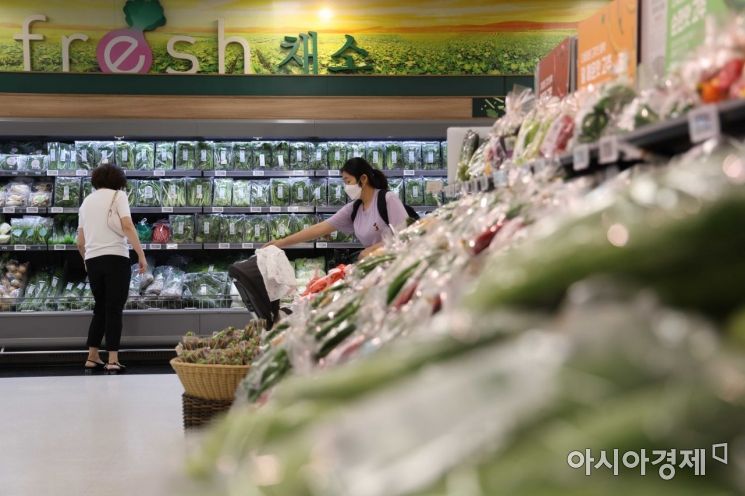
[Asia Economy Reporter Heo Midam] Recently, with prices soaring rapidly, the number of 'thrifty consumers' trying to save even a single penny is increasing. These consumers make efforts for rational consumption by purchasing 'imperfect products' with near expiration dates or minor defects at low prices, or by buying items cheaply through secondhand transactions.
According to the Korea Consumer Agency's Cham Price statistics on the 30th, the average price of a bowl of cold noodles in Seoul in May this year was 10,269 KRW, kimchi stew set meal 7,308 KRW, bibimbap 9,538 KRW, and knife-cut noodles 8,269 KRW. Compared to the average price in January, prices have risen by about 200 to 500 KRW in five months. The Bank of Korea also forecasted that the consumer price inflation rate this year will exceed 4.7%. During the 2008 global financial crisis, the annual consumer price inflation rate was 4.7%, and there is now a prospect that it could surpass this level.
Due to the increased burden of rising prices, more consumers are seeking cost-effective products regardless of the item. A representative cost-effective product is the 'imperfect product.' Although these have defects that reduce their marketability, there is no difference in taste or size, so they are also called 'Grade B products.'
Companies are creating separate sections to sell imperfect products in response to such consumer demand. The e-commerce platform TMON renewed its 'Thrifty Shopping' section last month. This section introduces products that cannot be sold at normal prices for various reasons but have no issues with use. It includes products that could not be sold due to minor defects during distribution, items nearing their expiration date, discontinued or overstocked products. According to TMON, sales in the 'Thrifty Shopping' section increased by 279% in May compared to the previous month.
Also, the number of people trying to purchase goods at low prices through secondhand transactions is increasing. On secondhand trading platforms, various items are traded, from hobby-related goods such as fishing and camping equipment to clothing, daily necessities, and home appliances.
Kim (28), an office worker who recently bought a used camera through Junggonara, said, "I wanted to buy a camera to shoot vlogs, but even the cheapest new ones cost over 1 million KRW. Since I wasn't sure if I would keep using the camera, I thought buying a used one was more reasonable."
Some also use secondhand trading platforms as a means to generate extra income by selling unused items to earn some profit. Jeon (26), an office worker, said, "I tried listing items I didn't want to throw away on Danggeun Market, and they sold better than I expected, so I was able to make some pocket money. From the buyer's perspective, it's also beneficial because they can get the items they want at a low price."
With the activation of online secondhand trading, the related market size is also growing. According to Hana Financial Management Research Institute, the domestic secondhand trading market size, which was 4 trillion KRW in 2008, grew fivefold to 20 trillion KRW in 2020. The global secondhand trading market size is also expected to grow from 27 billion USD (about 35 trillion KRW) in 2021 to 77 billion USD (about 100 trillion KRW) in 2025.
Professor Lee Eunhee of Inha University's Department of Consumer Studies said, "As prices soar, consumers are considering various ways to reduce spending. Office workers try to reduce lunch expenses by using company cafeterias or buying convenience store lunch boxes. Since wages remain the same but prices rise, quality of life inevitably declines. Therefore, they try to cut costs as much as possible where they can."
© The Asia Business Daily(www.asiae.co.kr). All rights reserved.


















