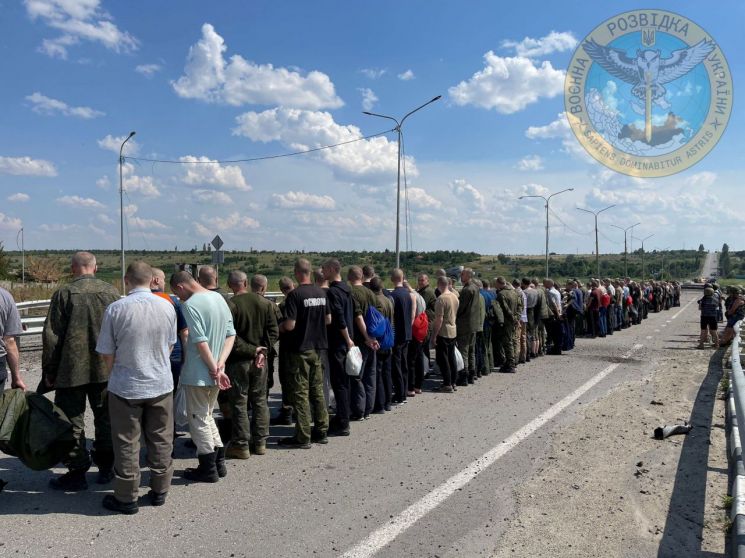
[Asia Economy Reporter Hyunwoo Lee] Ukraine and Russia have conducted the largest prisoner exchange since the start of the war, involving 144 individuals. A significant number of them are known to be Ukrainian soldiers who had resisted at the Azovstal steel plant in Mariupol, southern Ukraine.
According to CNN on the 29th (local time), the Ukrainian Ministry of Defense announced that it carried out a prisoner exchange with Russia involving 144 people, the largest number since the war began, and that the exchanged soldiers have returned home. Among them, 95 are reported to be soldiers who defended the Azovstal steel plant in Mariupol, which had been under siege by Russian forces.
The Ukrainian Ministry of Defense stated via Telegram, "A total of 144 Ukrainian Defense Forces personnel aged between 19 and 65 have returned through the prisoner exchange. Among them are 59 regular Ukrainian soldiers and 43 members of the Azov Regiment who fought at the Mariupol Azovstal steel plant." This prisoner exchange is the largest since the first exchange between the two sides began on March 24. Most of the Ukrainian prisoners are reported to be seriously wounded.
The Russian side also announced the prisoner exchange. Denis Pushilin, the representative of the Donetsk People's Republic (DPR), a pro-Russian separatist regime in the Donbas region, stated that the Ukrainian government recently released soldiers from the DPR and the Russian Federation. Pushilin said, "Today, we are returning 144 DPR and Russian Federation soldiers captured by the enemy to their homeland. We handed over the same number of prisoners to Kyiv."
Meanwhile, some Russian politicians are reportedly opposing the fact that members of the Azov Regiment were returned to Ukraine. According to the British Guardian, Andrey Medvedev, Deputy Speaker of the Russian State Duma, criticized via his Telegram account, "Why did Russia have to exchange members of the Azov (Azov) Regiment? Were there no other prisoners Russia could exchange?" Some members of the State Duma have announced plans to submit legislation to exclude Azov Regiment members from prisoner exchanges.
In Russian political circles, the Azov Regiment is defined as an extreme right-wing nationalist force akin to Nazis, and there are strong voices advocating that instead of treating them as prisoners of war, they should be tried and given severe sentences.
© The Asia Business Daily(www.asiae.co.kr). All rights reserved.

















