If You Work 40 Hours a Week, You Earn 2,010,580 KRW
Night Shift Workers Receive 1.5 Times the Hourly Wage
 A convenience store part-time worker on duty. With next year's minimum wage set at 9,620 won, a 5% increase from this year, part-time workers who complete the full statutory working hours next year are expected to earn a monthly salary of over 2.01 million won. / Photo by Yonhap News
[Asia Economy Intern Reporter Song Hyundo] With the decision to raise next year's minimum wage by 5% compared to this year, the monthly salary of part-time workers who complete the full statutory working hours is expected to exceed 2 million won for the first time.
On the 29th of last month, the Minimum Wage Commission (hereinafter referred to as the Minimum Wage Commission) decided to increase next year's minimum wage by 5% compared to this year. As a result, the minimum wage, which was 9,160 won per hour, will increase by 460 won to 9,620 won starting next year.
According to Article 50 of the Labor Standards Act, the statutory working hours are 8 hours per day excluding break time, and 40 hours per week. Based on this, assuming 8 hours a day and 5 days a week, with the addition of weekly holiday allowance, a total of 209 hours of wages can be received. The amount converted to a monthly salary is about 1 million won higher than this year (1,914,400 won), reaching 2,010,580 won.
Under the '52-hour workweek system,' when working up to a maximum of 52 hours per week, workers receive 1.5 times the minimum hourly wage for hours worked beyond the statutory working hours. Therefore, the monthly salary assuming a 52-hour workweek can reach the 2.7 million won range.
However, not all part-time workers receive a monthly salary of over 2 million won. This is because there are short-term part-time jobs with less than 15 hours per week, which do not require payment of weekly holiday allowance. According to data released by Statistics Korea in March this year, among 13.26 million workers in their 20s and 30s, 17.3%, or 2.31 million, are engaged in short-term part-time jobs. Assuming these workers work the maximum hours without weekly holiday allowance applied, which is 14 hours per week, their monthly salary is only in the 500,000 to 600,000 won range.
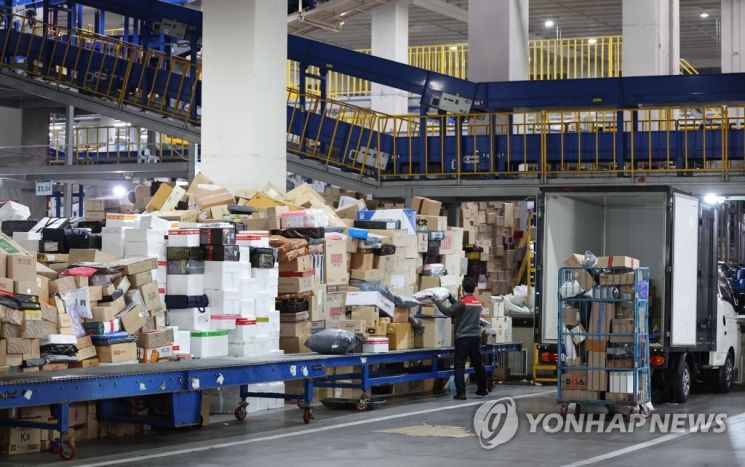 A logistics center in Seoul. The photo is not related to any specific expression in the article. / Photo by Yonhap News
Jobs that involve working at dawn, such as the 'night shift' at logistics centers like Coupang and Market Kurly, will also see a significant increase in monthly wages. According to Article 56 of the current Labor Standards Act, when working from 10 p.m. to 6 a.m. the next day, a night shift allowance applies, paying 1.5 times the hourly wage.
Therefore, night workers next year who work 8 hours from 10 p.m. to 6 a.m. will receive a daily wage of 115,440 won. However, small businesses with fewer than 5 regular employees are exempt from additional allowances and night shift allowances.
Meanwhile, the minimum wage increase plan for next year will be finalized after approval by the Minister of Employment and Labor by August 5. If the increase plan is approved, it will take effect from January 1 of next year and apply until December 31 of the same year.
© The Asia Business Daily(www.asiae.co.kr). All rights reserved.


















