Promotion of Non-core Asset Sales, Restructuring of Underperforming Investee Companies, and Workforce Reallocation
Establishment of Fiscal Soundness and Mid-to-Long-Term Financial Management Plans... Government to Monitor Implementation Performance Semiannually
[Asia Economy Sejong=Reporter Kwon Haeyoung] Fourteen financially distressed public institutions, including Korea Electric Power Corporation (KEPCO) and its power generation subsidiaries, resource public enterprises, and Korea Railroad Corporation (KORAIL), all with debt ratios exceeding 200%, have been designated as 'financial risk institutions' and will receive focused government management. The government will require these institutions to enhance profitability, improve expenditure efficiency, restructure business operations, and sell non-core assets, while conducting semiannual performance reviews. This marks the beginning of a high-intensity restructuring of public enterprises that have become excessively large and financially unstable over the past five years.
On the 30th, the Ministry of Economy and Finance held the 8th Public Institution Management Committee meeting chaired by Second Vice Minister Choi Sang-dae, selecting 14 out of 27 institutions (excluding financial and fund-type institutions) that submitted mid- to long-term financial management plans as financial risk institutions. These include KEPCO, Korea Hydro & Nuclear Power, five power generation companies (Namdong, Dongseo, Nambu, Seobu, Jungbu), Korea District Heating Corporation, Korea Land and Housing Corporation (LH), nine institutions with deteriorating business profitability, and five institutions with overall weak financial structures such as Korea National Oil Corporation, Korea Mine Reclamation Corporation, Korea Gas Corporation, Korea Coal Corporation, and KORAIL.
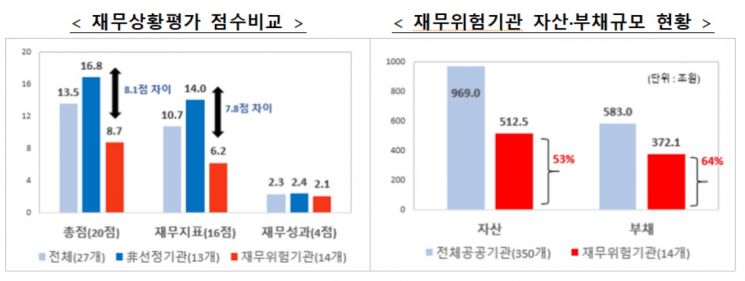
The criteria for designation as a financial risk institution are either a government-assessed financial status evaluation score below 14 points (out of a maximum of 22 points, including up to 2 bonus points), indicating 'investment ineligibility,' or a debt ratio of 200% or higher. The average financial status evaluation score of the 14 financial risk institutions was 8.7 points, which is 8.1 points lower than the 16.8 points of non-financial risk institutions and 4.8 points below the overall average of 13.5 points among all 27 institutions.
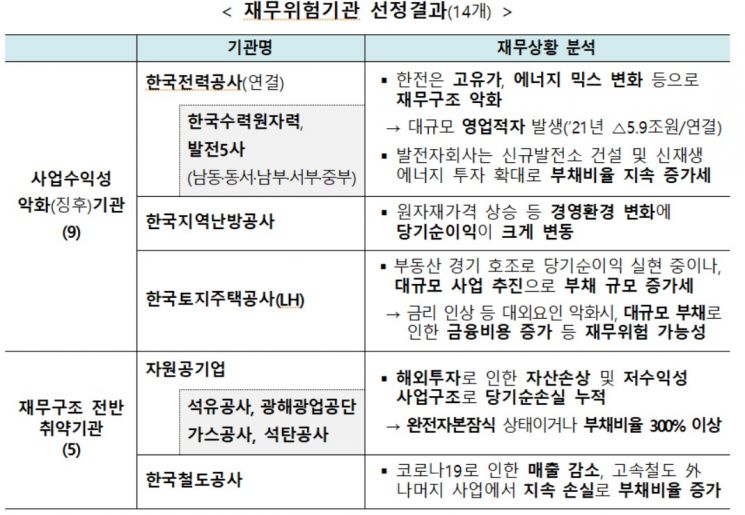
In particular, KEPCO's financial structure has significantly deteriorated due to high oil prices and changes in the energy mix, including the expansion of renewable energy promoted by the previous Moon Jae-in administration. In 2021 alone, KEPCO recorded an operating loss of 5.9 trillion KRW on a consolidated basis. Its power generation subsidiaries have also seen a continuous increase in debt ratios due to new power plant construction and investments in renewable energy.
Resource public enterprises have experienced asset impairments from overseas investments and accumulated net losses due to low-profit business structures, resulting in either complete capital erosion or debt ratios exceeding 300%. KORAIL's debt ratio has increased due to revenue declines caused by COVID-19 and ongoing losses in businesses other than high-speed rail.
The government assessed that the rising debt ratios of financial risk institutions pose a significant risk of overall public institution insolvency. The combined debt of the 14 financial risk institutions amounts to 372.1 trillion KRW, representing 64.5% of the total debt of 350 public institutions (583 trillion KRW), and their assets total 512.5 trillion KRW, accounting for 53% of the total assets of public institutions (969 trillion KRW).
The government plans to implement a two-track, customized intensive management approach, dividing the institutions into nine 'business profitability deterioration institutions' and five 'overall financial structure vulnerable institutions.' For the business profitability deterioration institutions, efforts will focus on improving profitability and analyzing cost structures to enhance expenditure efficiency and curb debt growth. For the overall financial structure vulnerable institutions, active debt reduction will be pursued through profitability improvement, expenditure efficiency, and business restructuring.
By the end of July, each institution will establish a five-year 'Fiscal Soundness Plan,' which will include measures such as ▲selling non-core assets ▲investment and business rationalization ▲management efficiency improvements. This will cover asset sales unrelated to core tasks or excessive welfare, restructuring underperforming investee companies with unclear capital recovery, prohibiting institutional contributions except for decisions made by various committees, management efficiency measures such as workforce reallocation, and annual funding plans through debt portfolio diversification and borrowing timing adjustments.
The government will also require the formulation of mid- to long-term financial management plans reflecting these measures by the end of August and will conduct semiannual performance evaluations. The 2022 management evaluation manual will be revised by September to enable assessment of the implementation performance of the focused management of financial risk institutions.
© The Asia Business Daily(www.asiae.co.kr). All rights reserved.
![Clutching a Stolen Dior Bag, Saying "I Hate Being Poor but Real"... The Grotesque Con of a "Human Knockoff" [Slate]](https://cwcontent.asiae.co.kr/asiaresize/183/2026021902243444107_1771435474.jpg)

















