'Sunjo Taebongdo' and 'Heonjong Taebongdo' Also Announced for Treasure Designation
When a royal descendant was born in the Joseon royal family, the placenta (胎) was moved outside the palace and enshrined separately. A propitious site (吉地) was selected for burial, and a placenta chamber (胎室) was constructed. If the owner of the placenta ascended to the throne, the site was specially adorned with stone structures. The Placenta Map (胎封圖) is a royal document created for the king’s viewing, which includes detailed records of this process in the Uigwe (儀軌) and paintings depicting the placenta chamber and the surrounding landscape.
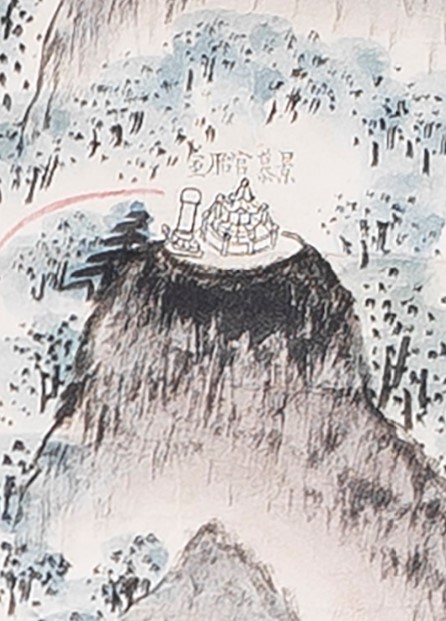
On the 30th, the Cultural Heritage Administration announced the designation of three Placenta Maps as national treasures. These are the 'Jangjo Placenta Map (莊祖 胎封圖·1785)', 'Sunjo Placenta Map (純祖 胎封圖·1806)', and 'Heonjong Placenta Map (憲宗 胎封圖·1847)'. The oldest, the Jangjo Placenta Map, depicts the placenta chamber of Crown Prince Sado, the father of King Jeongjo, and the surrounding scenery. The placenta chamber was established around 1735 behind Myeongbongsa Temple in Yecheon-gun, Gyeongbuk Province. After Sado was posthumously honored as Jangjo in 1785, additional stone structures such as railings and stele were installed. The Annals of the Joseon Dynasty record it as the 'Gyeongmogung (景慕宮) Placenta Chamber.' The term Gyeongmo means 'greatly beloved,' which suggests how deeply King Jeongjo mourned his father, who lived a tragic life.
The Jangjo Placenta Map applies a landscape painting perspective from a high vantage point looking downward. The placenta chamber occupies the center of an oval composition surrounded by many mountain peaks. The lotus-patterned roof stone, octagonal railings, and turtle-shaped pedestal with a stele are each depicted. The method of writing place names, the rows of triangular-shaped mountains, and other map-like expressions stand out prominently.
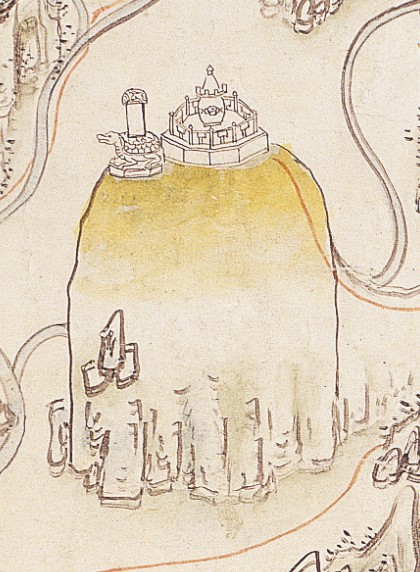
The Sunjo placenta chamber is located in Naesok-ri, Boeun-gun, Chungbuk Province. In the Placenta Map, it is situated on a round peak on the right side of an S-shaped boundary line. The surrounding background is left blank, making it particularly prominent. Below on the left, Beopjusa Temple of Sogrisan Mountain, with several pavilions, is depicted. The road is clearly marked with a red line, and the dense foliage is expressed through repeated brush strokes, reflecting a mixture of map and landscape painting characteristics.
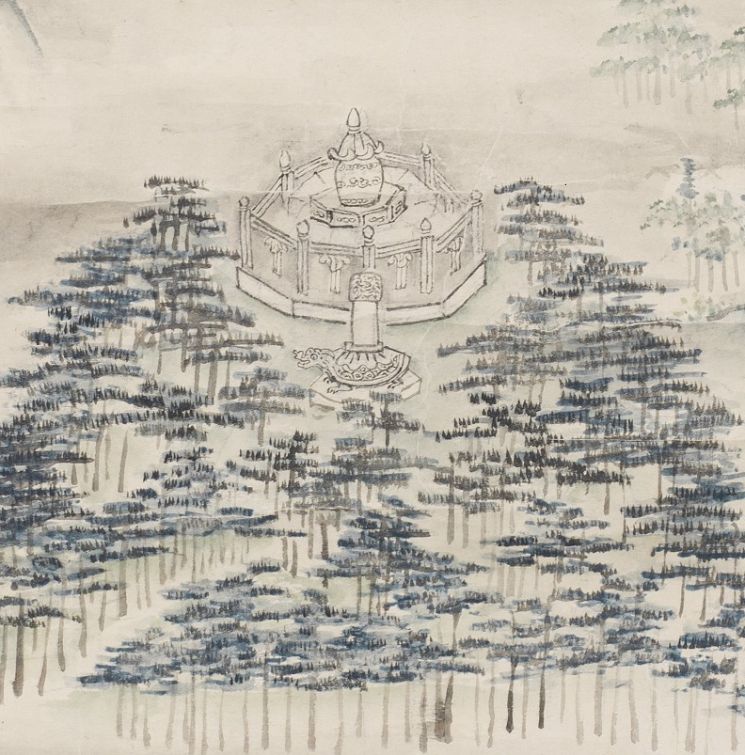
The Heonjong placenta chamber is located in Deoksan-myeon, Yesan-gun, Chungnam Province. In the Placenta Map, it is represented by the roof stone with a lotus roof, octagonal railings, and a stele erected on a turtle-shaped pedestal. The painting follows a typical landscape composition. The middle ground features the placenta chamber, the foreground shows a village, and the background includes mountain peaks and distant hills rendered simply. The artist skillfully depicted the mountain peaks with realism. Soft ink tones add a sense of depth, and effects such as mist are effectively used to create a mysterious atmosphere.
© The Asia Business Daily(www.asiae.co.kr). All rights reserved.



















