Ministry of Science and ICT Announces on the 30th
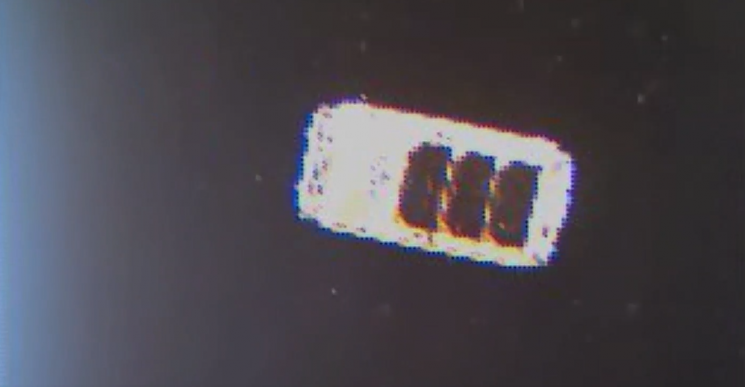 The cube satellite made by Chosun University is separating from the Nuri rocket performance verification satellite on the afternoon of the 29th. Photo by Ministry of Science and ICT
[Asia Economy Reporter Kim Bong-su] The Ministry of Science and ICT and the Korea Aerospace Research Institute (KARI) announced on the 30th that communication with the first CubeSat ejected by the performance verification satellite, which was placed in orbit by the second Nuri rocket launch on the 21st, was successful on the afternoon of the 29th.
The CubeSat that communicated on this day was made by Chosun University, and some status information (beacon signals) was received from the ground station around 3:48 a.m.
However, out of the 20 repeated receptions targeted during the satellite's flight over South Korea, only 2 receptions were successful. The status information sent by the CubeSat included the satellite's mode, attitude, GPS status (currently off), battery mode (normal), and battery voltage (normal).
Regarding the reason why only some of the transmissions were received, the Ministry of Science and ICT explained, "Based on the CubeSat's ejection video, the reason why only some status information was received is believed to be because the satellite's attitude is currently rapidly rotating (tumbling). It seems that more time is needed for attitude stabilization to enable reliable two-way communication."
The next communications are scheduled for around 3:48 p.m. and 5:26 p.m. on the same day. Plans include receiving status information and conducting communication commands.
The CubeSat made by Chosun University is one of the four university teams selected from the 5th 'CubeSat Competition' held in 2019. It was planned to observe volcanic activity of Baekdu Mountain using infrared and visible light.
In the case of CubeSats, there are aspects where reliability is lower compared to commercial satellites due to budget and structural factors, and it is not easy to accurately identify the cause of failure, so most malfunctions are presumed to be caused by power or shock issues.
The Ministry of Science and ICT stated, "Currently, the satellite's battery mode and voltage appear to be normal, so if attitude stabilization proceeds normally, positive results can be expected," and added, "The performance verification satellite will undergo attitude stabilization, and the remaining three CubeSats will be ejected as scheduled."
© The Asia Business Daily(www.asiae.co.kr). All rights reserved.
![User Who Sold Erroneously Deposited Bitcoins to Repay Debt and Fund Entertainment... What Did the Supreme Court Decide in 2021? [Legal Issue Check]](https://cwcontent.asiae.co.kr/asiaresize/183/2026020910431234020_1770601391.png)