[Asia Economy Choi Seok-jin, Legal Affairs Specialist] The Ministry of Justice has submitted a brief to the Constitutional Court ahead of next month's public hearing on the death penalty, outlining reasons to maintain the death penalty.
According to the legal community on the 29th, the Ministry of Justice recently submitted a brief through its representative, the Government Legal Corporation, stating that there is no reason to overturn the existing ruling that the death penalty is constitutional.
In the brief, the Ministry of Justice emphasized, "Advanced countries such as the United States and Japan also maintain the death penalty, which is a clear example showing that simply retaining the death penalty does not make a country backward or barbaric," adding, "Abolishing the death penalty is not a condition for being an advanced country."
It also argued that many countries that joined the European Union (EU), which requires the abolition of the death penalty as a condition for membership, decided to abolish the death penalty more for economic reasons and national interests than due to changes in public perception.
Furthermore, citing a 2021 domestic public opinion survey in which 77.3% responded that the death penalty should be maintained, the Ministry stated, "The national will and the spirit and atmosphere of the times cannot be ignored with a simplistic sense of justice."
The Ministry of Justice stated, "The death penalty is not barbaric revenge but rather aligns with justice," and expressed opposition to the often-mentioned alternative punishment of "life imprisonment without parole."
Additionally, the Ministry argued that Mr. A, who filed the constitutional complaint, had already been sentenced to life imprisonment for the murder of a family member during the court proceedings, so the Constitutional Court's decision on the death penalty would not affect him, thus failing to meet the "legitimacy requirements for constitutional complaints," such as self-relevance of basic rights infringement.
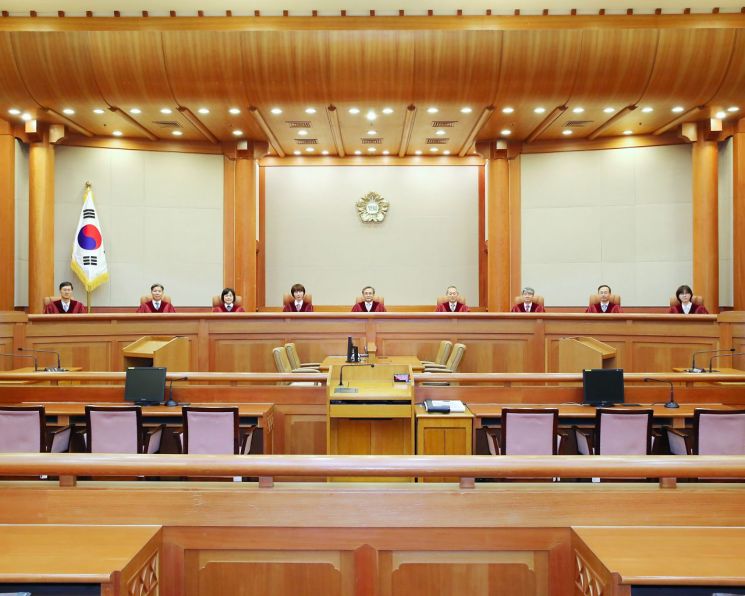
Meanwhile, the Constitutional Court, currently conducting its third review of the constitutionality of the death penalty, will hold a public hearing on the constitutional complaint filed by Mr. A, who was detained and indicted on charges including murder of a family member and forcible molestation, regarding Article 41, Paragraph 1, Item 1 of the Criminal Act, which stipulates the death penalty as a type of punishment, and Article 250, Paragraph 2 (murder of a family member), which includes the death penalty as a statutory punishment, on the 14th of next month at 2 p.m. in the Grand Courtroom.
This will be the first time in 13 years since the Constitutional Court's second ruling in 2010 that the death penalty system will be discussed in the court.
At the public hearing, following statements from the lawyers representing Mr. A and the Government Legal Corporation representing the Minister of Justice, who is an interested party in this case, witnesses recommended by both sides will argue respectively for the abolition and the necessity of maintaining the death penalty.
Mr. A applied for a constitutional review of the relevant provisions during the first trial, but after the court dismissed the request, he filed a constitutional complaint with the Constitutional Court.
Previously, the Constitutional Court ruled the constitutionality of Article 41, Paragraph 1, Item 1 of the Criminal Act, which defines the death penalty as a type of punishment, and Article 250 of the Criminal Act (murder), which includes the death penalty as a statutory punishment, in 1996 with a 7 (constitutional) to 2 (unconstitutional) vote, and again in 2010 with a 5 (constitutional) to 4 (unconstitutional) vote.
At that time, the Constitutional Court concluded, "Although our Constitution does not directly regulate the death penalty system, it indirectly recognizes the death penalty system through the interpretation of Article 110, Paragraph 4 of the Constitution, and the expectation of the death penalty's crime prevention effect cannot be considered unreasonable," adding, "It cannot be seen as a fundamental infringement of the right to life or a violation of the principle of proportionality."
Article 110, Paragraph 4 of the Constitution states, "Military trials under martial law may be conducted in a single instance only in cases of crimes by soldiers or military personnel, espionage related to the military, and crimes related to sentries, guard posts, supply of poisonous food, or prisoners of war as prescribed by law. However, this does not apply in cases where the death penalty is imposed," directly mentioning the death penalty.
The Constitutional Court also stated regarding the statutory punishment of death for murder, "Defining the death penalty as one of the illegal effects for a criminal act that denies another person's life is an unavoidable choice of means to protect the life and value of the offender and one or more lives, and thus does not violate the principle of proportionality."
For the Constitutional Court to declare a law unconstitutional, at least six of the nine justices must agree. Among the current justices, five?including Chief Justice Yoo Nam-seok, and Justices Lee Seok-tae, Lee Eun-ae, Moon Hyung-bae, and Lee Mi-seon?have expressed positions favoring the abolition of the death penalty or actively considering it.
According to the Constitutional Court, Mr. A's side argues that ▲ Article 110, Paragraph 4 of the Constitution, which sets the cases and exceptions for single-instance military trials under martial law, is a technical provision and cannot serve as a constitutional basis for the death penalty; ▲ the claim that the death penalty has more effective crime deterrence than other punishments or that maintaining the death penalty contributes to preventing heinous crimes is an unfounded assumption without solid evidence; ▲ once the death penalty is executed, there is no way to correct a later proven wrongful conviction; and ▲ the function of permanently isolating criminals from society to protect society can be sufficiently achieved through life imprisonment or life imprisonment without parole, so the death penalty is unconstitutional and should be abolished.
On the other hand, the Ministry of Justice argues that ▲ the decision to abolish the death penalty is a matter for the people and legislators, not the judiciary; ▲ the Constitution at least indirectly recognizes the death penalty based on the interpretation of its wording; ▲ the death penalty, imposed proportionally to the severity of the crime, is an expression of retributive justice based on an objective sense of justice and thus aligns with justice; ▲ the deterrent effect of the death penalty should not be denied simply because it is not statistically proven; ▲ life imprisonment without parole cannot replace the death penalty; and ▲ the possibility of wrongful convictions is an inherent limitation of the judicial system that should be addressed through appellate and retrial systems.
© The Asia Business Daily(www.asiae.co.kr). All rights reserved.

















