 Lim Hasu, Director of the Forest Welfare Bureau, is announcing the "2nd Basic Plan for Forest Trail Creation and Management" at the Government Daejeon Complex on the 29th. Photo by Korea Forest Service
[Asia Economy (Daejeon) Reporter Jeong Il-woong] The Korea Forest Service is establishing a nationwide forest trail network and introducing a forest trail certification system to quantify the operation and management of forest trails. Ultimately, the Korea Forest Service's big picture is to enable forest trails to serve as a medium that captures the two benefits of ‘local economy’ and ‘public leisure.’
The Korea Forest Service announced the ‘2nd Basic Plan for Forest Trail Creation and Management (hereinafter referred to as the 2nd Plan),’ a mid- to long-term plan updated every five years, on the 29th.
The 2nd Plan focuses on expanding the designation of national forest trails and introducing a forest trail certification system and index. This reflects changes in lifestyle due to COVID-19 and the increasing public demand for health and recreational activities amid aging and urbanization, emphasizing the expansion and systematic management of forest trails.
Specifically, the Korea Forest Service has set six major strategies: ▲establishing a forest trail network connecting nationwide forest trails ▲enhancing the quality and functions of forest trails ▲driving community development through forests ▲contributing to climate change mitigation through forest trails ▲positioning forest trails as a link for cooperation and coexistence ▲and creating a foundation to support forest trail creation and management.
The establishment of the forest trail network involves creating a connection network linking general roads, the 100 famous mountains, and forest trails designated by other organizations nationwide. To this end, the Korea Forest Service plans to create and maintain 20,000 km of forest trails nationwide, expand the designation of national forest trails to 15 locations, and develop an 849 km East-West Trail connecting Taean Anmyeondo to Uljin.
Alongside building the network, the Korea Forest Service will also strengthen the quality and functions of forest trails. This will be done by introducing a forest trail certification system and forest trail index and deploying 1,500 forest trail managers on-site.
In particular, the difficulty level of forest trails will be classified into five grades based on user walking convenience factors such as slope and surface conditions, allowing forest trail users to select trails that suit their individual health conditions.
The difficulty levels will be categorized as ▲Very Easy ▲Easy ▲Moderate ▲Difficult ▲Very Difficult, reflecting factors such as forest trail, slope, surface condition, surface width, and section distance.
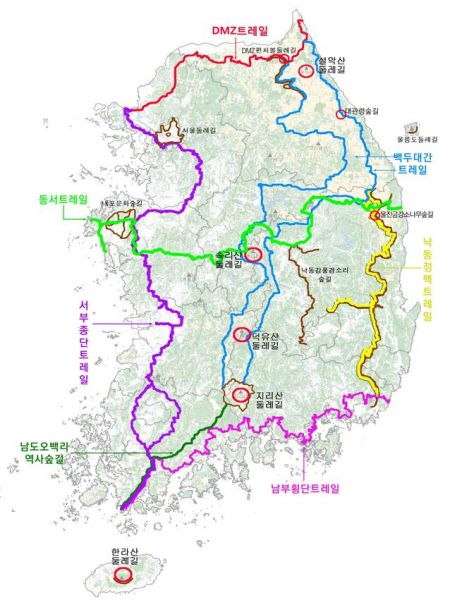
Measures to drive the local economy through forest trails will also be pursued. The Korea Forest Service plans to establish 107 mountain village hubs along the forest trails and create 143 small-scale campgrounds by section, while fostering eight village enterprises to increase the influence of forest trails on local communities.
For example, village enterprises will play a role in developing forest tourism products that reflect local characteristics in connection with regional resources and providing related services.
Additionally, the Korea Forest Service will plant trees in damaged forest trail connection sections to create new forests and expand forest trails in urban areas where they are lacking. To support forest trail creation and management, a forest trail information support system will be established, and safety facilities will be expanded and strengthened in hazardous areas.
Im Ha-su, Director of the Forest Welfare Bureau at the Korea Forest Service, said, “According to the 2nd Plan, we will work to create and manage 20,000 km of forest trails nationwide over the next five years starting this year, aiming to increase annual forest trail users to 3 million. Through this, we will build a Korea where local communities and the public find happiness together through forest trails.”
© The Asia Business Daily(www.asiae.co.kr). All rights reserved.


















