Labor Groups and Opposition "Are Workers Alone to Bear the Pain of Inflation?" Backlash
Expert "Understand the Intent... But It’s a Matter for Labor and Management to Coordinate"
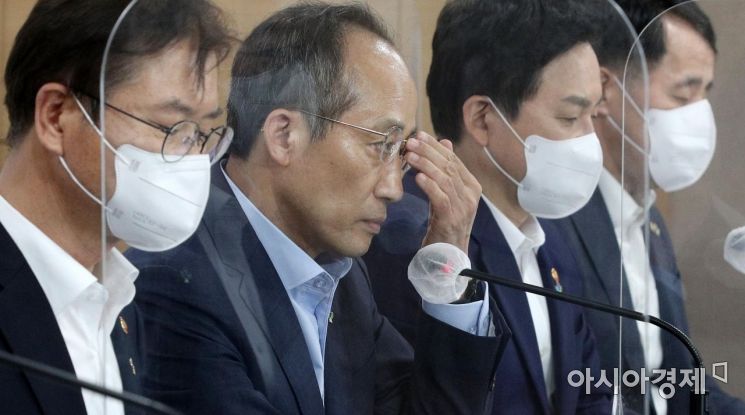 Deputy Prime Minister and Minister of Economy and Finance Choo Kyung-ho is announcing the new government's economic policy direction at the Government Seoul Office in Jongno-gu, Seoul on the 16th. From the left, Minister of Employment and Labor Lee Jeong-sik, Deputy Prime Minister Choo, Minister of Land, Infrastructure and Transport Won Hee-ryong, and First Vice Minister of Trade, Industry and Energy Jang Young-jin. Photo by Kim Hyun-min kimhyun81@
[Asia Economy Reporter Kang Juhee] Deputy Prime Minister and Minister of Economy and Finance Choo Kyung-ho's request for private companies to refrain from excessive wage increases that pressure inflation has sparked backlash from labor groups. Critics argue that the government is placing the responsibility for price stability on workers and excessively intervening in labor-management issues.
At a meeting with the Korea Employers Federation (KEF) chairpersons in Mapo-gu, Seoul, on the 28th, Deputy Prime Minister Choo said, "Excessive wage increases not only exacerbate the high inflation situation but also widen the wage gap between large corporations and small and medium-sized enterprises (SMEs), increasing the relative deprivation of SMEs and vulnerable workers and potentially intensifying social conflicts."
He added, "Recently, there has been a concerning trend of high wage increases centered on some IT companies and large corporations, showing signs of spreading to other industries and companies." He explained that inflation leads to wage increases, which in turn lead to further inflation, creating a vicious cycle.
Deputy Prime Minister Choo's remarks appear to stem from concerns that wage increases by some companies could influence the entire industry, causing wage-driven inflation to spread uncontrollably. Earlier, Kakao and Naver decided to raise their annual salaries by 15% and 10%, respectively, and Samsung Electronics also agreed to a 9% wage increase through labor-management consultations, marking significant wage hikes among major domestic corporations.
In this context, Professor Kim Tae-gi of Dankook University's Department of Economics said, "If wages rise sharply, the prices of products produced by companies inevitably increase, eventually leading to inflation. If wage increases are excessively high compared to the inflation rate, it will inevitably have a negative impact on price stability."
However, labor groups are opposing Deputy Prime Minister Choo's remarks, calling them excessive government intervention. Lee Ji-hyun, spokesperson for the Federation of Korean Trade Unions (FKTU), issued a verbal statement on the same day, criticizing, "It is difficult to understand why a government that emphasizes liberalism and market economy and stresses private autonomy intervenes in labor issues of large corporations."
She continued, "Instead of artificially cutting wages of large corporation workers to correct the situation, unfair trade practices between large corporations and SMEs should be rectified first, which would naturally resolve the wage gap." She pointed out, "(Deputy Prime Minister Choo's remarks) seem to be blatant favoritism toward large corporations, including recent policies to reduce corporate taxes for large companies."
The opposition party also criticized Deputy Prime Minister Choo's remarks. Kim Tae-nyeon, chairman of the Democratic Party's Special Committee on Economic Crisis Response, said at a National Assembly press conference, "Prices are rising, fuel costs are rising, everything is rising, so if wages do not increase, does that mean wage workers alone should bear the pain?" He added, "This is something government officials should not say." Given that public utility fees such as electricity and gas have recently increased consecutively, adding to the burden on ordinary citizens, freezing wages alone is considered unreasonable.
Professor Sung Tae-yoon of Yonsei University's Department of Economics said, "I fully understand Deputy Prime Minister Choo's intention to prevent the vicious cycle of wage increases and inflation. However, wage increases should be autonomously decided by companies and workers considering each other's circumstances," adding, "It is difficult to apply a blanket wage freeze to all companies."
© The Asia Business Daily(www.asiae.co.kr). All rights reserved.

















