KRIHS '1st New Town Residents Perception Survey' Report
"Dissatisfaction with Housing Aging... Will Accept Reconstruction if Sharing 200 Million KRW"
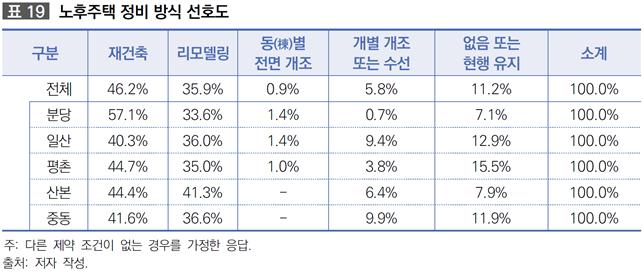
Among homeowners in the first-generation new towns, 9 out of 10 prefer housing redevelopment through reconstruction or remodeling. The majority of residents wishing to move cited housing aging as the reason.
According to the 'Survey on Perceptions of Homeowners in First-Generation New Towns' report published by the Korea Research Institute for Human Settlements on the 29th, the most preferred housing redevelopment method among homeowners in first-generation new towns was reconstruction (46.2%). This was followed by remodeling at 35.9%, no change or maintaining the current state at 11.2%, and individual renovation or repair at 5.8%.
This report was prepared to understand the perceptions of homeowners in five first-generation new towns in Gyeonggi Province?Bundang, Pyeongchon, Ilsan, Sanbon, and Jungdong?regarding housing purchase, residence, moving out, and housing redevelopment, and to suggest directions for redevelopment policies.
By new town, Bundang had the highest percentage of respondents hoping for reconstruction at 57.1%, followed by Pyeongchon at 44.7%, Sanbon at 44.4%, Jungdong at 41.6%, and Ilsan at 40.3%.
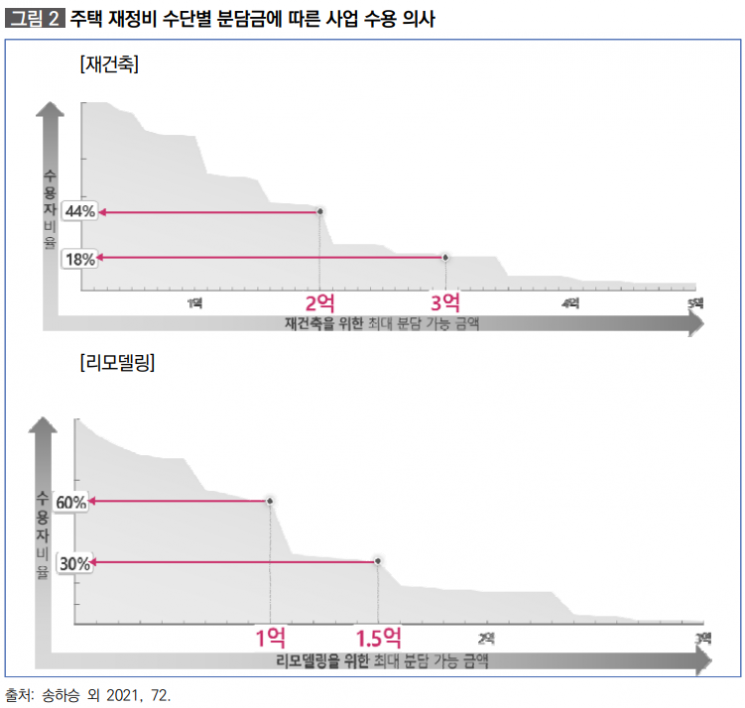
Homeowners in the first-generation new towns indicated that, without constraints, they are willing to pay an average of 180 million KRW for reconstruction and an average of 100 million KRW for remodeling or full renovation by building.
However, it was found that as the individual contribution increases, the likelihood of choosing redevelopment methods other than reconstruction also increases.
In reconstruction projects, 56.0% of respondents were unwilling to accept the project if the contribution was 200 million KRW, and 82.0% were unwilling if it was 300 million KRW. For remodeling projects, 40.0% were unwilling to accept the project if the contribution was 100 million KRW, and 70.0% were unwilling if it was 150 million KRW.
Son Eun-young, a senior researcher at the Korea Research Institute for Human Settlements, stated, "Although reconstruction and remodeling are mainly preferred as housing redevelopment methods, there are differences in ranking between new towns and differences in the maximum payable amounts for each method. Therefore, management measures tailored to the characteristics of demanders and regions are required." She added, "We need to consider institutionalizing measures to diversify and activate redevelopment methods so that new types such as full renovation by building or individual full or partial repairs can be chosen."
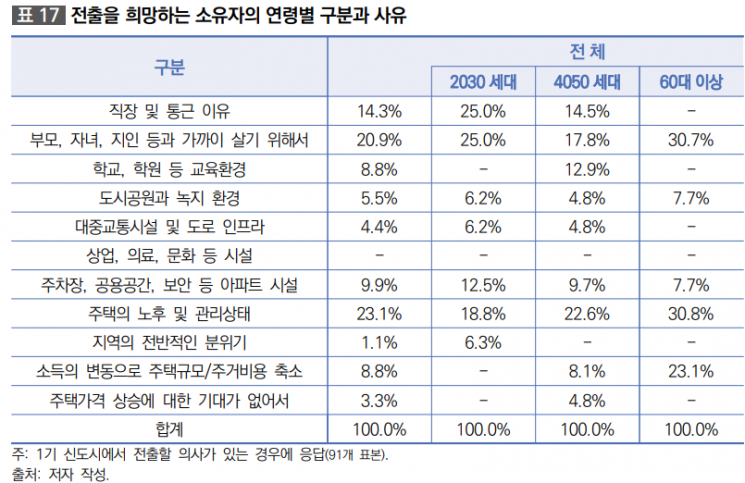
Residents wishing to move out from the first-generation new towns in Gyeonggi Province most frequently cited dissatisfaction with the management condition due to housing aging as the reason for moving.
The biggest reason for wanting to move out from the first-generation new towns was housing aging and management condition (23.1%). This was followed by wanting to live closer to parents, children, or acquaintances (20.9%), work or commuting (14.3%), and facilities such as parking lots, common areas, and security (9.9%).
The most important factor in deciding whether to reside was work or commuting (32.4%), followed by educational environment such as schools and academies (17.0%), urban parks and green environments (13.7%), and wanting to live closer to parents, children, or acquaintances (13.2%).
The main reason for not residing in the first-generation new towns was also work or commuting (51.2%). This was followed by wanting to live closer to parents, children, or acquaintances (19.4%) and housing aging and management condition (11.6%).
Homeowners in the first-generation new towns expect prices to rise over time (37.2%) and also anticipate a new town premium effect (30.7%) and price increases due to development benefits such as reconstruction and remodeling (25.6%).
The initial occupancy of the first-generation new towns was between 1991 and 1993. In the earliest cases, 32 years have passed since occupancy, and as of this year, apartments exceeding 30 years of building age account for 60,986 units out of a total of 365,492 units, representing 16.7%. In particular, in Pyeongchon and Bundang, more than 25,000 units have exceeded 30 years of building age and are undergoing aging.
© The Asia Business Daily(www.asiae.co.kr). All rights reserved.
![Clutching a Stolen Dior Bag, Saying "I Hate Being Poor but Real"... The Grotesque Con of a "Human Knockoff" [Slate]](https://cwcontent.asiae.co.kr/asiaresize/183/2026021902243444107_1771435474.jpg)


















