Seoul Metropolitan Area Also Faces 'Kkangtong Jeonse' Warning
Won Hee-ryong "Will Announce Support Measures for Jeonse Fraud Victims"
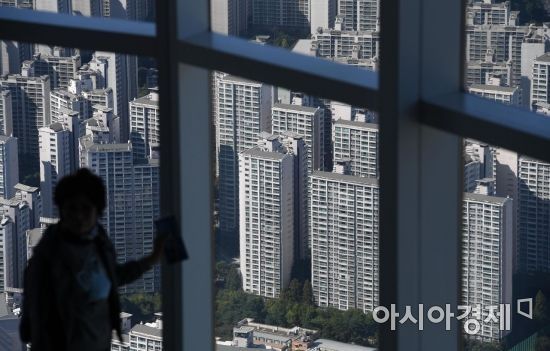 View of apartment complexes in Seoul city from Seoul Sky, the observation deck of Lotte World Tower in Seoul. The photo is unrelated to specific expressions in the article. Photo by Asia Economy DB.
[Asia Economy Reporter Heo Midam] As demand for villas increases due to the surge in jeonse prices and interest rate hikes, concerns over so-called 'Kkangtong Jeonse' are growing. Kkangtong Jeonse refers to cases where the jeonse price is higher than the sale price, making it difficult for landlords to return the jeonse deposit to tenants even if they sell the house later. Especially among young people with little real estate transaction experience, cases of Kkangtong Jeonse damage are rapidly increasing, prompting the government to announce plans for countermeasures.
According to real estate big data company Asil on the 28th, an apartment in Pyeongtaek, Gyeonggi Province (exclusive area 27㎡) signed a jeonse contract at 120 million KRW, which is 26 million KRW more expensive than the previous sale price of 94 million KRW. Also, in Gangdong-gu, Seoul, an officetel (exclusive area 13㎡) had a jeonse price of 170 million KRW, while the sale price was 119 million KRW, making the jeonse price 51 million KRW higher.
The reason for the increasing cases where jeonse prices surpass sale prices is related to the recent slowdown in the housing price rise. According to the Korea Real Estate Board, as of the 13th, the nationwide apartment sale demand-supply index was 93.4, down 0.3 points from the previous week (93.7). This index represents the ratio of demand to supply, and the lower it is below the baseline (100), the more sellers there are compared to buyers in the market.
Ultimately, real buyers worried about falling house prices began to prefer jeonse over purchase, leading to a shortage of jeonse supply and a sharp rise in jeonse prices.
Given this situation, concerns over Kkangtong Jeonse are intensifying. If house prices fall, landlords may not be able to return the jeonse deposit on time even if they sell the house. Especially, jeonse fraud is increasing mainly in multi-family housing (one-room, officetel, etc.) where many young tenants such as first-time workers and newlyweds with little real estate transaction experience reside, causing significant damage to the youth.
In fact, according to the Housing and Urban Guarantee Corporation (HUG), among the victims of jeonse deposit return guarantee accidents last year, those in their 20s and 30s accounted for 64.7%. The jeonse deposit return guarantee is a system where HUG pays the jeonse deposit to the subscriber (tenant) if the landlord does not return the deposit after the contract period ends, and later claims it from the landlord. This means that the number of young tenants who do not receive their deposits on time from landlords is increasing.
As cases of jeonse fraud such as Kkangtong Jeonse continue to emerge, the government has also announced plans to prepare countermeasures. On the 2nd, Won Hee-ryong, Minister of Land, Infrastructure and Transport, said at a meeting related to jeonse fraud held at the HUG Seoul Northern Management Center in Seorin-dong, Jongno-gu, Seoul, "Protecting tenants' precious jeonse deposits safely from jeonse fraud is an important responsibility of the state," and added, "We will announce comprehensive measures for jeonse damage prevention and support as soon as possible."
© The Asia Business Daily(www.asiae.co.kr). All rights reserved.

















