[Asia Economy Reporter Lee Seon-ae] The domestic stock market has plummeted to the lowest rank globally due to significant downward pressure caused by short selling, sparking soaring dissatisfaction among individual investors. As the stock market's decline becomes more pronounced, calls for a complete ban on short selling, which was partially resumed last May, are growing louder.
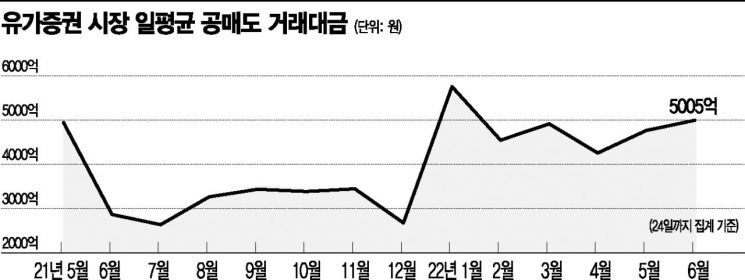
According to the Korea Exchange on the 28th, the average daily short selling amount in the KOSPI market this month (as of the 24th) was 500.5 billion KRW, surpassing last month's 477.8 billion KRW. When combined with the KOSDAQ market, the scale is even larger, exceeding 600 billion KRW. In the KOSDAQ market, the average daily short selling amount reached 138.3 billion KRW, exceeding last month's 136.6 billion KRW.
Rapid Increase in Short Selling Transaction Amounts
Since the partial resumption of short selling last May, the amount of short selling has steadily increased. Last month, the average short selling balance in the KOSPI market was approximately 12.5 trillion KRW, accounting for about 59% of the monthly average transaction amount. A similar trend continues into June.
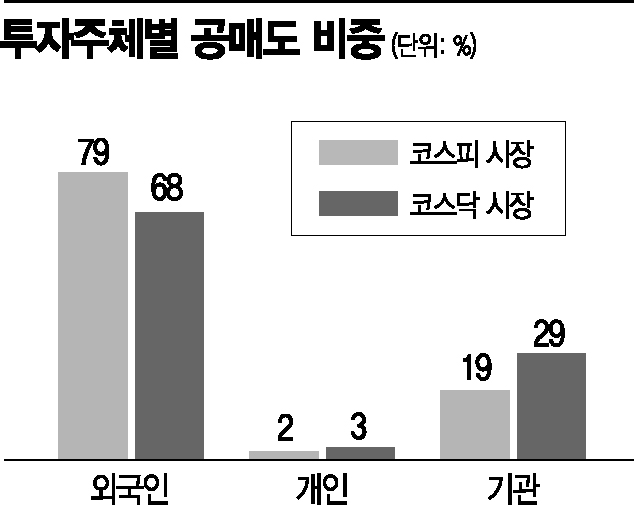
The problem is that only individual investors are being thoroughly marginalized. As of this month, foreigners accounted for 79% of short selling in the KOSPI market, while individuals accounted for only 2%. The KOSDAQ market shows a similar pattern, with foreigners holding 68% and individuals 3%. The remaining shares were held by institutions, accounting for 19% in the KOSPI market and 29% in the KOSDAQ market.
In the securities industry, there are concerns that the surge in short selling is further cooling investor sentiment. Lee Kyung-soo, a researcher at Hana Financial Investment, pointed out, "During periods of increased index volatility, a surge in short selling amid a lack of supply and demand foundation can cause further declines in the index."
Strong Protests Demand ‘Ban and System Improvement’
Individual investors are protesting fiercely. They continuously file complaints to the Financial Services Commission, the Prime Minister's Office, the Ministry of Strategy and Finance, political parties, and lawmakers' offices. They are demanding an immediate review of a short selling ban and a temporary ban on short selling. Investors belonging to the Korea Stock Investors Association, which has about 51,000 members, are leading the charge. This year alone, they have held over 40 rallies and demonstrations, and plan to hold a rally in front of the Financial Services Commission this week to demand short selling reform.
They argue that before the full resumption of short selling, it is necessary to correct the tilted playing field through system improvements. Jung Eui-jung, head of the Korea Stock Investors Association, said, "Individuals have a short selling repayment period of 90 days, but foreigners and institutions effectively have unlimited time." He raised his voice, saying, "The repayment period for foreigners and institutions should be changed to 90 days, the same as individuals, and a clause should be added to prohibit re-short selling for one month after repayment." He added, "The collateral ratio applied when borrowing stocks for short selling is about 140% for individuals, but significantly lower at 105% for foreigners and institutions," and emphasized, "The collateral ratio for foreigners and institutions should also be raised to 140%."
The Korea Stock Investors Association proposed a ‘short selling total volume system’ as a way to correct the tilted playing field. By setting an upper limit on short selling, it is expected to reduce the damage caused by concentrated short selling on specific stocks.
The political sphere is also focusing on the short selling debate as a major issue. Lee Jae-myung, a member of the Democratic Party of Korea, said, "A temporary ban on short selling should be implemented to at least open breathing space for individual investors." Park Yong-jin, a candidate for the Democratic Party leadership, urged system improvements, saying, "While maintaining the positive function of short selling to prevent price bubbles, illegal short selling that strangles individual investors should be minimized."
The Financial Services Commission, together with related agencies such as the Financial Supervisory Service and the Korea Exchange, held a 'Stock Market Inspection Meeting' and stated that if excessive anxiety further increases volatility, they will implement necessary market stabilization measures according to the contingency plan. However, there are currently no plans to take separate measures such as banning short selling. Although there was a plan to fully resume short selling in the first half of this year, discussions have not yet taken place.
© The Asia Business Daily(www.asiae.co.kr). All rights reserved.
![Clutching a Stolen Dior Bag, Saying "I Hate Being Poor but Real"... The Grotesque Con of a "Human Knockoff" [Slate]](https://cwcontent.asiae.co.kr/asiaresize/183/2026021902243444107_1771435474.jpg)












