Among 40 Global Market Indices This Month
Top 2 Decliners Are KOSDAQ and KOSPI
Proportion of Margin Loan Balances in Korean Stock Market
Higher Than Pre-COVID Average
Forced Sales of Stocks with High Margin Balances
Price Drops Limit Stock Market Rebound
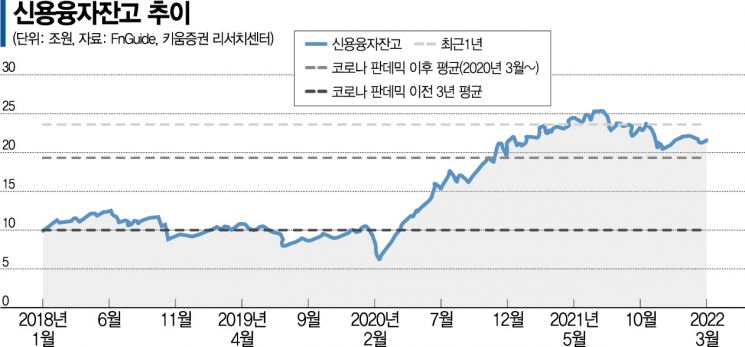
[Asia Economy Reporter Kwon Jae-hee] As the KOSPI index has fallen by 12% this month, returning to levels seen during the COVID-19 pandemic, experts point to the role of "debt investing" (bit-tu) as a key reason why the Korean stock market has declined more sharply than others. While rising exchange rates and oil prices are also factors weighing on the market, the burden of outstanding credit loan balances in margin trading is said to be limiting an overall market rebound from a supply-demand perspective.
Outstanding credit loan balances refer to the amount of loans taken out using stocks or cash as collateral, representing a form of speculative demand. Leveraged funds through margin trading contribute to liquidity supply in a bull market, but in a bear market, forced liquidation triggers larger price drops in stocks with high credit balances, thereby increasing downside risk in the market.
According to the Korea Exchange on the 28th, among 40 representative global stock indices from June 1 to 24, the largest decline was seen in KOSDAQ (-16.02%), followed by KOSPI (-11.89%). This contrasts with the 3-5% declines recorded by the three major New York stock exchanges during the same period. Compared to emerging markets similar to Korea, such as Brazil (-11.39%) and Argentina (-10.49%), the performance is also weaker.
The securities industry attributes the particularly poor performance of the Korean market to the scale of "debt investing." This is evident in the size of outstanding credit loan balances, which stand at about 0.6% of market capitalization for the KOSPI market and 2.7% for KOSDAQ. These levels remain high compared to pre-COVID-19 averages (KOSPI 0.4%, KOSDAQ 2.3%). Historical patterns show that a decrease in the credit loan balance ratio is necessary for a sustained market rebound, suggesting that to recover to pre-pandemic levels, the Korean market needs to reduce outstanding credit loan balances by approximately 3 to 5 trillion KRW going forward.
Huh Jae-wan, a researcher at Eugene Investment & Securities, stated, "Last week's price decline mostly resulted from forced liquidations due to margin calls," adding, "It is difficult to say that the clearing of debt investing is fully complete, so the burden on the stock market is likely to remain for some time."
The problem with the domestic market is that while the total trading volume decreases due to sharp price drops, the credit balance ratio is showing a stepwise decline. This means that the reduction in outstanding credit loan balances is not keeping pace with the decrease in market capitalization.
Han Ji-young, a researcher at Kiwoom Securities, analyzed, "The burden of outstanding credit loan balances is limiting an overall market rebound. Particularly, the inflow of leveraged funds despite the market decline this year appears to be influenced by the reinvestment of some of the subscription deposits (about 110 trillion KRW) refunded during the LG Energy Solution IPO and the surge in credit related to theme stocks around the March presidential election."
She added, "For the credit burden to be resolved, either further market adjustments must occur to reduce outstanding credit loan balances, or the macroeconomic uncertainty must ease, leading to a market rise and increased market capitalization. However, it is difficult for both conditions to be met in the short term."
© The Asia Business Daily(www.asiae.co.kr). All rights reserved.

















