61% of Companies Respond to Future Inflation with "Price Increases"
[Asia Economy Reporters Sunmi Park, Hyungil Oh, Daeyeol Choi, Donghoon Jung] From the second half of the year, prices of most products and services that consumers encounter, ranging from automobiles to electronic devices, are expected to rise one after another. Due to rising raw material prices and logistics costs, companies are tightening their belts to protect profitability, and with additional inflation expected in the second half, they can no longer postpone price increases. There are growing concerns that signs of stagflation, characterized by economic recession and high inflation, are becoming a reality.
◆ 69% of all companies "Increase product and service prices" = According to the Regional Economic Report by the Bank of Korea on the 28th, 7 out of 10 domestic companies (69%) have raised product and service prices reflecting the rise in raw material costs. Among companies that have not raised prices, more than half (55%) plan to increase prices within the year. This survey was conducted from May 12 to June 2, targeting 570 companies nationwide (343 manufacturing, 30 construction, 197 service).
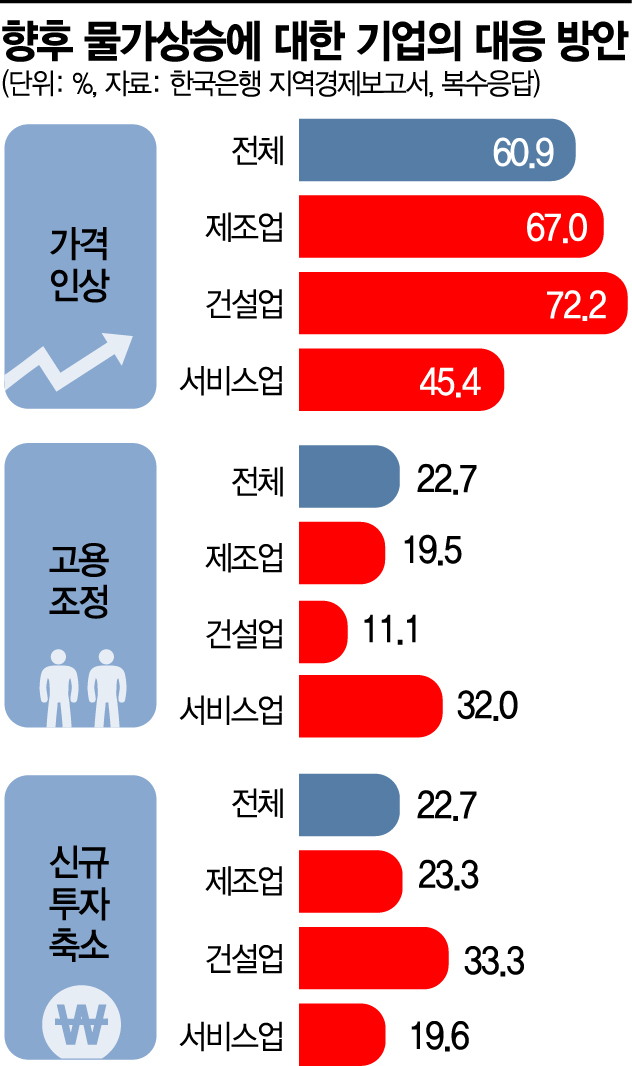
Companies are raising product prices because they are suffering serious damage to profitability due to rising raw material and labor costs, the Ukraine crisis, and increased logistics costs caused by lockdowns in some Chinese cities. In particular, 86% of companies expect additional inflation in the second half of this year, and 61% responded that they will respond to future inflation by raising prices, making further price hikes in the second half inevitable.
Immediately, an increase in steel prices is anticipated following Korea Electric Power Corporation's (KEPCO) electricity rate hike starting in the third quarter. KEPCO decided to raise the fuel cost adjustment rate for electricity by 5 won per kWh in the third quarter. Last year, the industrial sector's electricity consumption was 291,333 GWh, so a 5 won increase per kWh means about 1.4567 trillion won more in electricity bills.
This is a significant burden for the steel industry, which is a major electricity consumer. A steel industry official said, "As the share of electric furnaces increases due to the trend of reducing carbon emissions, the proportion of electricity costs in product costs is very large," adding, "The electricity rate increase will be directly reflected in costs, so steel prices must rise to protect profitability."
If steel prices rise, a domino effect of price increases will follow in other products such as automobiles, ships, construction, machinery equipment, and home appliances. Finished car prices are already soaring sharply. Due to production disruptions caused by a shortage of vehicle semiconductors, popular models can take more than a year to purchase, so it is not surprising that automakers raise prices further to secure profitability.
◆ Home appliances, automobiles, tires... nothing will avoid price hikes in the second half = Tesla has already raised prices three times this year. In Korea, prices have also been raised several times this year, with the cheapest Model 3 rear-wheel drive exceeding 70 million won. Compared to the end of last year, this is an increase of 10 million won, and about 30 million won compared to the initial launch in 2019.
Domestic cars are also joining the price hike trend. Hyundai Motor's Ioniq 5, which will accept orders for the model year change from next month, is expected to see a price increase due to increased battery capacity and some added features. The newly unveiled Ioniq 6, expected next month, is anticipated to be priced in the mid-50 million won range, about 5 million won more expensive than existing dedicated electric vehicles. Major models such as Grandeur and Avante have raised prices by tens or hundreds of thousands of won with model year changes, and price hikes are expected to be even larger in the second half.
Tire prices will also rise starting next month. Hankook Tire will raise prices for bus and truck tires by 5-10% from the 1st of next month, and Kumho Tire will increase prices for bus and truck tires by 3-7% starting next month. Imported brands have already completed their price hikes.
The home appliance industry also sees a high possibility of price increases in the second half. Even if they cannot immediately raise the retail price reflecting increased product costs, they have no choice but to reduce marketing and promotion expenses provided to intermediaries to protect profitability. This means distributors will reduce large-scale discounts or promotional sales to boost home appliance sales as before. Ultimately, consumers will have to pay more for the same products. An industry insider said, "Economic vitality is declining, and home appliance inventories are increasing," adding, "During periods of demand slowdown, it is difficult to raise retail prices reflecting cost increases, but indirect methods such as reducing marketing expenses are used, so consumer prices are likely to rise."
Experts warn that if raw material prices rise and companies reflect this by raising product prices, it could lead to a vicious cycle that negatively impacts the Korean economy. Kim Taeg-gi, emeritus professor of economics at Dankook University, said, "With skyrocketing raw material prices, high interest rates, and high wages, production costs are rising, reducing both production and consumption, while wages continue to rise, increasing the risk of a vicious cycle," advising, "The government should exercise leadership to persuade labor unions to restrain wage increase demands and companies to postpone product and service price hikes."
© The Asia Business Daily(www.asiae.co.kr). All rights reserved.
![Clutching a Stolen Dior Bag, Saying "I Hate Being Poor but Real"... The Grotesque Con of a "Human Knockoff" [Slate]](https://cwcontent.asiae.co.kr/asiaresize/183/2026021902243444107_1771435474.jpg)
















