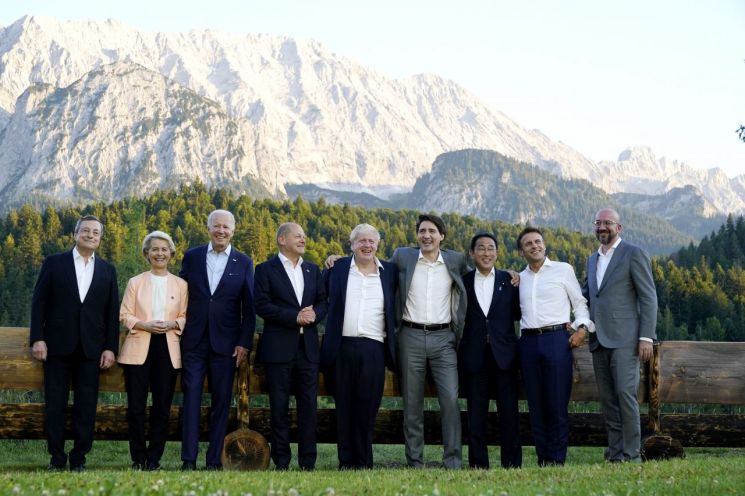
[Asia Economy New York=Special Correspondent Joselgina] The market is filled with question marks over the 'price cap on Russian crude oil' proposed by the United States at the Group of Seven (G7) summit, as the U.S. has yet to find a solution to soaring oil prices. The intention is to limit Russia's oil profits and curb the rising oil prices by setting a price ceiling, but the 'operating mechanism' itself is very complex and not easy to implement. International oil prices rose nearly 2% following news of the price cap discussions.
According to Bloomberg and others on the 27th (local time), G7 leaders instructed their respective finance ministries and related departments to review specific measures to implement the crude oil price cap to be included in the final statement. A senior U.S. official confirmed that "the G7 is in final discussions" and that the measure "directly targets Russian President Vladimir Putin's interests while minimizing the impact on the G7 and countries worldwide," effectively confirming agreement on implementing the price cap.
The core idea is that countries will not purchase Russian crude oil exceeding the set price limit. Methods under consideration include allowing transportation of products only below the agreed price through oil transport networks under G7 jurisdiction or refusing to provide ship insurance for transactions exceeding the cap. Unlike existing sanctions on Iran, the U.S. side, which proposed this, believes energy supply will remain smooth since trade channels remain open.
The problem lies in the specific operating mechanism and its effectiveness. Even G7 officials who agree with the purpose of the system point out that very complex and precise technical measures are necessary. Dawei Kung, commodity portfolio manager at DWS, warned of side effects, saying, "If the energy market becomes more complicated, friction will intensify, making transactions difficult and potentially driving prices higher." China's criticism the day before, calling the creation of a price cap itself "an impossible task in reality" (Global Times), stems from similar concerns.
International support is also uncertain. Even within the European Union (EU), it is considered difficult to achieve unanimous approval from all 27 member states. Bloomberg noted, "If the price cap is implemented but not maintained, it will symbolically represent a victory for President Putin." Opposition is also expected from countries like India, which import large amounts of Russian oil.
Some even raise concerns about Russia retaliating by deliberately reducing market supply, an 'energy weaponization.' This is possible, similar to Russia cutting off natural gas supplies to certain countries. The New York Times (NYT) pointed out, "Despite sanctions imposed so far, imports of Russian oil have increased, and global consumers are suffering from soaring energy prices," adding, "There is no guarantee that the price cap will succeed."
Ultimately, the solution to soaring oil prices lies in increasing crude oil supply from other oil-producing countries. However, major producers including Saudi Arabia have shown a negative stance toward increasing production, deepening concerns for the U.S. and the G7. France argued on the same day that Iran and Venezuela, currently under U.S. sanctions, should be allowed back into the market. U.S. President Joe Biden previously permitted some Venezuelan crude oil into the market. He is also scheduled to visit Saudi Arabia next month. On the 28th, indirect talks between Iran and the U.S. to restore the stalled Iran nuclear deal (JCPOA - Joint Comprehensive Plan of Action) will take place in Qatar.
News of the price cap review is also fueling supply concerns. On the same day, August West Texas Intermediate (WTI) crude oil prices on the New York Mercantile Exchange closed at $109.57 per barrel, up $1.95 (1.81%) from the previous session.
© The Asia Business Daily(www.asiae.co.kr). All rights reserved.
![Clutching a Stolen Dior Bag, Saying "I Hate Being Poor but Real"... The Grotesque Con of a "Human Knockoff" [Slate]](https://cwcontent.asiae.co.kr/asiaresize/183/2026021902243444107_1771435474.jpg)
















