Exports (95→82) and Domestic Sales (96→78) Both Plunge
Concerns Over Consumption Contraction Amid Persistent High Inflation and Exchange Rates
Cosmetics, Food & Beverage, and Shipbuilding Perform Well
Petrochemicals and Non-Metallic Minerals with High Import Ratios, and Auto Parts Hit Hardest
Only Jeju Shows Positive Outlook
Jeonnam 63, Daejeon 66, Incheon 68 Lag Behind
Risks in Second Half: Exchange Rate and Inflation Volatility, Consumption Contraction
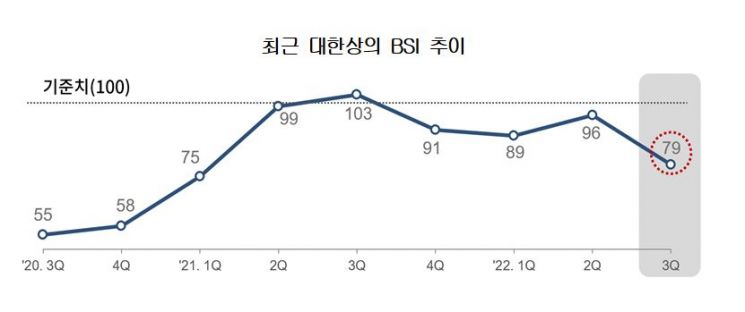
[Asia Economy Reporter Jeong Dong-hoon] The corporate sentiment index for the third quarter plummeted sharply due to soaring inflation and exchange rate increases. By industry, petrochemicals, non-metallic minerals, and automobile parts, and by region, Jeonnam, Daejeon, Incheon, Ulsan, and Gwangju are expected to experience poor economic conditions.
The Korea Chamber of Commerce and Industry (KCCI) announced on the 28th that the '2022 Q3 Business Survey Index (BSI)' surveyed among 2,389 manufacturing companies nationwide was recorded at 79, down 17 points from 96 in the previous quarter. Analyzing export-oriented and domestic-oriented companies based on a 50% export ratio to sales, export companies dropped sharply from 95 to 82, and domestic companies from 96 to 78 compared to Q2. A BSI above 100 means more companies view the quarter's economy positively compared to the previous quarter, while below 100 indicates the opposite.
Regarding this, KCCI analyzed, "With ongoing global supply chain bottlenecks and a high exchange rate nearing 1,300 KRW, the prolonged Russia-Ukraine war makes the stabilization of international oil prices and raw materials uncertain," adding, "If high inflation persists, domestic consumption may also contract."
Cosmetics, Food & Beverage, and Shipbuilding Perform Well... Petrochemicals, Non-metallic Minerals, and Auto Parts with High Import Ratios Worsen
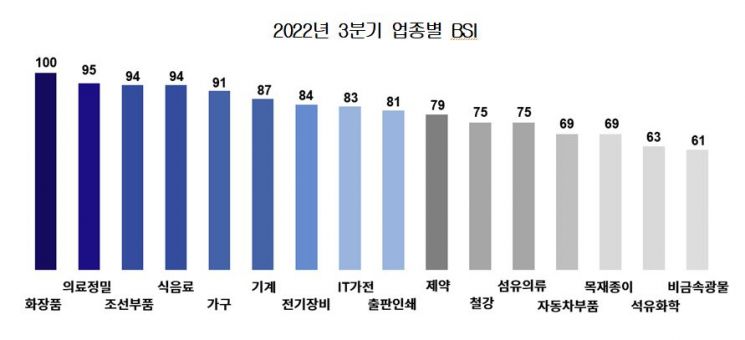
By industry, most sectors failed to exceed the benchmark of 100, indicating a predominantly negative outlook, while cosmetics (100), medical precision instruments (95), and food & beverage (94) showed relative strength. In particular, the cosmetics and food & beverage sectors are believed to have benefited from the domestic demand boost following the lifting of COVID-19 restrictions.
Meanwhile, shipbuilding (94) and furniture (91) also performed well, with the shipbuilding industry seemingly benefiting from recent strong orders, high exchange rates, and high freight rates. Conversely, industries directly impacted by rising global raw material prices due to high import ratios, such as automobile parts (69), petrochemicals (63), and non-metallic minerals (61), experienced the worst economic sentiment.
Regionally, all areas except Jeju (100), which remained stable, saw a decline in BSI compared to the previous quarter. Jeju's recent lifting of restrictions and tourism boom appear to have positively influenced the local economy.
On the other hand, regions heavily influenced by petrochemicals and automobile parts, including Daegu (77) and Ulsan (71), as well as Gyeongnam (79), Chungnam (76), Gyeonggi (75), and Gwangju (72), experienced significant drops in economic sentiment nationwide. Negative evaluations were most pronounced in Incheon (68), Daejeon (66), Jeonnam (63), and Sejong (60).
Second Half Risks Are 'Exchange Rate and Inflation Volatility'
Meanwhile, as the first half of the year concludes, more than half of the responding companies reported experiencing poor performance. While 54.9% of companies expected their first-half operating profits to fall short of their plans set at the beginning of the year, only 3.8% anticipated exceeding their targets.
Among companies that reported underperformance in the first half, 6 out of 10 (62.6%) identified 'continued volatility in inflation and exchange rates' as the biggest domestic and international risk for the second half. This was followed by 'consumption contraction' (52.3%), 'ongoing supply chain bottlenecks' (30.6%), 'deterioration of financing conditions' (20.9%), and 'emerging market instability due to interest rate hikes' (19.8%).
Kim Hyun-soo, Director of Economic Policy at KCCI, emphasized, "Facing high costs from inflation and exchange rates, both domestic demand and exports stand at a crossroads of stagnation," adding, "Special measures such as stabilizing raw material prices, tax reforms and support, export financing, and logistics cost assistance are necessary for severely affected industries." He further stated, "For policies requiring legislative amendments to defend against stagflation (low growth and high inflation) and stabilize livelihoods, not only the government but also the National Assembly should operate normally and pursue bipartisan cooperation."
© The Asia Business Daily(www.asiae.co.kr). All rights reserved.
![Clutching a Stolen Dior Bag, Saying "I Hate Being Poor but Real"... The Grotesque Con of a "Human Knockoff" [Slate]](https://cwcontent.asiae.co.kr/asiaresize/183/2026021902243444107_1771435474.jpg)

















