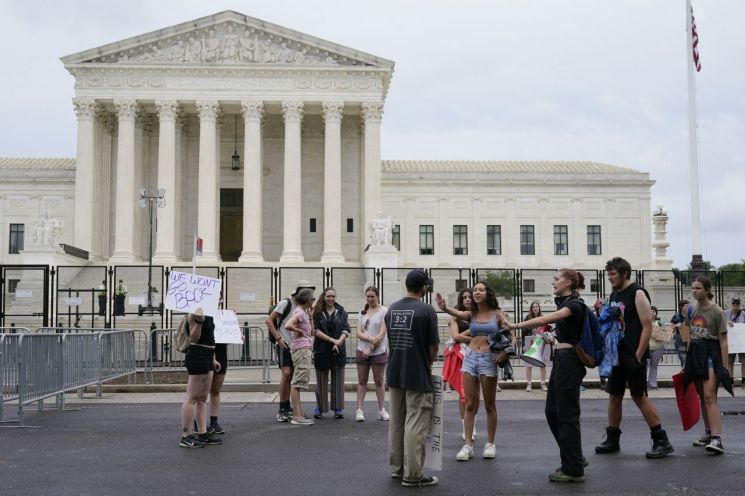
[Asia Economy New York=Special Correspondent Joselgina] Following the U.S. Supreme Court's ruling not recognizing abortion as a constitutional right, related lawsuits are continuously emerging in individual states. Conservative-leaning states, including Louisiana, have enacted laws that immediately ban or restrict abortion under 'trigger clauses,' prompting abortion advocacy groups to initiate legal battles to block these measures.
On the 27th (local time), according to the Associated Press (AP), Judge Robin Zaruso of the New Orleans District Court in Louisiana ruled to temporarily halt the enforcement of Louisiana's abortion ban law based on the trigger clause. This decision accepted a lawsuit filed by abortion advocacy groups, arguing that it is difficult to clearly determine when the trigger clause takes effect and which actions are prohibited.
In Florida, a lawsuit was filed on the 26th by abortion advocacy groups seeking to block the enforcement of state law. Prior to this, lawsuits challenging the trigger clauses were also underway in Arizona and Utah. AP reported, "Since the Supreme Court issued its ruling on the 24th, abortion procedures have been halted in at least 11 states due to confusion over state laws or these laws themselves."
Earlier, right after the Supreme Court ruling on the 24th, the news agency reported that hospitals in Alabama, Oklahoma, Arizona, Arkansas, Kentucky, Missouri, South Dakota, Wisconsin, West Virginia, and Louisiana began suspending abortion surgeries one after another. Many of these states had laws containing trigger clauses that allow abortion regulations to be enforced upon the overturning of the Supreme Court's previous precedents.
Accordingly, whether states can apply pre-existing abortion ban laws at this point has become a subject of legal disputes. Wisconsin passed a law in 1849 banning abortion except when the life of the pregnant woman is at risk, but the state's Democratic Attorney General has expressed opposition to this law.
Idaho, Oklahoma, and Texas have provisions that offer rewards for reporting those who assist with abortions. AP reported that legal issues remain regarding whether these provisions apply to individuals beyond the state borders and whether they apply not only to practitioners but also to those who deliver abortion pills. Ultimately, the Supreme Court's ruling has led to a wave of lawsuits surrounding abortion.
With the upcoming November midterm elections, abortion laws have emerged as a key election issue, intensifying political debates.
While the Democratic Party has raised the Supreme Court's decision to overturn abortion rights as a reason for judgment in the November midterms, 8 out of 10 Democratic supporters have expressed their intention to vote. According to a recent poll conducted by U.S. public radio NPR and PBS, 78% of Democratic supporters said, "I am likely to vote in this election because of the Supreme Court decision."
Additionally, 88% of Democratic supporters and 53% of independents responded that they "strongly oppose" the Supreme Court's decision. Among Republican supporters, 77% supported the Supreme Court's decision, with only 10% opposing it.
Some voices have raised concerns that the Supreme Court, which has clearly shifted conservative, may issue rulings further restricting voting rights following abortion rights. The political media outlet Politico reported on the same day that the Supreme Court, ahead of hearings this fall on Alabama's redistricting issues, may roll back key provisions of the Voting Rights Act that prohibit voting practices and procedures based on racial and minority discrimination.
© The Asia Business Daily(www.asiae.co.kr). All rights reserved.

















