[Asia Economy (Daejeon) Reporter Jeong Il-woong] Cash fare boxes will disappear from city buses in Daejeon.
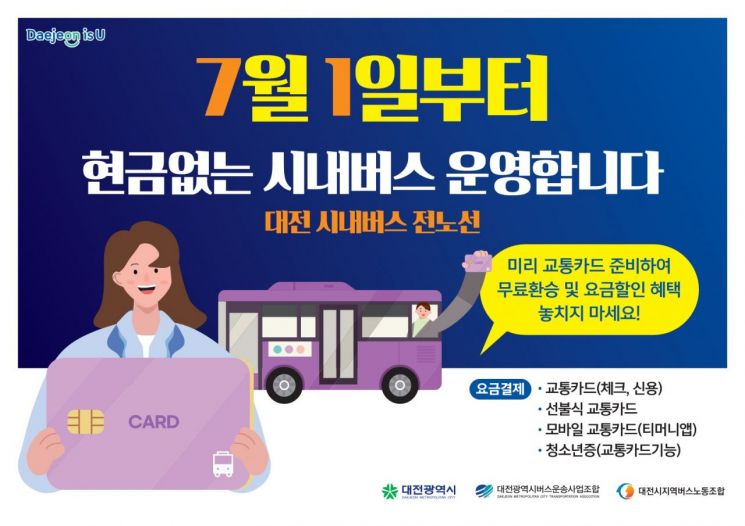
The Daejeon city government announced on the 28th that starting from the 1st of next month, all local city bus routes will operate without cash payments.
The cashless city bus operation will undergo a three-month guidance period starting next month and is scheduled to be fully implemented from October.
This decision reflects the decreasing proportion of cash payments for city bus fares, growing concerns about infectious diseases transmitted through currency, and the burden of cash management on site.
First, the number of cash payments for Daejeon city bus fares has decreased from 2.2% of total transactions in 2020 to 1.8% in 2021, and this year it has dropped to around 1.5%. The majority of citizens using city buses have used transportation cards instead of cash as their payment method.
In particular, since the city began a pilot operation in July last year restricting cash boarding on the Bus Rapid Transit (BRT) Barota B1 (formerly route 1001) line to transportation cards only, the cash boarding rate on this bus route has significantly decreased from 1.0% in 2020 to 0.4% last year, and has maintained around 0.03% this year.
Recently, concerns have arisen that coins and bills could be vectors for infectious diseases such as COVID-19, leading to an increase in contactless payments across various consumer sectors, which also supports the restriction of cash boarding on city buses.
Additionally, the cost of managing cash when cash boarding is allowed has been a burden. The estimated annual cost for cash fare settlement and management is approximately 150 million KRW (including labor costs).
Moreover, the city explained that unnecessary time and personnel burdens due to cash settlement, as well as the physical strain on transportation workers caused by the weight of cash fare boxes, were major reasons for implementing cashless city bus operations.
The city plans to conduct a guidance period from July to September to minimize inconvenience to citizens during the transition to cashless city buses. It will also promote the use of transportation cards by posting promotional posters at all bus stops, including regional intercity sections, and inside and outside buses.
After removing the cash fare boxes, the city will provide guidance on post-ride account transfers for citizens who have no payment method other than cash, allowing them to board first.
Han Seon-hee, Director of the Transportation and Construction Bureau of the city, said, “Operating cashless city buses will provide passengers with fare discounts and three free transfers (when using transportation cards), and transportation companies will reduce management costs associated with operating cash fare boxes.” He added, “The city will analyze issues arising during the three-month pilot operation period and make every effort to minimize inconvenience to citizens.”
Meanwhile, Seoul, Incheon, and Sejong have been operating some local city bus routes as cashless on a pilot basis since last year, and these local governments are reportedly reviewing full implementation by gradually expanding the pilot routes.
© The Asia Business Daily(www.asiae.co.kr). All rights reserved.

















