Chairman Koo Kwang-mo's 4th Anniversary Management Evaluation
Business Community Praises "Slimmed Down and Strengthened Fundamentals"
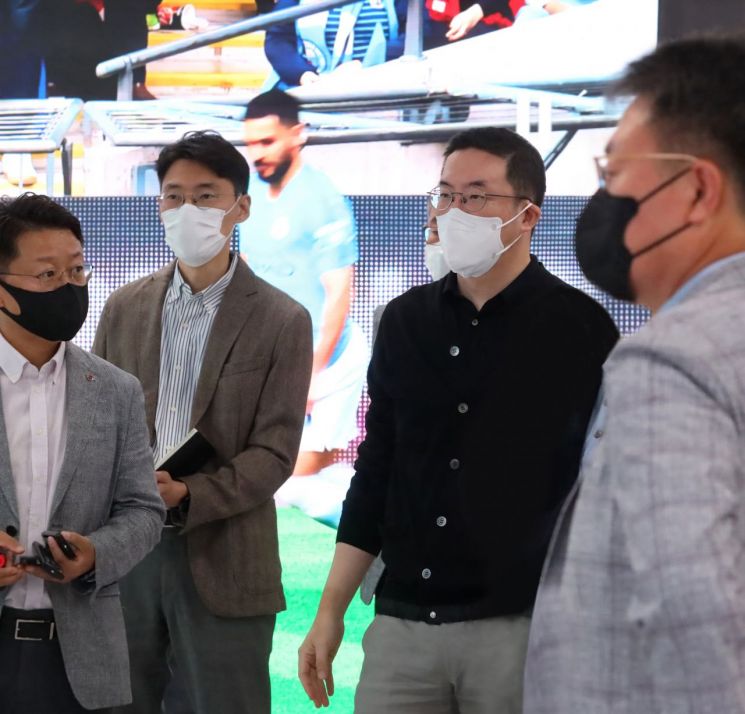 Koo Kwang-mo, Chairman of LG Group, is seen conversing with employees at the LG Electronics Home Entertainment (HE) Research Center within LG Digital Park in Pyeongtaek, Gyeonggi Province. (Photo by LG Group)
[Asia Economy Reporter Moon Chaeseok]
"We trimmed the fat and strengthened our fundamentals."
This is the evaluation of the four years of management under the leadership of Koo Kwang-mo, who has championed 'pragmatism.' Chairman Koo focused on improving the group's structure by increasing investments in future growth engines such as electric vehicles and artificial intelligence (AI), while boldly exiting perennial deficit businesses like mobile and solar panel sectors. Since his inauguration, the company's total assets have significantly increased, and its scale continues to grow.
According to the business community on the 27th, Koo Kwang-mo, who will mark his 4th anniversary as chairman of LG Group on the 29th, succeeded the late former chairman Koo Bon-moo, who passed away on May 20, 2018. Since then, he has attracted attention through bold mergers and acquisitions (M&A) and restructuring. He completed the separation from LX Group and firmly improved the group's structure by focusing on high value-added businesses such as electric vehicle batteries, automotive components, and organic light-emitting diode (OLED) technology.
According to the Fair Trade Commission, LG Group's total fair assets this year stand at 167.5 trillion KRW, a 36.1% increase from 123.1 trillion KRW in 2018, the first year of Koo's chairmanship. During the same period, the number of affiliates increased slightly from 70 to 73, although it decreased by two compared to 75 in 2019. This suggests that the group did not merely 'bulk up' but devoted considerable effort to 'selection and concentration.' Early in his tenure, Chairman Koo drew attention for his restructuring capabilities by withdrawing from LG Electronics’ mobile communications (MC) and solar panel businesses. Recently, he has been praised for vertically integrating electric vehicle charging, batteries, and components (automotive electronics). He decisively invested in profitable businesses and cut off loss-making ones.
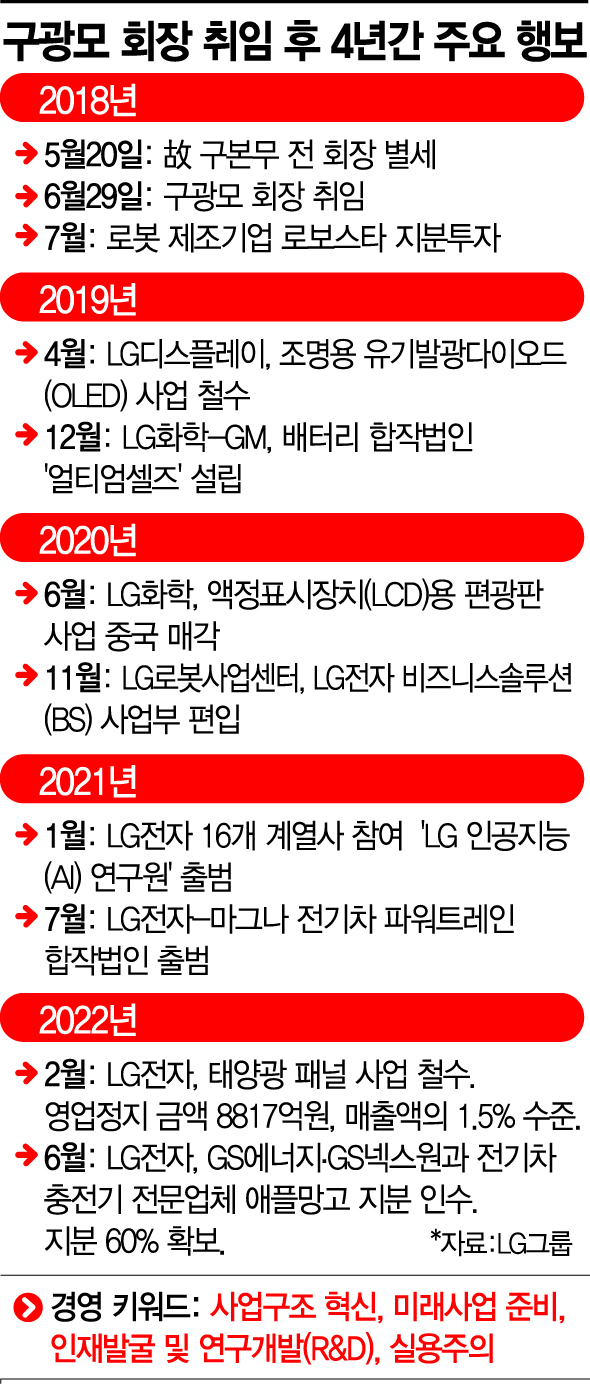
Among Chairman Koo’s management successes, the withdrawal last year from the MC division, which had accumulated an operating loss of 5 trillion KRW before exit, stands out. Cutting off the MC division meant abandoning smartphones, which are closely tied to LG Group’s brand value, signaling a strong commitment to significantly improve profitability. The official separation from LX Group, approved by the Fair Trade Commission on the 23rd, also attracted attention. The commission stated, "LG will focus on electronics, chemicals, and telecommunications services, while LX will concentrate on semiconductors, logistics, and trading, strengthening independent and responsible management," and added that "the ownership and governance structure of the large business groups will become clearer." Last year, LX Group’s operating profit rose 213% year-on-year to 1.2591 trillion KRW, marking what was called a ‘beautiful separation.’
It was not just about trimming the fat. Two months after taking office, LG Electronics acquired Austrian automotive headlamp manufacturer ZKW for about 1.4 trillion KRW. This acquisition laid the foundation for a solid electric vehicle ecosystem that has developed over the past four years, including vehicle infotainment (automotive electronics and VS business division), e-powertrain (joint venture LG Magna), charging infrastructure (startup Apple Mango acquisition), and a five-pronged electric vehicle battery production system centered on LG Energy Solution and the General Motors joint venture 'Ultium Cells.' Additionally, LG has accelerated its business restructuring toward OLED and robotics, competing in new business arenas with other major domestic and global companies such as Samsung, Hyundai Motor, and SK.
Considering that Chairman Koo took office just over a month after the passing of former Chairman Koo and faced challenging management conditions such as China’s pursuit in the secondary battery sector, which had been invested in for over 20 years, he is regarded as having made a strong start. The electric vehicle sector, in particular, is a fierce battleground involving vertical integration between automakers and battery cell manufacturers, joint ventures between companies, and market share battles in key regions such as the U.S., Europe, and China. LG is praised for not avoiding investment in this sector and for steadily building a stable portfolio.
A business community official said, "Even for large conglomerates, if they fail to select and concentrate resources well amid limited assets, they can fall into crisis due to the rapid pace of industrial restructuring. Seeing how LG has solidly built its electric vehicle portfolio, it can be said that LG Group under Chairman Koo’s four-year leadership has done well in selection and concentration."
Kim Kyung-joon, CEO Score’s CEO, commented, "Chairman Koo’s LG Group, by reorganizing the MC division and solar sector and building the electric vehicle value chain, has established a distinct identity from the previous chairman while successfully focusing on selection and concentration. This is a case of strategic business structure reorganization to lead the digital era."
© The Asia Business Daily(www.asiae.co.kr). All rights reserved.
!["The Woman Who Threw Herself into the Water Clutching a Stolen Dior Bag"...A Grotesque Success Story That Shakes the Korean Psyche [Slate]](https://cwcontent.asiae.co.kr/asiaresize/183/2026021902243444107_1771435474.jpg)

















