Inter-Unit 'Odor Issues' Cause Resident Conflicts
"Criticism Over Food Smells... Must Also Accept Multi-Family Characteristics," Opinions Arise
Health Impact Concerns Over 'Secondhand Smoke'
Unclear Institutional Solutions... "Social Consensus Needed Before Legal Approaches"
 Conflicts over 'inter-floor odors' among residents of apartment complexes are severe.
 [Image source=Yonhap News]
[Asia Economy Reporter Kim Jung-wan] #. Park (37), who lives in an apartment in Gangbuk-gu, Seoul, hesitates to open the window for ventilation despite the arrival of summer. This is because of the cigarette smell that suddenly wafts in when the window is opened. Even after requesting the management office to resolve the issue, the effect lasts only briefly; the foul smell returns as soon as the window is opened again. Park sighed, saying, "Is it reasonable for someone to blatantly smoke on the veranda in a place where many households live together, like an apartment?"
As summer approaches, the issue of 'inter-floor odors' is becoming serious among residents of multi-unit housing such as apartments and villas. Due to the building structure, not only everyday living odors but also cigarette smells pass through windows and ventilation ducts, leading to increasing complaints. However, some argue that pointing out everyday living odors is excessive.
In fact, many people suffer from inter-floor odors such as cigarette smoke. According to the Anti-Corruption and Civil Rights Commission (ACRC), complaints about indirect smoking between floors submitted to the National Petition System in 2020 reached 2,844 cases, showing nearly a 20% increase compared to 2,386 cases in 2019. Data on 'Complaints about Indirect Smoking and Inter-floor Noise in Multi-unit Housing' submitted by Rep. Park Sang-hyuk of the Democratic Party to the Ministry of Land, Infrastructure and Transport also showed that indirect smoking complaints in 2020 were 256 cases, more than double the 114 cases in the previous year.
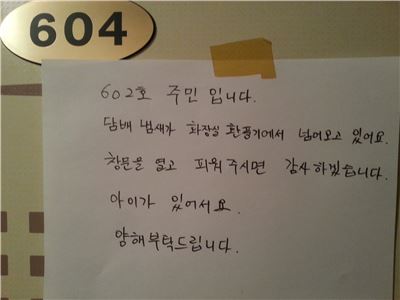 In 2020, complaints about cigarette smoke between floors submitted to the National Petition Office increased by nearly 20% compared to the previous year.
On the other hand, some believe that living odors must be tolerated due to the nature of multi-family residences. Han (29), who moved to an officetel in Mapo-gu four months ago, said she was baffled after hearing a public announcement recently asking residents to be cautious because neighbors were suffering from the smell and smoke of grilled fish. She said, "It's not cigarette smoke, so why am I being told to be careful about cooking smells?" She lamented, "Isn't that what ventilation fans are for? We have to tolerate some things. Criticizing the temporary smell of food is too much."
There are also concerns that cigarette smoke, which affects health, is particularly problematic. Kim (25), who lives in a one-room apartment near a university, understands the building structure that allows odors to spread easily but cannot accept cigarette smoke coming through the ventilation ducts. Kim said, "Since the small spaces are connected, I understand food smells. When I eat, someone else might be bothered, but they probably endure it," adding, "But morally, people shouldn't smoke. It's bad for health and truly painful for non-smokers."
Secondhand smoke causes not only mental distress but also direct adverse health effects. According to the National Smoking Cessation Support Center of the Korea Health Promotion Institute, adults exposed to secondhand smoke have a higher risk of stroke, lung cancer, and heart disease. Children have an increased risk of respiratory diseases such as otitis media and asthma.
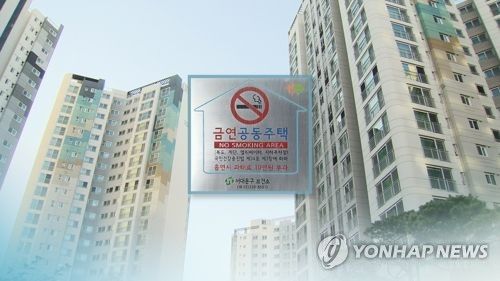 As there is no sharp solution to the problem of smoking between floors, opinions suggest that a 'social consensus' should come first. [Image source=Yonhap News]
Conflicts caused by inter-floor cigarette odors are considered as serious as inter-floor noise, sometimes escalating to crimes. On the 20th, in a villa located in Cheongcheon-dong, Bupyeong-gu, Incheon, a man in his 50s who had ongoing disputes with neighbors over smoking and noise stabbed a neighbor multiple times with a weapon, killing him, and was arrested by the police. According to the ACRC and the Ministry of Land, Infrastructure and Transport, among 1,196 complaints about inter-floor noise and indirect smoking submitted to the National Petition System from January 2014 to May 2016, 688 cases (57.5%) were about indirect smoking, exceeding the 508 cases (42.5%) related to inter-floor noise.
However, there is no clear solution to the problem of inter-floor smoking. According to the Multi-unit Housing Management Act, "Residents and users of multi-unit housing must make efforts to prevent causing harm to other residents due to smoking inside units such as balconies and bathrooms," but the mediation authority is limited to the management office. Under the National Health Promotion Act, laws exist to prevent harm from smoking, but a building can only be designated as a smoke-free apartment if more than half of the residents agree.
Given this situation, opinions suggest that 'social consensus' should take precedence over institutional approaches. A representative from a management office of an apartment in Seoul said, "I heard there are many ambiguous aspects legally. The management office cannot possibly find every instance of smoking on site," emphasizing, "Some people think of their home as a private space, but since an apartment is a community as a whole, mutual consideration is necessary." They added, "If needed, efforts should be made to appropriately allocate smoking areas through residents' meetings. Shouldn't we be comfortable with each other at home?"
© The Asia Business Daily(www.asiae.co.kr). All rights reserved.

















